Putin praises Trump's efforts to end Ukraine war ahead of Friday summit in Alaska
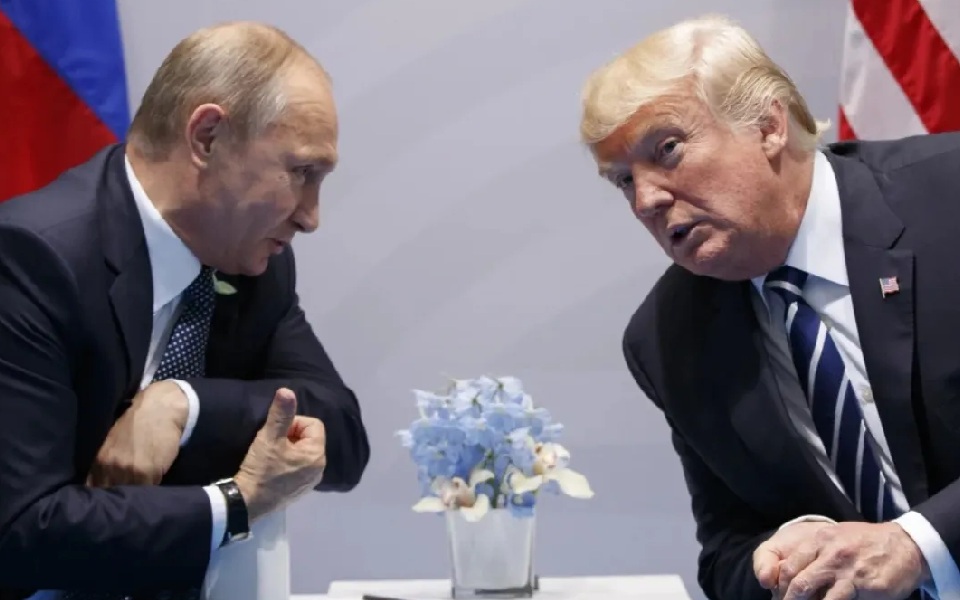
London, Aug 14 (AP): Russian President Vladimir Putin on Thursday praised US President Donald Trump's efforts to end the war in Ukraine, more than three years after Moscow launched its invasion, as the two leaders prepared for a pivotal US–Russia summit Friday in Alaska.
Following a meeting Thursday with top government officials on the summit, Putin said in a short video released by the Kremlin that the Trump administration was making “quite energetic and sincere efforts to stop the hostilities” and to “reach agreements that are of interest to all parties involved.”
Putin also suggested that “long-term conditions of peace between our countries, and in Europe, and in the world as a whole,” could be reached under an agreement with the US on nuclear arms control.
Meanwhile, Ukrainian President Volodymyr Zelenskyy and other European leaders worked to ensure their interests are taken into account when Trump and Putin meet in Anchorage.
Uncertainty for Europe
UK Prime Minister Keir Starmer welcomed Zelenskyy to London on Thursday in a show of British support for Ukraine a day before the critical Trump-Putin meeting. The two embraced warmly outside Starmer's offices at 10 Downing Street without making any comments, and Zelenskyy departed about an hour later.
Zelenskyy's trip to the British capital came a day after he took part in virtual meetings from Berlin with Trump and the leaders of several European countries. Those leaders said that Trump had assured them that he would make a priority of trying to achieve a ceasefire in Ukraine when he meets with Putin.
Speaking after the meetings to reporters, Trump warned of “very severe consequences” for Russia if Putin doesn't agree to stop the war against Ukraine after Friday's meeting.
While some European leaders, including German Chancellor Friedrich Merz and French President Emmanuel Macron, praised Wednesday's video conference with Trump as constructive, uncertainty remained over how the US leader — whose rhetoric toward both Zelenskyy and Putin has evolved dramatically since retaking office this year — would conduct negotiations in the absence of any other interested parties.
Both Zelenskyy and the Europeans have worried that the bilateral US-Russia summit would leave them and their interests sidelined, and that any conclusions could favour Moscow and leave Ukraine and Europe's future security in jeopardy.
Kremlin spokesperson Dmitry Peskov tamped down expectations for any breakthroughs from the Friday summit, saying there were no plans to sign documents and that it would be a “big mistake” to predict the results of the negotiations, according to Russian news outlet Interfax.
The Kremlin on Thursday said the meeting between Trump and Putin would begin at 11:30 am local time. Putin's foreign policy adviser, Yuri Ushakov, told reporters that Trump and Putin will first sit down for a one-on-one meeting followed by a meeting between the two delegations. Then talks will continue over “a working breakfast.” A joint news conference will follow.
Ukraine's territorial integrity
Starmer said Wednesday that the Alaska summit could be a path to a ceasefire in Ukraine, but he also alluded to European concerns that Trump may strike a deal that forces Ukraine to cede territory to Russia. He warned that Western allies must be prepared to step up pressure on Russia if necessary.
During a call Wednesday among leaders of countries involved in the “coalition of the willing” — those who are prepared to help police any future peace agreement between Moscow and Kyiv — Starmer stressed that any ceasefire deal must protect the “territorial integrity” of Ukraine.
“International borders cannot be, and must not be changed by force,'' he said.
Kyiv has long insisted that safeguards against future Russian attacks provided by its Western allies would be a precondition for achieving a durable end to the fighting. Yet many Western governments have been hesitant to commit military personnel.
Countries in the coalition, which includes France and the UK, have been trying for months to secure US security backing, should it be required. Following Wednesday's virtual meetings, Macron said Trump told the assembled leaders that while NATO must not be part of future security guarantees, “the United States and all the parties involved should take part.”
“It's a very important clarification that we have received,” Macron said.
Trump did not reference any US security commitments during his comments to reporters on Wednesday.
Some Ukrainians are sceptical
With another high-level meeting on their country's future on the horizon, some Ukrainians expressed skepticism about the summit's prospects.
Oleksandra Kozlova, 39, who works at a digital agency in Kyiv, told The Associated Press on Wednesday that she believes Ukrainians “have already lost hope” that meaningful progress can be made toward ending the war.
“I don't think this round will be decisive,” she said. "There have already been enough meetings and negotiations promising us, ordinary people, that something will be resolved, that things will get better, that the war will end. Unfortunately, this has not happened, so personally I don't see any changes coming.”
Anton Vyshniak, a car salesman in Kyiv, said Ukraine's priority now should be saving the lives of its military service members, even at the expense of territorial concessions.
“At the moment, the most important thing is to preserve the lives of male and female military personnel. After all, there are not many human resources left," he said. "Borders are borders, but human lives are priceless.”
Russia and Ukraine trade strikes
Zelenskyy said Thursday that Ukraine had secured the release of 84 people from Russian captivity, including both soldiers and civilians. Those freed included people held by Russia since 2014, 2016 and 2017, as well as soldiers who had defended the now Russian-occupied Ukrainian city of Mariupol, Zelenskyy wrote on Telegram.
The Russian Defense Ministry said Thursday that it too had received 84 soldiers as part of a prisoner exchange.
In other developments, Russian strikes in Ukraine's Sumy region overnight Wednesday resulted in numerous injuries, Ukrainian regional officials said. A missile strike on a village in the Seredyna-Budska community wounded a 7-year-old girl and a 27-year-old man, according to regional governor Oleh Hryhorov. The girl was hospitalized in stable condition.
In Russia, a Ukrainian drone attack damaged several apartment buildings in the southern city of Rostov-on-Don, near the border with Ukraine, where 13 civilians were wounded, according to acting governor of the region, Yuri Slyusar. Two of the wounded were hospitalised in serious condition, Slyusar said.
Let the Truth be known. If you read VB and like VB, please be a VB Supporter and Help us deliver the Truth to one and all.
Indian startup's 'Drishti' satellite launched aboard SpaceX rocket
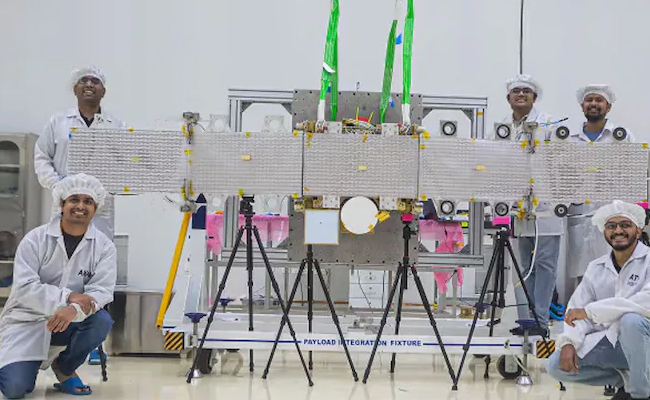
New Delhi (PTI): Bengaluru-based space start-up GalaxEye's Mission Drishti satellite was launched on Sunday aboard SpaceX's Falcon 9 rocket from California.
Mission Drishti is the world's first OptoSAR satellite, integrating electro-optical (EO) and synthetic aperture radar (SAR) sensors into a single operational platform, according to the company.
While EO sensors capture high-resolution images during sunlight and clear skies, SAR sensors provide all-weather and all-time images, using radar pulses.
In a statement, Suyash Singh, founder and CEO of GalaxEye, said, "With the satellite (Mission Drishti) now successfully in orbit, our immediate focus is on completing its commissioning. As we move through this phase, we are already witnessing strong global interest in the differentiated datasets enabled by our OptoSAR payload."
The satellite will help address long-standing limitations of conventional systems and enable more reliable and consistent data acquisition across diverse environmental conditions, the company said.
As a dual-use Earth observation satellite, the mission will support use cases across defence, agriculture, disaster management, maritime monitoring, and infrastructure planning.
The satellite is also expected to complement India's broader initiatives, including the 29 active Earth Observation satellites outlined in ISRO's recent annual report.
The launch came after five years of indigenous research and development, and extensive environmental testing and performance validation of the Mission Drishti.
In a statement, Lt Gen AK Bhatt (Retd), director general of Indian Space Association (ISpA), said, "GalaxEye has achieved what only a few global players have, which is seamlessly combining optical and SAR capabilities on a single platform to enable persistent, all-weather intelligence."
What stands out is not just the technology, but its broader impact on how downstream applications will increasingly define value in the space economy, particularly in Earth observation, where timely, decision-grade insights are critical," he added.
ISpA is the premier industry association of space and satellite companies in the country.
Union Minister Jitendra Singh also took note of the Mission Drishti launch, saying the development marked a significant milestone in India's space journey.
In a post on X, the minister said, "The successful launch of the world's first OptoSAR satellite, and the largest privately-built satellite in the country, reflects the immense potential of our young innovators driving nation-building."
GalaxEye aims to scale up Mission Drishti to a constellation of 10 satellites by 2030, developing a robust and sovereign Earth observation infrastructure for India.