Putin says gunmen who raided Moscow concert hall tried to escape to Ukraine. Kyiv denies involvement
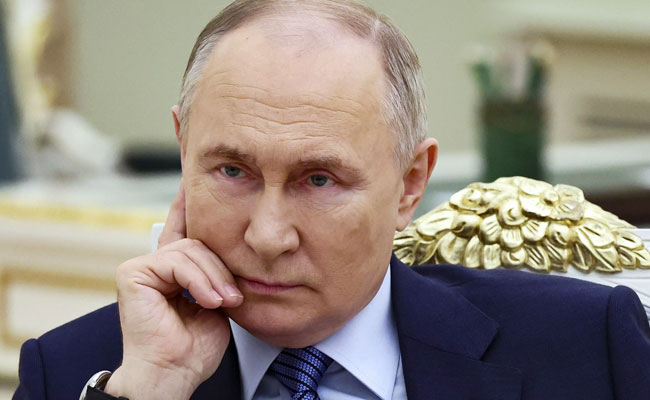
Moscow (AP/PTI): The suburban Moscow music hall where gunmen opened fire on concertgoers was a blackened, smoldering ruin Saturday as the death toll in the attack surpassed 130 and Russian authorities arrested four suspects. President Vladimir Putin claimed they were captured while fleeing to Ukraine.
Kyiv strongly denied any involvement in Friday's assault on the Crocus City Hall music venue in Krasnogorsk, and the Islamic State group's Afghanistan affiliate claimed responsibility.
Putin did not mention IS in his speech to the nation, and Kyiv accused him and other Russian politicians of falsely linking Ukraine to the assault to stoke fervor for Russia's war in Ukraine, which recently entered its third year.
US intelligence officials confirmed the claim by the IS affiliate.
"ISIS bears sole responsibility for this attack. There was no Ukrainian involvement whatsoever," National Security Council spokeswoman Adrienne Watson said in a statement.
The US shared information with Russia in early March about a planned terrorist attack in Moscow and issued a public warning to Americans in Russia, Watson said.
Putin said authorities detained a total of 11 people in the attack, which also wounded more than 100. He called it "a bloody, barbaric terrorist act" and said Russian authorities captured the four suspects as they were trying to escape to Ukraine through a "window" prepared for them on the Ukrainian side of the border.
Russian media broadcast videos that apparently showed the detention and interrogation of the suspects, including one who told the cameras he was approached by an unidentified assistant to an Islamic preacher via a messaging app and paid to take part in the raid.
Russian news reports identified the gunmen as citizens of Tajikistan, a former Soviet republic in Central Asia that is predominantly Muslim and borders Afghanistan. Up to 1.5 million Tajiks have worked in Russia and many have Russian citizenship.
Tajikistan's foreign ministry, which denied initial Russian media reports that mentioned several other Tajiks allegedly involved in the raid, did not immediately respond to a request for comment about the arrests.
Many Russian hard-liners called for a crackdown on Tajik migrants, but Putin appeared to reject the idea, saying "no force will be able to sow the poisonous seeds of discord, panic or disunity in our multi-ethnic society."
He declared Sunday a day of mourning and said additional security measures were imposed throughout Russia.
The number of dead stood at 133, making the attack the deadliest in Russia in years. Authorities said the toll could still rise.
The raid was a major embarrassment for the Russian leader and happened just days after he cemented his grip on the country for another six years in a vote that followed the harshest crackdown on dissent since the Soviet times.
Some commentators on Russian social media questioned how authorities, who have relentlessly suppressed any opposition activities and muzzled independent media, failed to prevent the attack despite the US warnings.
The assault came two weeks after the US Embassy in Moscow issued a notice urging Americans to avoid crowded places in view of "imminent" plans by extremists to target large Moscow gatherings, including concerts. Several other Western embassies repeated the warning. Earlier this week, Putin denounced the warning as an attempt to intimidate Russians.
Investigators on Saturday combed through the charred wreckage of the hall for more victims. Hundreds of people stood in line in Moscow to donate blood and plasma, Russia's health ministry said.
Putin's claim that the attackers tried to flee to Ukraine followed comments by Russian lawmakers who pointed the finger at Ukraine immediately after the attack.
Ukrainian President Volodymyr Zelenskyy angrily rejected Moscow's accusations as an attempt by Putin and his lieutenants to shift the blame to Ukraine while treating their own people as "expendables."
"They are burning our cities and they are trying to blame Ukraine," he said in a statement on his messaging app channel. "They torture and rape our people and they blame them. They drove hundreds of thousands of their terrorists here to fight us on our Ukrainian soil, and they don't care what happens inside their own country."
Images shared by Russian state media showed emergency vehicles still gathered outside the ruins of the concert hall, which could hold more than 6,000 people and hosted many big events, including the 2013 Miss Universe beauty pageant that featured Donald Trump.
On Friday, crowds were at the venue for a concert by the Russian rock band Picnic.
Videos posted online showed gunmen in the venue shooting civilians at point-blank range. Russian news reports cited authorities and witnesses as saying the attackers threw explosive devices that started the fire, which eventually consumed the building and caused its roof to collapse.
Dave Primov, who survived the attack, told the AP that the gunmen were "shooting directly into the crowd" in the front rows. He described the chaos in the hall as concertgoers raced to escape: "People began to panic, started to run and collided with each other. Some fell down and others trampled on them."
After he and others crawled out of the hall into nearby utility rooms, he said he heard pops from small explosives and smelled burning as the attackers set the building ablaze. By the time they got out of the massive building 25 minutes later, it was engulfed in flames.
"Had it been just a little longer, we could simply get stuck there in the fire," Primov said.
Messages of outrage, shock and support for the victims and their families streamed in from around the world.
White House press secretary Karine Jean-Pierre said in a statement that the US condemned the attack and noted that the Islamic State group is a "common terrorist enemy that must be defeated everywhere."
IS, which lost much of its ground after Russia's military action in Syria, has long targeted Russia. In a statement posted by the group's Aamaq news agency, IS's Afghanistan affiliate said it had attacked a large gathering of "Christians" in Krasnogorsk.
The group issued a new statement Saturday on Aamaq saying the attack was carried out by four men who used automatic rifles, a pistol, knives and firebombs. It said the assailants fired at the crowd and used knives to kill some concertgoers, casting the raid as part of IS's ongoing war with countries that it says are fighting Islam.
In October 2015, a bomb planted by IS downed a Russian passenger plane over Sinai, killing all 224 people on board, most of them Russian vacation-goers returning from Egypt.
The group, which operates mainly in Syria and Iraq but also in Afghanistan and Africa, also has claimed several attacks in Russia's volatile Caucasus and other regions in the past years. It recruited fighters from Russia and other parts of the former Soviet Union.
The group's Afghanistan affiliate is known variously as ISIS-K or IS-K, taking its name from Khorasan Province, a region that covered much of Afghanistan, Iran and Central Asia in the Middle Ages.
The affiliate has thousands of fighters who have repeatedly carried out attacks in Afghanistan since the country was seized in 2021 by the Taliban, a group with which they are at bitter odds.
ISIS-K was behind the August 2021 suicide bombing at Kabul airport that left 13 American troops and about 170 Afghans dead during the chaotic US withdrawal. They also claimed responsibility for a bomb attack in Kerman, Iran, in January that killed 95 people at a memorial procession.
On March 7, just hours before the US Embassy warned about imminent attacks, Russia's top security agency said it had thwarted an attack on a synagogue in Moscow by an IS cell and killed several of its members in the Kaluga region near the Russian capital. A few days before that, Russian authorities said six alleged IS members were killed in a shootout in Ingushetia, in Russia's Caucasus region.
Let the Truth be known. If you read VB and like VB, please be a VB Supporter and Help us deliver the Truth to one and all.
India, Vietnam elevate ties to enhanced comprehensive strategic partnership; set USD 25 bn
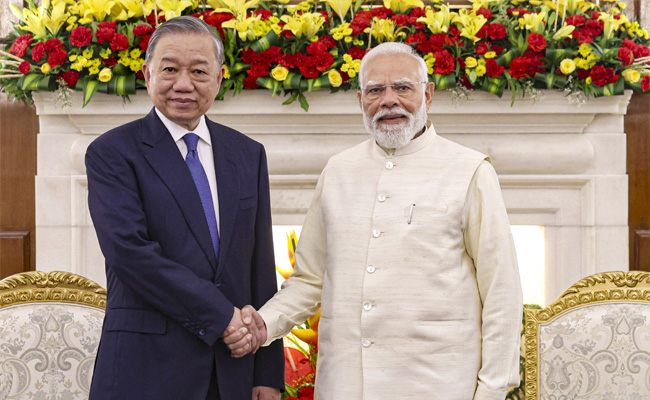
New Delhi (PTI): India and Vietnam on Wednesday elevated their ties to an enhanced comprehensive strategic partnership and set a USD 25 billion annual trade target by 2030 as Prime Minister Narendra Modi and Vietnamese President To Lam held talks focusing on expanding bilateral ties in areas of trade, defence, and critical minerals in the face of increasing geopolitical upheavals.
Following the Modi-Lam meeting, the two sides signed as many as 13 agreements which will provide for deeper two ways engagements in a range of areas including digital payments, rare earth minerals, pharmaceuticals, education, banking and culture.
Modi and Lam also deliberated on the situation in the Indo-Pacific amid China's increasing assertiveness in the region, and agreed to continue to contribute to the rule-of-law, peace, stability, and prosperity.
It is understood that China's growing military muscle-flexing in the South China Sea also figured in the delegation-level talks between the two sides.
Elected as president earlier this month, Lam began his first state visit to India on Tuesday, leading a high-level delegation for a three-day trip.
ALSO READ: Explosives used in blast outside Punjab Frontier BSF HQ in Jalandhar: Punjab Police
"A decade ago, Vietnam became India's first comprehensive strategic partner in ASEAN (Association of Southeast Asian Nations) . Since then, our relations have made rapid and comprehensive progress," Modi said in his media statement.
"Building on this strong foundation, today we are elevating our relations to the level of Enhanced Comprehensive Strategic Partnership. We will now advance our partnership to even higher goals," he said.
"Our cooperation will reach new levels in every area ' culture, connectivity, and capacity building, as well as security, sustainability, and supply chain resilience," Modi added.
He noted that the bilateral trade between India and Vietnam has doubled in the last decade to reach USD 16 billion and that the target now is to increase it to USD 25 billion by 2030.
Modi also cited a plethora of agreements signed between the two countries to emphasis that the economic engagement is expected to witness a significant upswing going forward.
"The MoU between our drug authorities will now increase access to Indian medicines in Vietnam. Exports of Indian agricultural, fisheries, and animal products to Vietnam are also set to become easier. Very soon, Vietnam will taste India's grapes and pomegranates," he said.
The two sides also agreed to update the India-ASEAN trade agreement by the end of this year.
"This will provide a new impetus to trade and investment between India and all ASEAN countries. New initiatives in critical minerals, rare earths, and energy cooperation will ensure the economic security and supply chain resilience of both countries," Modi said.
"To boost financial connectivity, we have today decided to enhance cooperation between our central banks. India's UPI and Vietnam's fast payment systems will soon be linked. Furthermore, we are strengthening state-to-state and city-to-city cooperation between the two countries," he noted.
Modi said India is grateful to Vietnam for its strong condemnation of the Pahalgam terrorist attack and standing with India in its fight against terrorism.
"In this era of global turmoil and economic challenges, thanks to their talent, good governance, and economic reforms, India and Vietnam are emerging as the world's fastest-growing economies," he said.
"Now, through our enhanced strategic partnership, we will support each other's rapid growth. As the Buddha's teachings say, 'If you light a lamp for someone else, it also illuminates your own path'," Modi said.
He also described Vietnam a a key pillar of India's Act East Policy and Vision Ocean.
"In the Indo-Pacific region as well, we share a common outlook. Through our strengthening defence and security cooperation, we will continue to contribute to the rule-of-law, peace, stability, and prosperity," he said.
The prime minister said India will broaden its relations with ASEAN with Vietnam's cooperation.
In his remarks, Lam said both sides agreed to deepen political trust and elevate security cooperation.
Last year, the two sides inked a pact to set up a framework for submarine search, rescue and support mechanism. They also signed a letter of intent (LoI) to strengthen bilateral defence industry collaboration.