Putin says Russia and North Korea have vowed to aid each other if attacked in new partnership deal
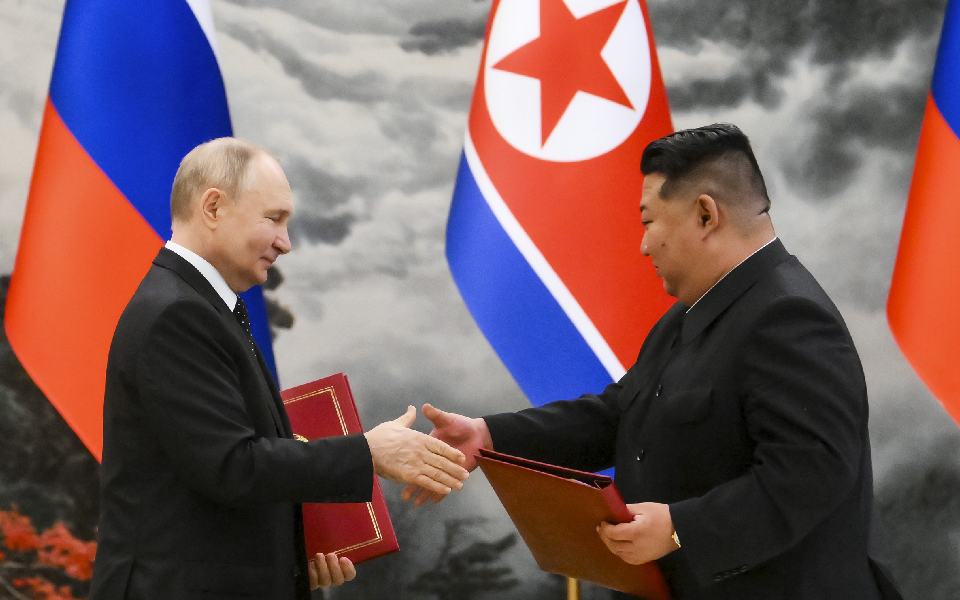
Seoul, Jun 19: Russian President Vladimir Putin and North Korean leader Kim Jong Un signed a partnership that includes a vow of mutual aid if either country is attacked, during a Pyongyang summit on Wednesday that came as both face escalating standoffs with the west.
It was not clear what kind of assistance the deal, described as a “comprehensive strategic partnership,” would call for.
Putin's first visit to North Korea in 24 years comes amid growing concerns over an arms arrangement in which the country provides Moscow with badly needed munitions for its war in Ukraine in exchange for economic assistance and technology transfers that could enhance the threat posed by Kim's nuclear weapons and missile program.
Speaking after a signing ceremony, Putin said that security and international issues took up a large part of the talks with Kim, according to Russian state media. He was also quoted to say that Russia would not rule out developing military-technical cooperation with North Korea under the deal.
Kim was quoted as saying that the agreement was of a peaceful and defensive nature. “I have no doubt it will become a driving force accelerating the creation of a new multipolar world," he was quoted to say.
Russia and North Korea also signed agreements on cooperation in the fields of healthcare, medical education, and science, Russian state media reported, citing the Kremlin's website.
Putin was met upon his nighttime arrival by Kim, who shook his hands, hugged him twice and rode with him from the airport in a limousine in a huge motorcade that rolled through the capital's brightly illuminated streets, where buildings were decorated with giant Russian flags and portraits of Putin.
After spending the rest of the night at a state guest house, Putin attended a lavish welcoming ceremony at the city's main square, where he and Kim saluted an honor guard and walked across a red carpet. Kim then introduced key members of his leadership including Foreign Minister Choe Son Hui; top aide and ruling party secretary Jo Yong Won; and the leader's powerful sister, Kim Yo Jong.
The square was filled with what appeared to be tens of thousands of spectators, including children holding balloons and people wearing coordinated t-shirts in the red, white and blue of the Russian and North Korean flags. Huge crowds lined up on the streets to greet Putin's motorcade, chanting “Welcome Putin” and waving flowers and North Korean and Russian flags.
As the talks began, Putin thanked Kim for North Korea's support for his war in Ukraine, part of what he said was a “fight against the imperialist hegemonistic policies of the U.S. and its satellites against the Russian Federation.”
He said the two planned to sign a “new fundamental document (that) will form the basis of our ties for the long term," hailing ties that he traced back to the Soviet army fighting the Japanese military on the Korean Peninsula in the closing moments of World War II, and Moscow's support for Pyongyang during the Korean War.
Kim said Moscow and Pyongyang's “fiery friendship” is now even closer than during Soviet times, and promised “full support and solidarity to the Russian government, army and people in carrying out the special military operation in Ukraine to protect sovereignty, security interests and territorial integrity.”
Kim has used similar language in the past, consistently saying North Korea supports what he describes as a just action to protect Russia's interests and blaming the crisis on the U.S.-led West's “hegemonic policy.” It wasn't immediately clear what that support might look like.
North Korea is under heavy U.N. Security Council sanctions over its weapons program, while Russia also faces sanctions by the United States and its Western partners over its aggression in Ukraine.
U.S. and South Korean officials accuse the North of providing Russia with artillery, missiles and other military equipment for use in Ukraine, possibly in return for key military technologies and aid. Both Pyongyang and Moscow deny accusations about North Korean weapons transfers, which would violate multiple U.N. Security Council sanctions that Russia previously endorsed.
Along with China, Russia has provided political cover for Kim's continuing efforts to advance his nuclear arsenal, repeatedly blocking U.S.-led efforts to impose fresh U.N. sanctions on the North over its weapons tests.
In March, a Russian veto at the United Nations ended monitoring of U.N. sanctions against North Korea over its nuclear program, prompting Western accusations that Moscow is seeking to avoid scrutiny as it buys weapons from Pyongyang for use in Ukraine.
Putin's foreign affairs adviser Yuri Ushakov told reporters in Pyongyang that the two leaders exchanged gifts after the talks. Putin presented Kim with a Russian-made Aurus limo and other gifts, including a tea set and a naval officer's dagger. Ushakov said that Kim's presents to Putin included artworks depicting the Russian leader.
Russia media said earlier that Kim will host a reception, and Putin is expected to leave Wednesday evening for Vietnam.
In Washington, U.S. Secretary of State Antony Blinken said Putin's visit to North Korea illustrates how Russia tries, “in desperation, to develop and to strengthen relations with countries that can provide it with what it needs to continue the war of aggression that it started against Ukraine.”
The North may also seek to increase labor exports to Russia and other illicit activities to gain foreign currency in defiance of U.N. Security Council sanctions, according to a recent report by the Institute for National Security Strategy, a think tank run by South Korea's main spy agency. There will likely be talks about expanding cooperation in agriculture, fisheries and mining and further promoting Russian tourism to North Korea, the institute said.
Tensions on the Korean Peninsula are at their highest point in years, with the pace of both Kim's weapons tests and combined military exercises involving the United States, South Korea and Japan intensifying in a tit-for-tat cycle.
The Koreas also have engaged in Cold War-style psychological warfare that involved North Korea dropping tons of trash on the South with balloons, and the South broadcasting anti-North Korean propaganda with its loudspeakers.
Let the Truth be known. If you read VB and like VB, please be a VB Supporter and Help us deliver the Truth to one and all.
11-year-old dies by suicide after sexual assault in Bareilly; accused arrested

Bareilly (UP) (PTI): A 26-year-old man has been arrested for allegedly sexually assaulting an 11-year-old girl, who later died by suicide due to trauma, police said on Wednesday.
The post-mortem report confirmed sexual assault and multiple injuries on the minor's body, including bite marks and nail scratches. The cause of death was found to be hanging, they said.
According to ASP (South) Anshika Verma, the incident came to light on 27 April, when the girl, a Class 8 student, was found hanging at her home in Deoria Abdullaganj village under the Mirganj police station area. Initially, the family reported the death as suicide and was reluctant to pursue police action.
"The autopsy report changed the course of the investigation. It confirmed sexual assault and noted severe physical trauma. The cause of death was confirmed as hanging," Verma said.
A breakthrough in the case came from the statement of the victim's younger sister, who told police that the accused, Zeeshan (26), a resident of the same village, frequently loitered near the minor's school and allegedly gave her small sums of money to keep his interactions with her a secret, she said.
Police said that on the day of the incident, the accused allegedly lured the minor and assaulted her. Distressed by the incident, the child later took her own life while her mother was away, police said.
"Based on technical surveillance, CCTV footage, and statements from the family, we established Zeeshan's involvement. He was arrested near the Mirganj weekly market on Tuesday," they said.