Rajapaksa's opponents win control of key panel in Lankan Parliament
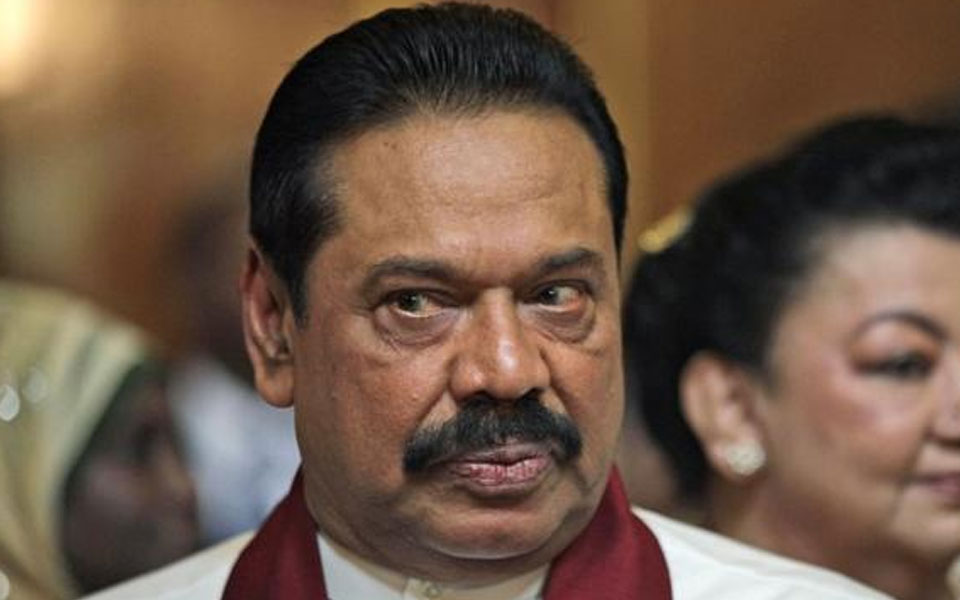
Colombo, Nov 23 : Ousted Sri Lankan Prime Minister Ranil Wickeremesinghe's alliance on Friday won control of a powerful panel in Parliament, dealing a major blow to President Maithripala Sirisena and his prime ministerial appointee Mahinda Rajapaksa.
Sirisena's party members walked out of Parliament, which resumed its session on Friday after being adjourned on Monday, protesting against Speaker Karu Jayasuriya's move to appoint five members of the United People's Freedom Alliance (UPFA) which is led by the President.
The Speaker named five members from the United National Front (UNF) of Wickeremesinghe, and one each from the Tamil National Alliance (TNA) and the Janatha Vimukthi Peramuna (JVP).
This is in continuation of the political unrest plaguing the country since October 26.
Both Wickremesinghe and Rajapaksa claim to be the prime ministers. Wickremesinghe says his dismissal is invalid because he still holds a majority in the 225-member Parliament.
Jayasuriya, at the start of the session, announced that following a meeting of all party leaders which ended without an agreement over the composition of the committee, he had decided to grant five members each to the UPFA and the UNF.
The committee would comprise 12 members, he said. Senior UPFA member Dinesh Gunawardena slammed the speaker's conduct as biased.
"I urge you to recognise us as the government and give us the majority in the select committee.
"We have precedents that even during the minority governments in the past the government had been given majority in the select committee," he said.
Lakshman Kiriella on behalf of the ousted government said that Jayasuriya has declared the members based on two previous votes that there was no government and the purported government does not exist.
Wimal Weerawansa, another Sirisena backer, said that if Jayasuriya was not recognising the government, they would not recognise Jayasuriya as the Speaker.
"We will leave the chamber allowing you to conduct a meeting of the United National Party," Weerawansa said and led Sirisena's side out of the chamber.
Jayasuriya then proceeded to take a vote on his decision on the select committee composition after a vote was moved by JVP's Vijitha Herath.
The proposal was adopted with 121 votes for and nothing against. The members of the UNF, Sri Lanka Muslim Congress and the Tamil National Alliance voted in favour.
Sri Lanka is witnessing a political crisis since President Sirisena abruptly sacked Wickremesinghe on October 26.
Sirisena later dissolved Parliament, almost 20 months before its term was to end, and ordered snap election. The Supreme Court overturned Sirisena's decision to dissolve Parliament and halted the preparations for snap polls.
Speaker Jayasuriya then ordered a floor test in the 225-member assembly to end the ongoing political crisis, a move which invited the wrath of the government of Rajapaksa.
The UNF has already moved two motions of no trust against Rajapaksa and they are to move a third vote again, perhaps Friday. Rajapaksa, however, has refused to step down.
On Wednesday, Wickremesinghe's party handed Parliament another motion, demanding suspension of funds of all ministry secretaries whom they claim had been illegally appointed since October 26.
Let the Truth be known. If you read VB and like VB, please be a VB Supporter and Help us deliver the Truth to one and all.
Brothers awaiting board exam results drown in canal

Erode (Tamil Nadu) (PTI): Minor brothers who were awaiting their board exam results have drowned in a canal in this district while spending their Summer holidays at their aunt's place, police said.
According to Arachalure Police, Santhosh, aged 17, and his younger brother Sanjai, aged 15, natives of Musiri village in Tiruchirapalli district, came to Gopaliparai hamlet near Arachalure to their Aunt's house a couple of days ago after writing their annual 12th and 10th examinations, respectively.
The police said on Friday that both boys went to the nearby Lower Bhavani Project canal to take a bath. It was alleged that while taking a bath, both boys went to a deeper area of the canal and went missing.
As they didn't return home, even two hours after they left, their aunt grew suspicious and informed the Fire and Rescue Services, Chennimalai. A rescue team from the department rushed to the spot. After a few minutes of searching, they located the dead bodies of the brothers and sent them to the hospital. Arachalure police registered a case of death due to drowning and are investigating.