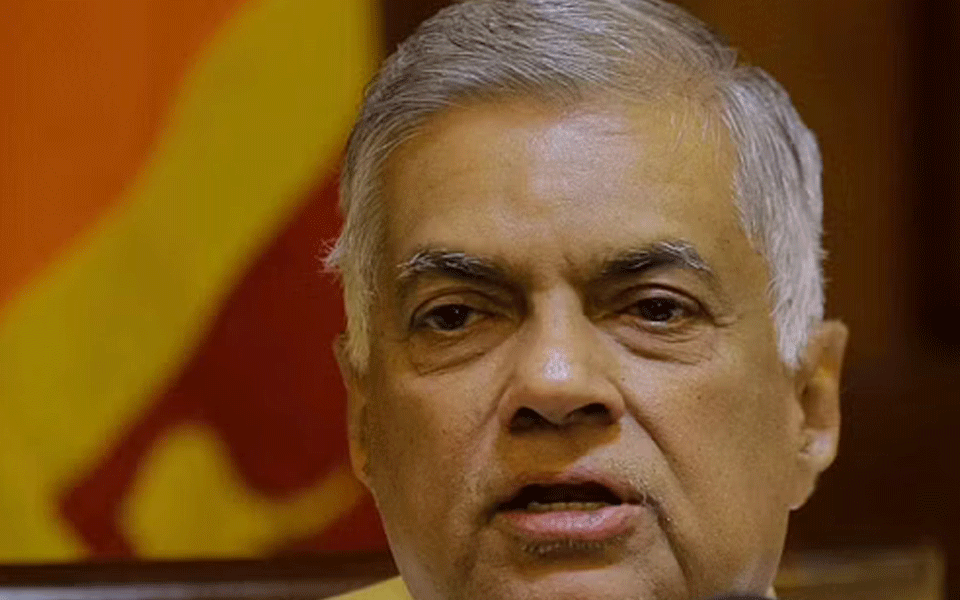
Colombo (PTI): Acting President Ranil Wickremesinghe was on Wednesday elected as Sri Lanka's new President by Parliament, following a high-voltage political drama which saw his predecessor Gotabaya Rajapaksa fleeing the country and resigning after a popular uprising against his government for mismanaging the economy.

The 73-year-old six-time prime minister secured 134 votes in the 225-member House while his nearest rival and dissident ruling party leader Dullas Alahapperuma got 82. Leftist Janatha Vimukthi Peramuna (JVP) leader Anura Kumara Dissanayake secured just three votes.

The new President will have a mandate to serve out the rest of Rajapaksa's term, which ends in November 2024.

Earlier, the voting by secret ballot took place amidst tight security in the wake of the simmering tensions in the island nation triggered by the unprecedented economic and political crisis. In the crucial election, 223 lawmakers voted while two MPs abstained. Four votes were rejected while 219 were declared valid.

This is for the first time in 44 years that Sri Lanka's Parliament has directly elected a president. Presidential elections in 1982, 1988, 1994, 1999, 2005, 2010, 2015 and 2019 had elected them by popular vote.

The only previous occasion when the presidency became vacant mid-term was in 1993 when president Ranasinghe Premadasa was assassinated. DB Wijetunga was unanimously endorsed by Parliament to run the balance of Premadasa's term.

Let the Truth be known. If you read VB and like VB, please be a VB Supporter and Help us deliver the Truth to one and all.


Imagine waking up one morning and finding that the price of wheat flour, rice, and milk has doubled overnight. Your grocery bag costs twice as much. Farmers in your village cannot afford fertiliser. The government is scrambling. This is not a nightmare. This is exactly what the Iran war could trigger — and it starts with something most of us never think about: natural gas.

How Does Gas Connect to Your Food?

There is a process called the Haber-Bosch process — a scientific method that mixes nitrogen from air with hydrogen from natural gas to create ammonia. Ammonia is then turned into urea, which is the fertiliser that farmers spray on wheat, rice, and maize fields. Simply put — no natural gas, no fertiliser. No fertiliser, no food.

Around 80% of the cost of making fertiliser comes from natural gas. So when gas supply gets disrupted even for a few weeks, fertiliser factories slow down or completely shut. Farmers get less fertiliser. Crops grow weaker. Harvests fall. And your plate gets emptier.

The Strait of Hormuz — A Small Passage, Giant Problem

There is a narrow sea passage called the Strait of Hormuz, located between Iran and the Arabian Peninsula. Nearly 20% of the world's LNG (Liquefied Natural Gas) and 30% of global fertiliser exports pass through this tiny corridor every single day.

Major countries like Qatar, Saudi Arabia, and UAE export fertilisers — urea and ammonia — through this route to nations across Asia, Africa, and Europe. Now, with Iran's military threatening this passage, ships are scared to pass. Fertiliser is stuck inside the Persian Gulf. The world outside is waiting — and waiting costs lives.

Worst Timing in Farming History

This war has arrived at the worst possible moment for global agriculture. Right now, farmers across the Northern Hemisphere — in USA, Canada, Europe, China, India, Russia — are preparing for the spring planting season. This is the peak time when demand for nitrogen fertiliser is at its absolute highest.

Unlike oil, which many countries store in emergency reserves, no country in the world has a strategic fertiliser reserve. If shipments are delayed even by four to six weeks, farmers will use less fertiliser and the autumn harvest will permanently fall. You cannot redo a planting season. Once that window closes, it is gone.

Your Chicken, Milk and Eggs Are Also at Risk

Many people think a food crisis only affects vegetarians. That is wrong. When fertiliser shortages reduce grain production, the price of animal feed — corn and soybean — shoots up. Livestock farmers operate on very thin profits. When feed prices rise sharply, the cost of chicken, pork, beef, milk, and eggs rises with it. A fertiliser shortage can become a full dairy and meat crisis within just a few months.

India's Mungaru Season Is in Serious Danger

For India, this situation is deeply personal — and for Karnataka and South India, it hits even closer to home. India sources nearly 60% of its total LNG imports from Middle East countries — with Qatar alone supplying over 42% and UAE adding another 11%. This makes India the most Middle East-dependent LNG buyer in the entire world.

If India's fertiliser plants cannot get affordable natural gas, domestic urea production will fall sharply — exactly before the Mungaru planting season. Mungaru is what Karnataka and South Indian farmers lovingly call the Kharif (Mungaru) season — the monsoon-driven planting window arriving around June, when farmers sow rice, ragi, sugarcane, and maize riding the southwest rains. This single season produces over half of India's total food grain. Miss this window, and there is no second chance until next year.

The government will be forced to spend thousands of crores extra on fertiliser subsidies. Every family — from a rice farmer in Mandya to a vegetable buyer in Bengaluru — will feel this burden.

Food in Cold Storage Is Also at Risk

Even food that is grown successfully may not reach your kitchen. Our food system runs on a massive cold chain — refrigerated trucks, frozen warehouses, temperature-controlled ships. As LNG prices surge, running these refrigeration systems becomes extremely expensive. More food spoils before reaching the market. Less supply means higher prices.

Countries Will Hoard, the Poor Will Starve

When prices rise and harvests fall, countries panic and stop food exports to protect themselves — exactly as happened during the 2022 Ukraine war. Wheat, rice, and sugar exports get banned overnight. Nations that depend on food imports — especially in Africa and South Asia — face severe shortages, hunger, and social unrest.

One war. One strait. One gas shortage. And the entire world goes hungry.

(Girish Linganna is an award-winning science communicator and a Defence, Aerospace & Geopolitical Analyst. He is the Managing Director of ADD Engineering Components India Pvt. Ltd., a subsidiary of ADD Engineering GmbH, Germany.)

Disclaimer: The views and opinions expressed in this article are solely those of the author. They do not necessarily reflect the views, policies, or position of the publication, its editors, or its management. The publication is not responsible for the accuracy of any information, statements, or opinions presented in this piece.