Rashida Tlaib, Ilhan Omar first Muslim women elected to US Congress

Palestinian-American Rashida Tlaib and Somali-American Ilhan Omar have become the first Muslim women elected to US Congress.
Tlaib took Michigan's 13th congressional district in a race in which she was the sole major party candidate. Omar won Minnesota's strongly Democratic fifth congressional district, replacing the first Muslim congressman, Keith Ellison, who vacated his seat to run in the state's attorney general race.
Who are Rashida Tlaib and Ilhan Omar?
Tlaib, 42, was born in Detroit to Palestinian immigrant parents.
She made history in 2008 by winning a seat on the Michigan Legislature, becoming the first Muslim woman to do so.
Her campaign platform included pledges to secure a $15 minimum wage, preventing cuts to welfare programmes, such as Medicare and Social Security, as well as stopping tax relief to large corporations.
Omar, who arrived in the US at the age of 14 after fleeing civil war in Somalia, campaigned on a similarly progressive platform, which calls for universal healthcare and tuition-free colleges.
She said her political life began attending local Democratic Farmer Labor party caucuses with her grandfather after arriving in the US.
Congratulations to my sister @RashidaTlaib on your victory!
— Ilhan Omar (@IlhanMN) November 7, 2018
I cannot wait to serve with you, inshallah. ??
Islamophobia
The pair's election to the US House of Representatives comes amid widespread negative feeling against American-Muslims by their compatriots.
A study released last week by the New America Foundation and the American Muslim Institution found around two in five Americans thought Islam was incompatible with American values, and that a similar number believed Muslims were not as patriotic as other citizens.
US Muslim civil rights groups say a lot of anti-Muslim rhetoric comes from the media, as well as the country's political establishment.
Researchers found that people identifying as Republicans were most likely to hold negative ideas about Islam and Muslims.
Another recent report, published by Muslim Advocates, found more than 80 instances of political candidates using anti-Muslim rhetoric in 2017 and 2018.
Courtesy: www.aljazeera.com
Let the Truth be known. If you read VB and like VB, please be a VB Supporter and Help us deliver the Truth to one and all.
MP cruise boat tragedy: Search ops expanded to trace four missing passengers
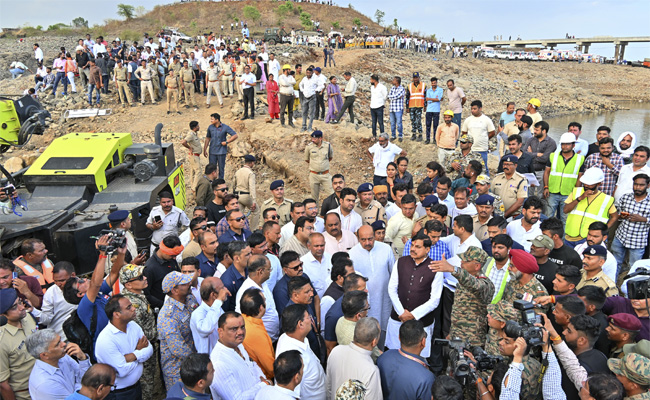
Jabalpur (PTI): Army divers and disaster response teams on Saturday expanded their search at Bargi Dam in Madhya Pradesh to locate a man and three children still missing after the cruise boat tragedy that claimed nine lives two days ago, officials said.
With 28 of the 41 identified passengers onboard the ill-fated cruise boat rescued safely, police are preparing to register an FIR in connection with the accident that occurred at the reservoir in Jabalpur district on Thursday evening, they said.
The search radius has been expanded to 5 km in the backwaters of the Bargi Dam, located downstream of the Narmada River, area sub-divisional officer of police (SDOP) Anjul Ayank Mishra told PTI.
Nine people drowned in the incident, while 28 were rescued, and efforts are ongoing to trace the missing persons, he said.
ALSO READ: Alleging unauthorised sorting of postal ballot covers, TMC files complaint with EC
According to the police, more than 200 rescuers, including around 20 Army divers airlifted from Agra, began the search operation at 5 am on Saturday to trace Kamraj, an employee of the Ordnance Factory in Khamaria, his son Tamil (5), Vijay Soni (6) and Mayuram (5).
Mishra said that an inquest case has been registered and the post-mortem of nine deceased persons has been completed.
"Our priority is to search for the missing persons. We will soon register an FIR," he said.
Investigators have said that CCTV footage near the boarding point showed 43 people heading towards the ill-fated boat, and the names of 41 persons, who boarded the vessel, have been ascertained so far.
Collector Raghvendra Singh confirmed that a search is underway for four missing persons.
The rescue operation, being carried out by the National Disaster Response Force (NDRF), State Disaster Response Force (SDRF) and local divers, was briefly affected around 9 am due to strong winds.
The state government on Friday ordered a probe into the incident and dismissed three crew members after survivors alleged negligence and safety lapses, including failure to provide life jackets.
The government also banned the operation of similar vessels in the state.
The boat, operated by the state tourism department, sank during a sudden storm around 6 pm on Thursday, and the wreckage was retrieved from the dam water on Friday, after the rescuers confirmed that there were no more bodies inside.
Eyewitnesses have said that strong winds made the water choppy, prompting passengers to raise an alarm and ask the crew to steer the vessel towards the riverbank.
A survivor alleged negligence by the crew and described a last-minute scramble for life jackets.