Report: Myanmar forces fire on funeral; crackdown continues

Yangon (Myanmar): Myanmar security forces opened fire Sunday on a crowd attending the funeral of student who was killed on the bloodiest day yet of a crackdown on protests against last month's coup, local media reported.
The escalating violence which took the lives of at least 114 people Saturday, including several children under 16 has prompted a U.N. human rights expert to accuse the junta of committing mass murder and to criticize the international community for not doing enough to stop it.
But it has not so far stopped either the demonstrations against the Feb. 1 takeover or the violent response of the military and police to them. Local outlet Myanmar Now reported that the junta's troops shot at mourners at the funeral in the city of Bago for Thae Maung Maung, a 20-year-old killed on Saturday.
He was reportedly a member of the All Burma Federation of Student Union, which has a long history of supporting pro-democracy movements in the country.
According to the report, several people attending the funeral were arrested. It did not say if anyone was hurt or killed. But at least nine people were killed elsewhere Sunday as the crackdown continued, according to the Assistance Association for Political Prisoners, which has been tallying deaths during demonstrations against the coup.
Some of the funerals held Sunday became themselves opportunities to demonstrate resistance to the junta.
At one in Bhamo in the northern state of Kachin, a large crowd chanted democracy slogans and raised the three-finger salute that has come to symbolize defiance of the takeover.
Family and friends were paying their respects to Shwe Myint, a 36-year-old who was shot dead by security forces on Saturday.
The military had initially seized her body and refused to return it until her family signed a statement that her death was not caused by them, according to the Democratic Voice of Burma, a broadcast and online news service.
In Yangon, the country's largest city, meanwhile, mourners flashed the three-finger salute as they wheeled the coffin of a 13-year-old boy. Sai Wai Yan was shot dead by security forces as he played outside his home.
The Feb. 1 coup that ousted Aung San Suu Kyi's elected government reversed years of progress toward democracy after five decades of military rule.
It has again made Myanmar the focus of international scrutiny as security forces have repeatedly fired into crowds of protesters. At least 459 people have been killed since the takeover, according to the Assistance Association for Political Prisoners.
The crackdown extends beyond the demonstrations: Humanitarian workers reported that the military had carried out airstrikes Sunday against guerilla fighters in the eastern part of the country.
The junta has accused some of the demonstrators of perpetrating the violence because of their sporadic use of Molotov cocktails and has said its use of force has been justified to stop what it has called rioting.
While protesters have occasionally hurled firecrackers at troops and on Saturday carried bows and arrows, they remain vastly out-gunned.
Saturday's death toll far exceeded the previous single-day high that ranged from 74 to 90 on March 14. The killings happened throughout the country as Myanmar's military celebrated the annual Armed Forces Day holiday with a parade in the country's capital, Naypyitaw.
Today the junta of Myanmar has made Armed Forces Day a day of infamy with the massacre of men, women and very young children throughout country, said Tom Andrews, the U.N.'s independent expert on human rights for Myanmar. Words of condemnation or concern are frankly ringing hollow to the people of Myanmar while the military junta commits mass murder against them. ... It is past time for robust, coordinated action.
Those calls were echoed by others. U.N. Secretary-General Antonio Guterres said he was shocked by the killings of civilians, including children, and a group of defense chiefs from 12 countries also condemned the violence.
U.N. Special Adviser on the Prevention of Genocide, Alice Wairimu Nderitu, and U.N. High Commissioner for Human Rights, Michelle Bachelet, said: The shameful, cowardly, brutal actions of the military and police who have been filmed shooting at protesters as they flee, and who have not even spared young children must be halted immediately.
But it's still not clear what action is possible or how quick it could be. The U.N. Security Council has condemned the violence but not advocated concerted action against the junta, such as a ban on selling it arms.
China and Russia are both major arms suppliers to Myanmar's military as well as politically sympathetic, and as members of the council would almost certainly veto any such move.
Let the Truth be known. If you read VB and like VB, please be a VB Supporter and Help us deliver the Truth to one and all.
Ruckus outside counting centre in Mamata's constituency, TMC claims entry of car with BJP flag
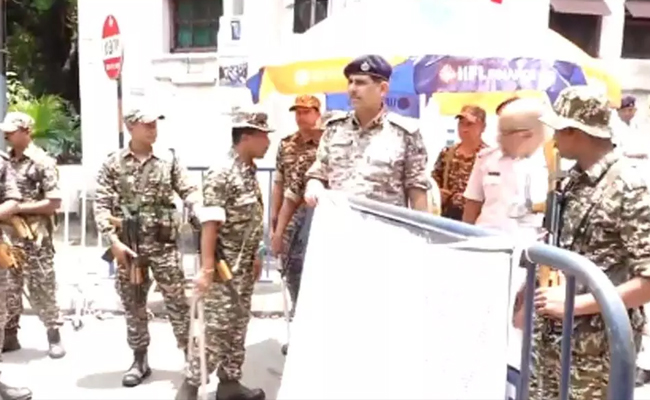
Kolkata (PTI): The counting centre at West Bengal Chief Minister Mamata Banerjee's Bhabanipur assembly constituency witnessed a ruckus a day ahead of the counting of votes, with TMC workers alleging two cars bearing the BJP's flag were allowed entry to the compound where EVMs are kept.
The incident comes close on the heels of a four-hour-long sit-in by Banerjee in front of the same counting centre at the Sakhawat Memorial Girls School on Thursday night, alleging unauthorised entry of persons into the strongroom.
With the polling now over, the wrangling for power in West Bengal has turned into a battle of nerves between the incumbent TMC and the BJP. Workers and leaders of both parties have been keeping a steely gaze on the security of strongrooms across the state where the electoral fate of the candidates is sealed.
Despite expressing her confidence in a "landslide victory", Banerjee has repeatedly aired her apprehensions of "counting malpractice and EVM tampering ahead of the day of results".
On Sunday morning, TMC workers camping 100 metres from the counting centre alleged that two cars with BJP flags entered the premises and went near the strongroom.
"The CAPF personnel at the spot are not allowing any vehicle or person to enter the premises of the counting centre without valid identity proof. Then how come this car, which we have not seen in the past few days, was allowed entry? Once we protested, the central forces asked us to move 100 metres away," a TMC activist said.
The TMC claimed that while the police personnel posted there promised the vehicle would be removed from the spot, it remained there for some time.
A senior Election Commission official said the car was passing by the Harish Mukherjee Road, and after checking by security forces and police, it was allowed to leave as nothing objectionable was found in it.
On Thursday night, two counting centres, including one at Sakhawat Memorial Girls School in the city, witnessed high drama after TMC leaders alleged a lack of transparency and possible malpractice at the strongrooms housing sealed EVMs of the assembly polls, which concluded on April 29.
TMC leaders and candidates, Sashi Panja and Kunal Ghosh, held a sit-in outside the Khudiram Anushilan Kendra counting centre on Thursday evening, alleging unauthorised activities inside the strongroom amid the absence of TMC agents
In Howrah, TMC protested renovation work by the public works department at a place adjacent to the strongroom, and the EC stopped the work temporarily.
On Saturday, the ruling party filed a complaint with the poll panel, alleging unauthorised sorting of postal ballot covers at the EVM strongroom in Khudiram Anushilan Kendra.
Similar scenes were witnessed on Saturday outside the strongrooms at Asansol College in Paschim Bardhaman and the Barasat Government College in North 24 Parganas districts, where TMC workers held protests, alleging that CCTV cameras were switched off for several minutes.
The EC turned down all allegations, saying the surveillance cameras were working in an uninterrupted manner.
BJP spokesperson Sajal Ghosh told reporters that the people of Bengal were finding it "hilarious" that the TMC, "which used to win elections through unfair means and strongarm tactics" were now coming up with all sorts of "frivolous charges".
"Are they scared of losing?" he posed.