Rescue efforts underway as Typhoon Hagibis kills 11 in Japan
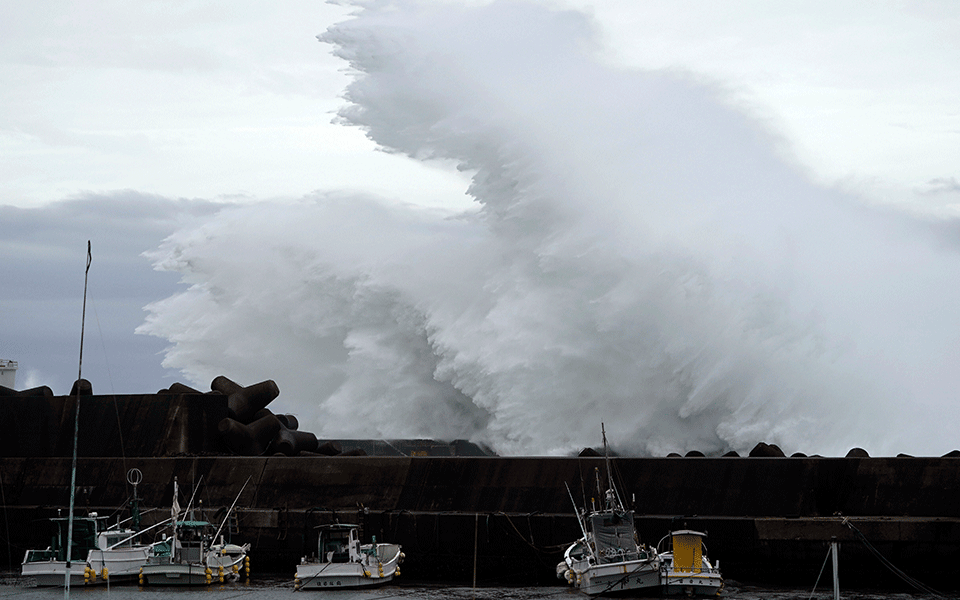
Tokyo: Japan's military scrambled Sunday to rescue people trapped by flooding after powerful Typhoon Hagibis ripped across the country, killing at least 11 people and leaving more than a dozen missing.
The storm's heavy rain triggered deadly landslides and caused rivers to burst their banks. The destruction forced Rugby World Cup organisers to cancel the third match of the tournament though the key Japan-Scotland clash will go ahead.
By Sunday morning, the significantly weakened storm had moved back off land, but serious flooding was reported in central Japan's Nagano, where a burst levee sent water from the Chikuma river gushing into residential neighbourhoods, flooding homes up to the second floor.
Japan's military deployed helicopters to rescue people seen standing on balconies waving towels to attract attention.
"Overnight, we issued evacuation orders to 427 households, 1,417 individuals," Yasuhiro Yamaguchi, an emergency official in Nagano city, told AFP, adding that it was unclear how many homes had been affected.
Aerial footage showed a row of bullet trains half-submerged in muddy waters at a depot in Nagano.
Hagibis smashed into the main Japanese island of Honshu around 7:00 pm (1000 GMT) Saturday as one of the most violent typhoons in recent years, with wind gusts of up to 216 kilometres per hour.
Well before making landfall, the outer bands of the storm claimed their first victim, a driver whose van was flipped over in the strong gusts.
Several more deaths were confirmed Saturday night, including a man killed in a landslide and another pulled from a flooded home.
And the toll continued to rise as the full scale of the disaster became clearer Sunday morning, with bodies recovered from submerged cars and landslides across several regions of the country.
National broadcaster NHK said at least 99 people had been injured and more than a dozen were missing after the storm.
Among the missing were eight people from a cargo ship that sank Saturday night in Tokyo Bay. The coast guard said they had rescued four of the Panama-flagged ship's crew but were still searching for the others.
At the storm's peak, more than seven million people were placed under non-compulsory evacuation orders, with tens of thousands heeding the call and moving into government shelters.
The Japan Meteorological Agency issued its highest-level rain disaster warning, saying "unprecedented" downpours were expected.
"The water came up higher than my head in the house," Hajime Tokuda, a finance professional living in Kawasaki near Tokyo told AFP. He moved to his family's home nearby, but that flooded too and they had to be rescued by boat.
In Saitama's Higashi Matsuyama city, northwest of Tokyo, rice and flower farmers were counting their losses, with water submerging warehouses full of freshly harvested product.
"We never had a flood like this before in this neighbourhood," said one farmer, who declined to give his name. "We cannot even go into the flower warehouse due to the water. I don't know where to start cleaning this mess."
The storm also brought travel chaos during a long holiday weekend in Japan, with flights grounded and both local and bullet trains serving Tokyo suspended fully or partially.
But Sunday morning, train services were resuming and operations were slowly restarting at the two airports serving the capital, although many flights remained cancelled.
The storm had already caused havoc for the sports world, forcing the delay of Japanese Grand Prix qualifiers and the cancellation of two Saturday Rugby World Cup matches.
On Sunday morning, organisers said they had been forced to cancel a third fixture -- Namibia-Canada -- but gave the go-ahead to three others including a crunch Japan-Scotland game in Yokohama, near Tokyo.
Scotland faced elimination if the match was cancelled and had threatened legal action if it was not played.
Let the Truth be known. If you read VB and like VB, please be a VB Supporter and Help us deliver the Truth to one and all.
AIITA welcomes Karnataka’s ban on obscene songs in school events

Bhatkal: The Karnataka unit of the All India Ideal Teachers Association (AIITA) has welcomed the Karnataka government’s decision to strictly ban school children from dancing to obscene songs during educational and cultural programmes in government, aided, and private schools across the state.
AIITA Karnataka State President M. R. Manvi congratulated the government for taking what he termed an important step to preserve the sanctity of education.
“Such decisions to safeguard the dignity of school children and uphold the values of education are the need of the hour. This rule should not be limited to government schools alone but must be strictly implemented in all private educational institutions as well,” he said.
He further urged the government to address other concerns within school programmes.
“The government should not only prohibit obscene dances in the name of school anniversaries, but also ensure that plays and dialogues that incite religious hatred are avoided. Schools should be centres of harmony, not platforms for spreading hatred,” he added.
According to a recent circular issued by the Department of School Education and Literacy, obscene dances are adversely affecting the mental health and moral values of students.
In this regard, schools have been advised to use songs that promote nationalism, positive thinking, the greatness of Kannada culture, and value-based traditions instead of inappropriate content during programmes.
The circular also emphasises that students should be dressed in decent attire.
AIITA also backed the department’s warning that disciplinary action would be taken against head teachers if such guidelines are violated. The association has further demanded that district Deputy Directors of Public Instruction strictly monitor the implementation of these rules.