Rescuers desperately search for survivors of earthquake in the Philippines that killed at least 72
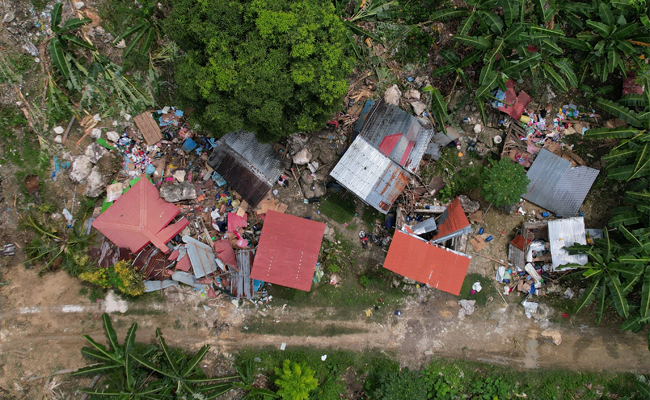
Bogo (Philippines) (AP): Rescuers used backhoes and sniffer dogs to look for survivors in collapsed houses and other damaged buildings in the central Philippines after an earthquake killed at least 72 people and injured more than 200 others.
The death toll was expected to rise from the 6.9 magnitude quake that hit about 10 pm Tuesday and trapped an unspecified number of residents in the hard-hit city of Bogo and outlying rural towns in Cebu province.
Sporadic rain and damaged bridges and roads have hampered the race to save lives.
A dangerous quake
On Wednesday night, rescuers in orange and yellow hard hats used spotlights, a backhoe and bare hands to sift through the rubble of concrete slabs, broken wood and twisted iron bars for hours in a collapsed building in Bogo city.
No survivor was found.
The earthquake occurred at a dangerously shallow depth of 5 kilometres and was centred about 19 kilometres northeast of Bogo, a coastal city of about 90,000 people in Cebu province where officials reported about half of the known deaths.
A desperate search
Workers were trying to transport a backhoe to hasten search and rescue efforts in a cluster of shanties in a mountain village hit by a landslide and boulders, Bogo city disaster-mitigation officer Rex Ygot told The Associated Press Wednesday.
“It's hard to move in the area because there are hazards,” said Glenn Ursal, another disaster mitigation officer, who added that some survivors were brought to a hospital from the mountain village.
Deaths also were reported from the outlying towns of Medellin and San Remigio, where three coast guard personnel, a firefighter and a child were killed separately by collapsing walls and falling debris while trying to flee to safety from a basketball game in a sports complex that was disrupted by the quake, town officials said.
The earthquake was one of the most powerful to batter the central region in more than a decade and it struck while many people slept or were at home.
A traumatized region
The Philippine Institute of Volcanology and Seismology briefly issued a tsunami warning and advised people to stay away from the coastlines of Cebu and the nearby provinces of Leyte and Biliran, but the warning was lifted within hours with no waves reported.
Still, thousands of traumatised residents refused to return home and chose to stay in open grassy fields and parks overnight despite intermittent rains.
Cebu and other provinces were still recovering from a tropical storm that battered the central region last Friday, leaving at least 27 people dead mostly due to drownings and falling trees, knocking out power in entire cities and towns and forcing the evacuation of tens of thousands of people.
Schools and government offices were closed in the quake-hit cities and towns while the safety of buildings were checked. More than 600 aftershocks have been detected after Tuesday night's temblor, Philippine Institute of Volcanology and Seismology director Teresito Bacolcol said.
Rain-soaked mountainsides were more susceptible to land- and mudslides in a major earthquake, he warned.
“This was really traumatic to people. They've been lashed by a storm then jolted by an earthquake,” Bacolcol said. “I don't want to experience what they've gone through.”
The Philippines, one of the world's most disaster-prone countries, is often hit by earthquakes and volcanic eruptions due to its location on the Pacific “Ring of Fire,” an arc of seismic faults around the ocean. The archipelago is also lashed by about 20 typhoons and storms each year.
Let the Truth be known. If you read VB and like VB, please be a VB Supporter and Help us deliver the Truth to one and all.
4 workers die after being buried under coal slurry in Jharkhand's Dhanbad
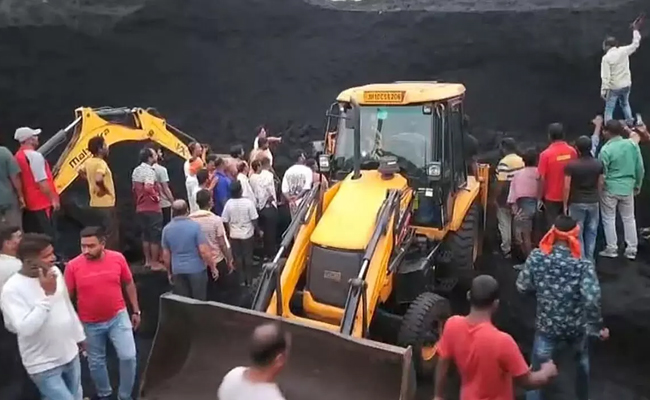
Dhanbad (Jharkhand) (PTI): At least four workers died after being buried under coal slurry in Jharkhand's Dhanbad district on Saturday, a police official said.
The incident took place at Moonidih coal washery in the command area of Bharat Coking Coal Limited (BCCL).
"Bodies of all four workers were dug out of debris during a rescue operation," Putki police station in-charge Waqar Hussain told PTI.
The incident took place when coal slurry was being loaded into trucks by workers, during which a large chunk of slurry fell and trapped several workers underneath, officials said.
The deceased have been identified as Manik Bauri, Dinesh Bauri, Deepak Bauri, and Hemlal Gope.
Meanwhile, the family members of the deceased and local villagers placed the bodies in front of the washery gate and began a protest.
They demanded compensation, jobs for dependents and action against those responsible for the incident.
Police and administration officials are trying to pacify the protesters, an official said.