Rescuers scramble in Turkey, Syria after quake kills 4,000
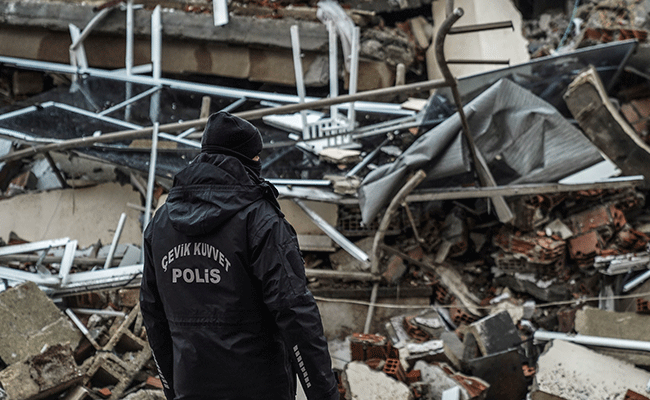
Adana (Turkey) (AP): Rescuers in Turkey and war-ravaged Syria searched through the frigid night into Tuesday, hoping to pull more survivors from the rubble after a 7.8 magnitude earthquake killed more than 4,000 people and toppled thousands of buildings across a wide region.
Authorities feared the death toll from Monday's pre-dawn earthquake and aftershocks would keep climbing as rescuers looked for survivors among tangles of metal and concrete spread across the region beset by Syria's 12-year civil war and refugee crisis.
Survivors cried out for help from within mountains of debris as first responders contended with rain and snow. Seismic activity continued to rattle the region, including another jolt nearly as powerful as the initial quake.
Workers carefully pulled away slabs of concrete and reached for bodies as desperate families waited for news of loved ones.
"My grandson is 1 1/2 years old. Please help them, please. ... They were on the 12th floor," Imran Bahur wept by her destroyed apartment building in the Turkish city of Adana on Monday.
Tens of thousands who were left homeless in Turkey and Syria faced a night in the cold. In the Turkish city of Gaziantep, a provincial capital about 33 kilometers (20 miles) from the epicentre, people took refuge in shopping malls, stadiums, mosques and community centres.
Turkish President Recep Tayyip Erdogan declared seven days of national mourning.
US President Joe Biden called Erdogan to express condolences and offer assistance to the NATO ally. The White House said it was sending search-and-rescue teams to support Turkey's efforts.
The quake, which was centred in Turkey's southeastern province of Kahramanmaras, sent residents of Damascus and Beirut rushing into the street and was felt as far away as Cairo.
It piled more misery on a region that has seen tremendous suffering over the past decade. On the Syrian side, the area is divided between government-controlled territory and the country's last opposition-held enclave, which is surrounded by Russian-backed government forces. Turkey, meanwhile, is home to millions of refugees from the civil war.
In the rebel-held enclave, hundreds of families remained trapped in rubble, the opposition emergency organisation known as the White Helmets said in a statement. The area is packed with some 4 million people displaced from other parts of the country by the war. Many live in buildings that are already wrecked from military bombardments.
Strained medical centres quickly filled with injured people, rescue workers said. Some facilities had to be emptied, including a maternity hospital, according to the SAMS medical organisation.
More than 7,800 people were rescued across 10 provinces, according to Orhan Tatar, an official with Turkey's disaster management authority.
The region sits on top of major fault lines and is frequently shaken by earthquakes. Some 18,000 were killed in similarly powerful earthquakes that hit northwest Turkey in 1999.
The US Geological Survey measured Monday's quake at 7.8, with a depth of 18 kilometers (11 miles). Hours later, a 7.5 magnitude temblor, likely triggered by the first, struck more than 100 kilometers (60 miles) away.
The second jolt caused a multistory apartment building in the Turkish city of Sanliurfa to topple onto the street in a cloud of dust as bystanders screamed, according to video of the scene.
Thousands of buildings were reported collapsed in a wide area extending from Syria's cities of Aleppo and Hama to Turkey's Diyarbakir, more than 330 kilometers (200 miles) to the northeast.
In Turkey alone, more than 5,600 buildings were destroyed, authorities said. Hospitals were damaged, and one collapsed in the city of Iskenderun.
Bitterly cold temperatures could reduce the time frame that rescuers have to save trapped survivors, said Dr. Steven Godby, an expert in natural hazards at Nottingham Trent University. The difficulty of working in areas beset by civil war would further complicate rescue efforts, he said.
Offers of help from search-and-rescue teams to medical supplies and money poured in from dozens of countries, as well as the European Union and NATO. The vast majority were for Turkey, with a Russian and even an Israeli promise of help to the Syrian government, but it was not clear if any would go to the devastated rebel-held pocket in the northwest.
The opposition's Syrian Civil Defense described the situation in the enclave as "disastrous."
The opposition-held area, centred on the province of Idlib, has been under siege for years, with frequent Russian and government airstrikes. The territory depends on a flow of aid from Turkey for everything from food to medical supplies.
UN spokesman Stephane Dujarric said 224 buildings in northwestern Syrian were destroyed and at least 325 were damaged, including aid warehouses. The UN had been assisting 2.7 million people each month via cross-border deliveries, which could now be disrupted.
At a hospital in Idlib, Osama Abdel Hamid said most of his neighbours died when their shared four-story building collapsed. As he fled with his wife and three children, a wooden door fell on them, shielding them from falling debris.
"God gave me a new lease on life," he said.
In the small Syrian rebel-held town of Azmarin in the mountains by the Turkish border, the bodies of several dead children, wrapped in blankets, were brought to a hospital.
In the Turkish city of Kahramanmaras, rescuers pulled two children alive from the rubble, and one could be seen lying on a stretcher on the snowy ground. Turkish broadcaster CNN Turk said a woman was pulled out alive in Gaziantep after a rescue dog detected her.
In Adana, 20 or so people, some in emergency rescue jackets, used power saws atop the concrete mountain of a collapsed building to open up space for any survivors to climb out or be rescued.
"I don't have the strength anymore," one survivor could be heard calling out from beneath the rubble of another building in Adana as rescue workers tried to reach him, said Muhammet Fatih Yavuz, a local resident.
In Diyarbakir, hundreds of rescue workers and civilians formed lines across a huge mound of wreckage, passing down broken concrete pieces and household belongings as they searched for trapped survivors.
At least 2,921 people were killed in 10 Turkish provinces, with nearly 16,000 injured, according to Turkish authorities.
The death toll in government-held areas of Syria climbed to 656 people, with some 1,400 injured, according to the Health Ministry. In the country's rebel-held northwest, groups that operate there said at least 450 people died, with many hundreds injured.
Huseyin Yayman, a legislator from Turkey's Hatay province, said several of his family members were stuck under the rubble of their collapsed homes.
"There are so many other people who are also trapped," he told HaberTurk television by phone. "There are so many buildings that have been damaged. People are on the streets. It's raining, it's winter."
Let the Truth be known. If you read VB and like VB, please be a VB Supporter and Help us deliver the Truth to one and all.
Iran offers to reopen Strait of Hormuz if US lifts its blockade and the war ends: officials
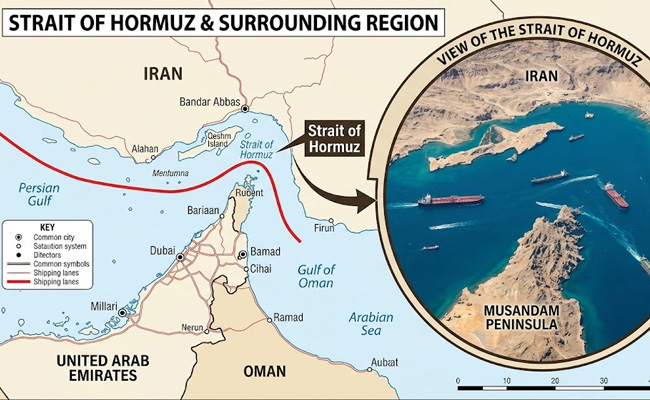
Cairo (AP): Iran has offered to end its chokehold on the Strait of Hormuz in exchange for the US lifting its blockade on the country and an end to the war, while proposing that discussions on the larger question of its nuclear programme would come in a later phase, two regional officials said Monday.
US President Donald Trump seems unlikely to accept the offer, which was passed to the Americans by Pakistan and would leave unresolved the disagreements that led the US and Israel to go to war on February 28.
With a fragile ceasefire in place, the US and Iran are locked in a standoff over the strait, through which a fifth of the world's traded oil and gas passes in peacetime. The US blockade is designed to prevent Iran from selling its oil, depriving it of crucial revenue while also potentially creating a situation where Tehran has to shut off production because it has nowhere to store the oil.
The strait's closure, meanwhile, has put pressure on Trump, as oil and gasoline prices have skyrocketed ahead of crucial midterm elections, and it has pressured his Gulf allies, which use the waterway to export their oil and gas.
The closure has also had far-reaching effects throughout the world economy, raising the price of fertilizer, food and other basic goods.
The proposal would push off negotiations on Iran's nuclear programme to a later date. Trump said one of the major reasons he went to war was to deny Iran the ability to develop nuclear weapons.
The two officials, who had knowledge of the proposal, spoke on condition of anonymity to discuss the closed-door negotiations between Iranian and Pakistani officials this weekend. The Axios news outlet first reported Iran's proposal.
It came as Iran's foreign minister visited Russia, which has long been a key backer of Tehran. It's unclear what, if any, assistance Moscow might offer now.
Strait of Hormuz remains blocked
===================
Iran's ability to choke off traffic in the Strait of Hormuz, the narrow mouth of the Persian Gulf, has proved one of its biggest strategic advantages in a war that has often boiled down to which side can take more pain.
Oil prices have risen steadily since the war began and tankers full of crude became stranded in the Persian Gulf, unable to safely transit through the strait and reach global distribution points.
On Monday, the spot price of Brent crude, the international standard, was trading at around $108 per barrel, nearly 50 per cent higher than when the war began.
Iranian foreign minister holds talks as negotiations with US stall
===============================
Trump last week indefinitely extended the ceasefire the US and Iran agreed to on April 7 that has largely halted fighting. But a permanent settlement remains elusive in the war that has killed thousands of people.
Iran's state-run IRNA news agency said Foreign Minister Abbas Araghchi landed in St. Petersburg on Monday morning ahead of a meeting with Russian President Vladimir Putin.
“It is a good opportunity for us to consult with our Russian friends about the developments that have occurred in relation to the war during this period and what is happening now,” Araghchi said in a video interview posted by IRNA.
It comes as Pakistan has been seeking to revive stalled talks between Iran and the US, and negotiations had been expected in Islamabad over the weekend. Instead, Trump called off a trip by his envoys and suggested the talks could take place by phone instead.
Over the weekend, Araghchi made two stops in Pakistan and a visit to Oman, which shares the strait with Iran. He also spoke by phone with counterparts in Qatar and Saudi Arabia on Sunday.
Iran wants to persuade Oman to support a mechanism to collect tolls from vessels passing through the strait, according to a regional official who spoke on condition of anonymity because he was not authorised to discuss the matter.
Oman's response wasn't immediately clear.
The official, who is involved in mediation efforts, also said Iran insisted on ending the US blockade before new talks and that Pakistan-led mediators are trying to bridge significant gaps between the countries.
Trump says Iran has offered a much better proposal
===========================
Trump told journalists Saturday that after he called off a trip by his envoys to Pakistan, Iran sent a “much better” proposal.
He did not elaborate but stressed that one of his conditions is that Iran “will not have a nuclear weapon”.
Iran insists its programme is peaceful, but the US wants to remove Tehran's stockpile of highly enriched uranium, which could be used to build a bomb, should Tehran choose to pursue one.
Since the war began, at least 3,375 people have been killed in Iran and at least 2,509 people in Lebanon, where fighting between Israel and the Iran-backed Hezbollah militant group resumed two days after the Iran war started. Another 23 people have been killed in Israel and more than a dozen in Gulf Arab states. Fifteen Israeli soldiers in Lebanon, 13 US service members in the region and six UN peacekeepers in southern Lebanon have been killed.
The ceasefire between Israel and Hezbollah has been extended by three weeks. Hezbollah has not participated in the Washington-brokered diplomacy.