Russia bombed four Syria hospitals in 12 hours: Report
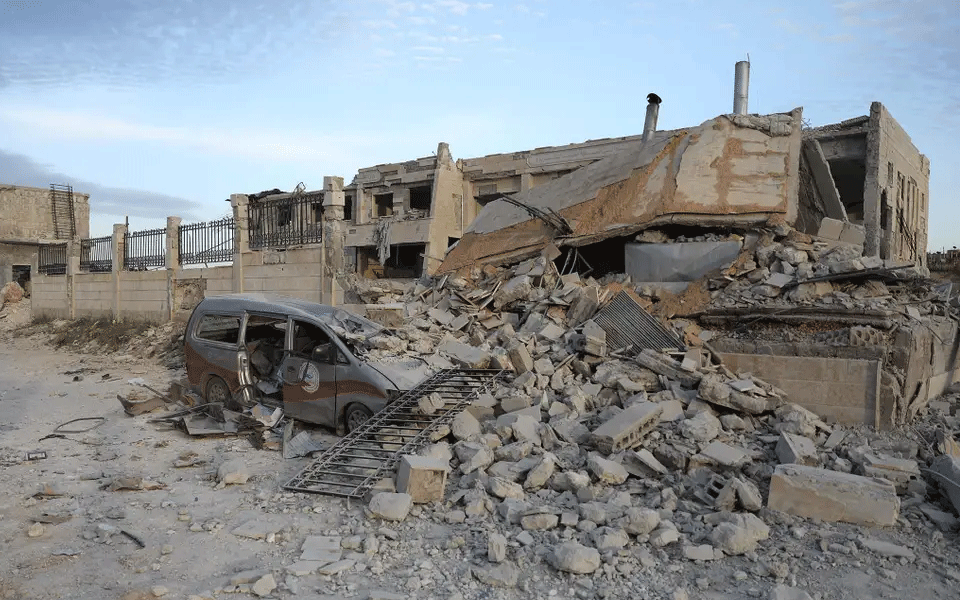
Washington: Russian warplanes bombed four hospitals in rebel-held territory in Syria over a period of just 12 hours earlier this year, The New York Times reported on Sunday.
The May strikes -- which the newspaper tied to Moscow through Russian radio recordings, plane spotter logs and accounts by witnesses -- are part of a larger pattern of medical facilities targeted by forces supporting Syrian President Bashar al-Assad in the country's devastating civil war.
Nabad al Hayat Surgical Hospital -- which staff had fled three days earlier in anticipation of the facility being bombed -- was one of those struck during the 12-hour period beginning on May 5, according to the Times' investigation.
A Russian ground controller gave the exact coordinates of the hospital to the pilot, who reported having it in sight a few minutes later, the newspaper said.
The controller gave the go-ahead for the strike at the same time that a spotter who was tasked with warning civilians about impending strikes logged a Russian jet in the area.
The pilot then reported releasing bombs, and local journalists filming the hospital recorded three bombs going through its roof and exploding.
Kafr Nabl Surgical Hospital -- just a few miles (kilometers) away -- was bombed multiple times shortly afterwards.
As with the earlier strike, a spotter registered one of Moscow's jets circling, and a Russian air force transmission recorded a pilot saying he had "worked" the target before delivering three strikes that were confirmed by a doctor, the Times said.
The Kafr Zita Cave Hospital and Al Amal Orthopedic Hospital were also bombed by Russian aircraft during the 12-hour period. All four facilities had provided their coordinates to the United Nations for inclusion on a list to avoid strikes.
UN Secretary General Antonio Guterres announced last month that he was setting up an internal investigation into the bombing of hospitals in Syria that had previously flagged their coordinates.
Several dozen medical facilities with links to the UN have been damaged or destroyed by bombs this year. Russian has denied deliberately targeting civilian installations.
Let the Truth be known. If you read VB and like VB, please be a VB Supporter and Help us deliver the Truth to one and all.
AIITA welcomes Karnataka’s ban on obscene songs in school events

Bhatkal: The Karnataka unit of the All India Ideal Teachers Association (AIITA) has welcomed the Karnataka government’s decision to strictly ban school children from dancing to obscene songs during educational and cultural programmes in government, aided, and private schools across the state.
AIITA Karnataka State President M. R. Manvi congratulated the government for taking what he termed an important step to preserve the sanctity of education.
“Such decisions to safeguard the dignity of school children and uphold the values of education are the need of the hour. This rule should not be limited to government schools alone but must be strictly implemented in all private educational institutions as well,” he said.
He further urged the government to address other concerns within school programmes.
“The government should not only prohibit obscene dances in the name of school anniversaries, but also ensure that plays and dialogues that incite religious hatred are avoided. Schools should be centres of harmony, not platforms for spreading hatred,” he added.
According to a recent circular issued by the Department of School Education and Literacy, obscene dances are adversely affecting the mental health and moral values of students.
In this regard, schools have been advised to use songs that promote nationalism, positive thinking, the greatness of Kannada culture, and value-based traditions instead of inappropriate content during programmes.
The circular also emphasises that students should be dressed in decent attire.
AIITA also backed the department’s warning that disciplinary action would be taken against head teachers if such guidelines are violated. The association has further demanded that district Deputy Directors of Public Instruction strictly monitor the implementation of these rules.