Russia, China object to US UNSC Presidency's Programme of Work over Iran
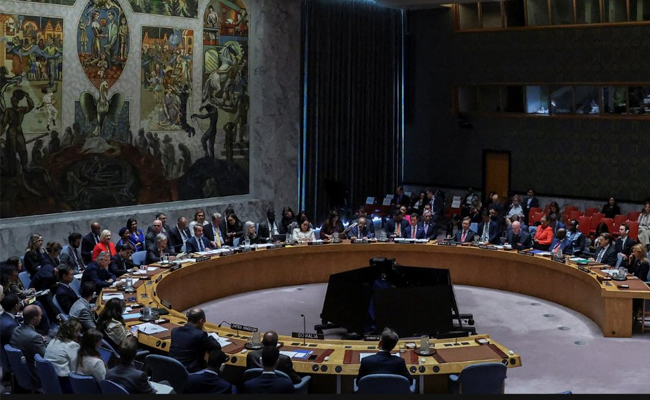
United Nations (PTI): In a development highlighting polarisation in the UN Security Council, the monthly programme of work for the US Presidency of the powerful UN organ could not be adopted after Russia and China raised objections concerning Iran.
The United States, a veto-wielding permanent member, assumed the Presidency of the 15-nation UN Security Council for the month of March. As is customary, a monthly programme of work that outlines the Council’s anticipated meetings and events for the month is adopted by the UN body at the commencement of the Presidency.
The Council President then briefs the media in the UN headquarters on the UNSC programme of work and agenda for the month.
However, the US-drafted programme of work for its monthly presidency of the Council could not be adopted on Monday after the other veto-wielding permanent members Russia and China raised objections pertaining to the 1737 Sanctions Committee concerning Iran.
ALSO READ: With 100 days to go, World Cup faces new challenges with Iran war and Mexico violence
“Russia & China objected to the adoption of the US-drafted UNSC PoW (Programme of Work) for March,” Russia’s Permanent Mission to the UN said.
“We were compelled to take this step because the provisional programme of work proposed by the US included a briefing on the work of the 1737 Sanctions Committee concerning Iran, whose work was allegedly resumed in September 2025 following the triggering by the UK, France, and Germany of the “snapback” mechanism to reimpose the anti-Iranian Security Council resolutions,” Russia said.
“In February, we once again brought our position on this matter to the attention of our US colleagues, urging them to refrain from including such an event in the provisional programme of work. Unfortunately, our appeal remained unheeded. For this very reason, we had no other choice but to object to the adoption of the UNSC programme of work for March,” it said.
The UN Security Council had in 2015 adopted a resolution that implemented the Joint Comprehensive Plan of Action (JCPOA) concerning Iran's nuclear programme. In August 2020, the United States invoked the resolution's "snapback" mechanism, under which the Security Council can reimpose UN sanctions.
Last year, France, Germany, and the United Kingdom (UK) (collectively known as the "E3") invoked the snapback mechanism, which resulted in the sanctions being reimposed on Iran on September 27, 2025 “based on Iran’s continuing “significant non-performance” of its nuclear commitments.”
In the wake of the failure of the adoption of its monthly Programme of Work, the US released its “Plan of Work” outlining the Council’s anticipated meetings and events for the month.
A press conference by the US Ambassador to the UN Mike Waltz to brief members of the media on the Programme of Work, initially scheduled for March 3, was also cancelled.
Council Presidents traditionally host about two signature events during their presidency. The first signature event by the US was a briefing on March 2 titled “Children, Technology, and Education in Conflict” under agenda item “Maintenance of international peace and security” which was presided over by First Lady Melania Trump, a history-making event since it was the first time ever that the spouse of a world leader chaired a UNSC meeting.
The second signature event that the US is expected to host will be a briefing on ‘Energy, critical minerals, and security’.
The US took over the UNSC gavel just a day after it, along with Israel, launched military strikes against Iran, killing Iran’s Supreme Leader Ayatollah Ali Khamenei and other senior leaders. Tehran launched retaliatory attacks against American and Israeli targets in West Asia, a region that is now plunged in a devastating war that is impacting millions of civilians.
Let the Truth be known. If you read VB and like VB, please be a VB Supporter and Help us deliver the Truth to one and all.
Man arrested with Rs 2.54-crore heroin in Mumbai

Mumbai (PTI): Police have arrested a man and seized over 500 grams of heroin worth Rs 2.54 crore in the illicit market from him in Mumbai, officials said on Friday.
The police's Anti-Narcotics Cell (ANC) made the drug seizure in Santacruz in the western suburbs. The operation was conducted by the Kandivali unit of the ANC on Thursday as part of a special crackdown against drug trafficking in the area, they said.
Acting on specific inputs, an ANC team conducted a raid in Santacruz (East) and intercepted a man. During a search, the team recovered 508 grams of high-grade heroin from his possession, an official said.
The seized contraband, a highly addictive, opioid drug derived from morphine, is estimated to be worth Rs 2.54 crore in the international market, he informed.
Following the seizure, a case was registered against the man under relevant sections of the Narcotic Drugs and Psychotropic Substances (NDPS) Act, 1985, and he was formally placed under arrest in the early hours of Friday.
The police are currently investigating the source of the drug and trying to identify the intended recipients of the consignment, he said.