Putin says Russia develops world's first vaccine against coronavirus
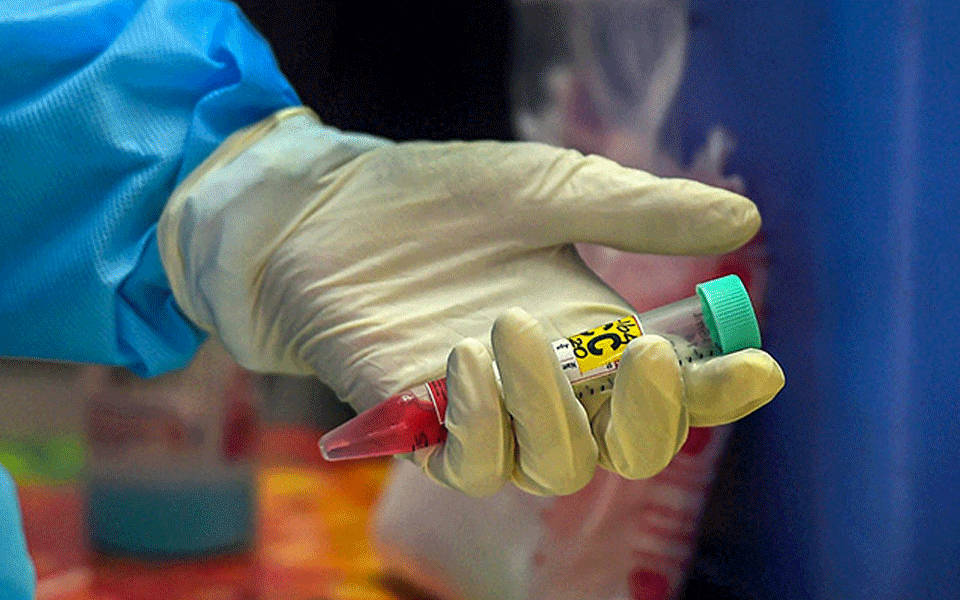
Moscow: President Vladimir Putin on Tuesday announced that Russia has developed the world's first vaccine against COVID-19 that works "quite effectively" and forms a "stable immunity" against the disease as he disclosed that one of his daughters has already been vaccinated.
"A vaccine against coronavirus has been registered for the first time in the world this morning," Putin said during a meeting with members of his government.
"I know that it works quite effectively, it forms a stable immunity," the official Tass news agency quoted Putin as saying.
Putin's claim has come amidst concerns raised by experts about the speed of Russia's work, suggesting that researchers might be cutting corners.
Amid fears that safety could have been compromised, the World Health Organization (WHO) urged Russia last week to follow international guidelines for producing a vaccine against COVID-19, the BBC reported.
The Russian vaccine is not among the WHO's list of six vaccines that have reached phase three clinical trials, which involve more widespread testing in humans, the report noted.
Putin said that one of his daughters had tested a Russian COVID-19 vaccine on herself and that she is feeling well. He said that the first Russian COVID-19 vaccine forms stable cell and antibody immunity.
"I know this very well, because one of my daughters got vaccinated, so in this sense, she took part in testing," Putin said.
The vaccine has been named Sputnik-V. The name is a reference to the surprise 1957 launch of the world's first satellite by the Soviet Union.
The treatment is yet to go through crucial Phase 3 trials where it would be administered to thousands of people.
President Putin noted that after the first vaccine shot, his daughter had a 38 C fever, and on the next day, a fever slightly higher than 37 C.
"And then, after the second shot, she had a slight fever again, and then everything was fine, she is feeling well and has a high [antibody] count," Putin said.
Russian Health Minister Mikhail Murashko said that clinical trials of the vaccine developed by the Gamaleya National Research Center for Epidemiology and Microbiology of the Russian Healthcare Ministry were over.
Medical workers and teachers will be the first to get the COVID-19 vaccine, he said.
"We will begin the stage-by-stage civilian use of the vaccine. First and foremost, we would like to offer vaccination to those who come into contact with infected persons at work. These are medical workers. And also those who are responsible for children's health - teachers," the minister said.
The vaccine has two separately-injected components that together are expected to build a long-term immunity against the virus, the Sputniknews reported.
Clinical trials of the vaccine kicked off on June 18 and included 38 volunteers. All of the participants developed immunity. The first group was discharged on July 15, the second group on July 20.
It will appear in circulation starting on January 1, 2021, the website of the State Register of Pharmaceuticals reported on Tuesday.
"Date of introduction to the civilian circulation - 01.01.2021," the site noted.
It had been reported that the Gamaleya centre has developed two forms of the vaccine - a liquid and a freeze-dried one. Health Minister Murashko said that the vaccine against the coronavirus infection will be produced in Russia on two sites.
Russia has received a request for the production of one billion doses of the COVID-19 vaccine from 20 states, head of the Russian Direct Investment Fund (RDIF) Kirill Dmitriev said during an online conference.
"We have received preliminary requests for the purchase of over 1 bln doses of the vaccine from 20 states. We are ready to ensure production of over 500 mln vaccine doses along with our foreign partners in five countries, and we plan to increase our production capacity further," he said.
According to Dmitriev, several Latin American, Middle Eastern and Asian states have expressed an interest in purchasing the Russian vaccine. Several contracts have been finalised.
He noted that the RDIF had agreed to hold the third stage of clinical trials of the COVID-19 vaccine abroad with the UAE, Saudi Arabia and other states.
According to the tally kept by Johns Hopkins University, coronavirus has infected more than 20 million people worldwide.
Let the Truth be known. If you read VB and like VB, please be a VB Supporter and Help us deliver the Truth to one and all.
Representative of Iran's Supreme Leader in India calls current situation 'no war, no peace'
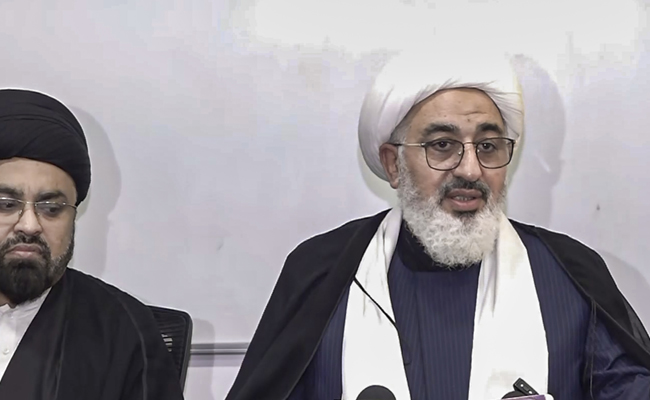
Bengaluru (PTI): Representative of Iran's Supreme Leader in India, Abdul Majeed Hakeem Ilahi on Saturday characterised the ongoing tensions between his country and the Israel-US alliance as a state of “no war, no peace”.
Calling for an immediate halt to the conflict, he said the global stability hinges on those who initiated the war.
He questioned why countries affected by the war and suffering from the energy crisis are not pressuring the US and Israel to stop the aggression.
Addressing a press conference here, Ilahi said Iran did not want the conflict, but was compelled to respond amid continued attacks, even as negotiations were expected to continue.
"Iran didn't want this war, but Iran was forced by the war and several times Iran tried to avoid this war... I don't know what is the condition of these people and these countries (US-Israel)... they want to impose on other countries what they want, and who gave them this authority?" he questioned.
Recalling the negotiations Iran held in Oman, he said talks later moved to Geneva and made progress before being disrupted by sudden attacks.
Ilahi claimed that airstrikes and missile attacks led to the deaths of Iran’s supreme leader Ayatollah Ali Khamenei, ministers, commanders and civilians.
"They killed a lot of civilians… They attacked a primary school, and they killed 175 innocent girls," he said, claiming over 4,000 deaths, more than 40,000 injuries, and widespread damage to houses, hospitals, universities and public infrastructure.
Despite these losses, he said Iran resisted calls for “unconditional surrender” and stood firm and defended itself.
"They wanted unconditional surrender. Which no one—no one can accept it. Iran said, 'Okay, we are ready to be sacrificed,' but we are not ready to submit ourselves," he added.
He argued that they (US-Israel) proposed the current ceasefire only after realising that they could not achieve any of their objectives after 40 days of conflict.
The envoy further claimed that the ceasefire is not an actual ceasefire, but a “no war, no peace” situation.
Explaining the current situation in Iran, he said conditions remain stable and people are going about their daily lives.
"They are working ....(leading) their ordinary life. They are working—they're going farming and they do everything....and they aren't scared of anything. And they are ready to defend themselves," he added.
Addressing the crisis in the Strait of Hormuz, he said the situation was stable before February 28 and all countries benefited from it.
"(For) 10,000 years, the Strait of Hormuz was open...and Iran daily yearly spent a lot for providing security in the Strait of Hormuz... so no one even complained anything about the Strait of Hormuz. Everyone was free...and even our enemies their warship was passing through the Strait of Hormuz," he said.
However, he linked the current maritime instability to the actions of the US and Israel.
"So Iran cannot do anything. Those people who initiated, created and started this war, they have to stop it. And everything will go back to normal," he said.
Criticising the mentality of the "great powerful country", Ilahi said, "they think they have the right to do whatever they want. It should change."
He sought to know why the countries affected by the conflict are not exerting pressure on the US and the "Zionist" regime to halt the war.
"Why are they not asking them? This crisis and problem by which a lot of countries are affected was created by them. A lot of factories are closed and even working days in some countries reduced... A lot of restaurants are closed," he said.
Seeking fairness and justice, Ilahi said instead of asking Iran, all those nations should ask those who initiated this war to stop it, by telling them, "we are suffering."
To a query on international mediation, Ilahi, referring to the US, asked, "Is it acceptable and reasonable that one country orders all countries -- you should not deal with this country, You should not purchase from this country. You should not have business with this country. You should not buy from this country."
Ilahi also highlighted Iran's long-standing ties with India and said, "It is a great country and we respect India and Indians."
"We have 5,000 years relationship and friendship. We are connected to India by education, by philosophy, by culture, by civilisation and by the economy," he said.
According to him, the bilateral cooperation remains strong, citing diplomatic engagement.
"At the moment also, our relationship, collaboration, cooperation with India is very good," he said, adding Iran allowing Indian ships to pass through Strait of Hormuz reflects the ties.
"Iran allowed Indian ships to pass through the Strait of Hormuz. Why? A lot of countries couldn't get this permission?... The relationship between Iran and India is very good," he added.
He expressed confidence that in future too, the ties between Iran and India will be strong.