Russia says it no longer will abide by its self-imposed moratorium on intermediate-range missiles

Moscow, Aug 5 (AP): Russia has declared that it no longer considers itself bound by a self-imposed moratorium on the deployment of nuclear-capable intermediate range missiles, a warning that potentially sets the stage for a new arms race as tensions between Moscow and Washington rise again over Ukraine.
In a statement Monday, the Russian Foreign Ministry linked the decision to efforts by the US and its allies to develop intermediate range weapons and preparations for their deployment in Europe and other parts of the world. It specifically cited US plans to deploy Typhoon and Dark Eagle missiles in Germany starting next year.
The ministry noted that such actions by the US and its allies create “destabilising missile potentials" near Russia, creating a "direct threat to the security of our country” and carry “significant harmful consequences for regional and global stability, including a dangerous escalation of tensions between nuclear powers.”
It didn't say what specific moves the Kremlin might take, but President Vladimir Putin has previously announced that Moscow was planning to deploy its new Oreshnik missiles on the territory of its neighbour and ally Belarus later this year.
“Decisions on specific parameters of response measures will be made by the leadership of the Russian Federation based on an interdepartmental analysis of the scale of deployment of American and other Western land-based intermediate-range missiles, as well as the development of the overall situation in the area of international security and strategic stability,” the Foreign Ministry said.
The Russian statement follows President Donald Trump's announcement Friday that he's ordering the repositioning of two US nuclear submarines “based on the highly provocative statements” of Dmitry Medvedev, who was president in 2008-12 to allow Putin, bound by term limits, to later return to the office. Trump's statement came as his deadline for the Kremlin to reach a peace deal in Ukraine approaches later this week.
Trump said he was alarmed by Medvedev's attitude. Medvedev, who serves as deputy chairman of Russia's Security Council chaired by Putin, has apparently sought to curry favor with his mentor by making provocative statements and frequently lobbing nuclear threats. Last week. he responded to Trump's deadline for Russia to accept a peace deal in Ukraine or face sanctions by warning him against “playing the ultimatum game with Russia” and declaring that “each new ultimatum is a threat and a step toward war.”
Medvedev also commented on the Foreign Ministry's statement, describing Moscow's withdrawal from the moratorium as “the result of NATO countries' anti-Russian policy.”
“This is a new reality all our opponents will have to reckon with,” he wrote on X. “Expect further steps.”
Intermediate-range missiles can fly between 500 to 5,500 kilometers (310 to 3,400 miles). Such land-based weapons were banned under the 1987 Intermediate-range Nuclear Forces (INF) Treaty. Washington and Moscow abandoned the pact in 2019, accusing each other of violations, but Moscow declared its self-imposed moratorium on their deployment until the US makes such a move.
The collapse of the INF Treaty has stoked fears of a replay of a Cold War-era European missile crisis, when the US and the Soviet Union both deployed intermediate-range missiles on the continent in the 1980s. Such weapons are seen as particularly destabilising because they take less time to reach targets, compared with intercontinental ballistic missiles, leaving no time for decision-makers and raising the likelihood of a global nuclear conflict over a false launch warning.
Russia's missile forces chief has declared that the new Oreshnik intermediate range missile, which Russia first used against Ukraine in November, has a range to reach all of Europe. Oreshnik can carry conventional or nuclear warheads.
Putin has praised the Oreshnik's capabilities, saying its multiple warheads that plunge to a target at speeds up to Mach 10 are immune to being intercepted and are so powerful that the use of several of them in one conventional strike could be as devastating as a nuclear attack.
Putin has warned the West that Moscow could use it against Ukraine's NATO allies who allowed Kyiv to use their longer-range missiles to strike inside Russia.
Let the Truth be known. If you read VB and like VB, please be a VB Supporter and Help us deliver the Truth to one and all.
Ruckus outside counting centre in Mamata's constituency, TMC claims entry of car with BJP flag
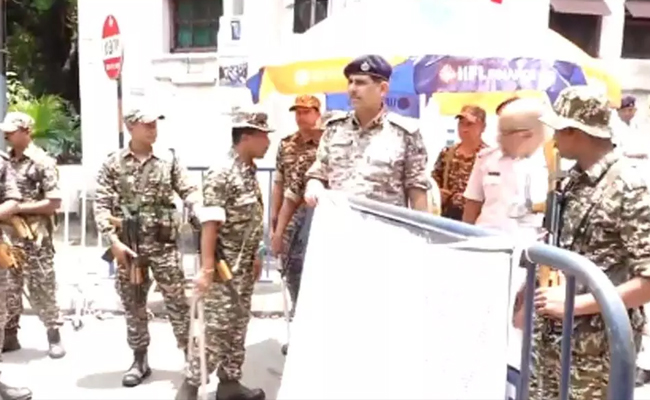
Kolkata (PTI): The counting centre at West Bengal Chief Minister Mamata Banerjee's Bhabanipur assembly constituency witnessed a ruckus a day ahead of the counting of votes, with TMC workers alleging two cars bearing the BJP's flag were allowed entry to the compound where EVMs are kept.
The incident comes close on the heels of a four-hour-long sit-in by Banerjee in front of the same counting centre at the Sakhawat Memorial Girls School on Thursday night, alleging unauthorised entry of persons into the strongroom.
With the polling now over, the wrangling for power in West Bengal has turned into a battle of nerves between the incumbent TMC and the BJP. Workers and leaders of both parties have been keeping a steely gaze on the security of strongrooms across the state where the electoral fate of the candidates is sealed.
Despite expressing her confidence in a "landslide victory", Banerjee has repeatedly aired her apprehensions of "counting malpractice and EVM tampering ahead of the day of results".
On Sunday morning, TMC workers camping 100 metres from the counting centre alleged that two cars with BJP flags entered the premises and went near the strongroom.
"The CAPF personnel at the spot are not allowing any vehicle or person to enter the premises of the counting centre without valid identity proof. Then how come this car, which we have not seen in the past few days, was allowed entry? Once we protested, the central forces asked us to move 100 metres away," a TMC activist said.
The TMC claimed that while the police personnel posted there promised the vehicle would be removed from the spot, it remained there for some time.
A senior Election Commission official said the car was passing by the Harish Mukherjee Road, and after checking by security forces and police, it was allowed to leave as nothing objectionable was found in it.
On Thursday night, two counting centres, including one at Sakhawat Memorial Girls School in the city, witnessed high drama after TMC leaders alleged a lack of transparency and possible malpractice at the strongrooms housing sealed EVMs of the assembly polls, which concluded on April 29.
TMC leaders and candidates, Sashi Panja and Kunal Ghosh, held a sit-in outside the Khudiram Anushilan Kendra counting centre on Thursday evening, alleging unauthorised activities inside the strongroom amid the absence of TMC agents
In Howrah, TMC protested renovation work by the public works department at a place adjacent to the strongroom, and the EC stopped the work temporarily.
On Saturday, the ruling party filed a complaint with the poll panel, alleging unauthorised sorting of postal ballot covers at the EVM strongroom in Khudiram Anushilan Kendra.
Similar scenes were witnessed on Saturday outside the strongrooms at Asansol College in Paschim Bardhaman and the Barasat Government College in North 24 Parganas districts, where TMC workers held protests, alleging that CCTV cameras were switched off for several minutes.
The EC turned down all allegations, saying the surveillance cameras were working in an uninterrupted manner.
BJP spokesperson Sajal Ghosh told reporters that the people of Bengal were finding it "hilarious" that the TMC, "which used to win elections through unfair means and strongarm tactics" were now coming up with all sorts of "frivolous charges".
"Are they scared of losing?" he posed.