Russian ambassador to Poland attacked with red paint
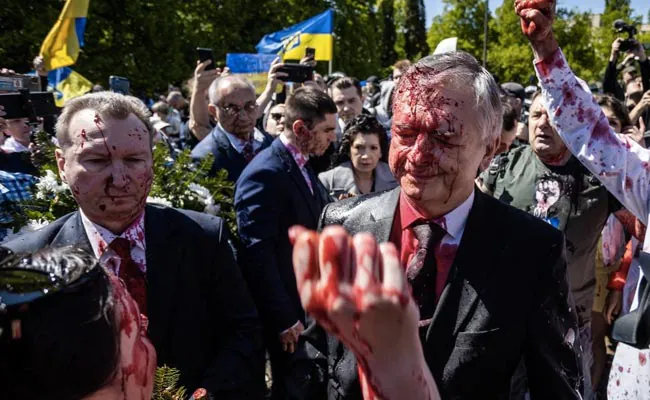
Warsaw, May 9: Russia's ambassador to Poland was splattered with red paint thrown at him by protesters opposed to the war in Ukraine, preventing him from paying respects on Monday at a Warsaw cemetery to Red Army soldiers who died during World War II.
Russian Foreign Ministry spokeswoman Maria Zakharova denounced the attack, saying on her messaging app channel that we won't be scared while the people of Europe should be scared to see their reflection in a mirror.
Ambassador Sergey Andreev arrived at the Soviet soldiers' cemetery to lay flowers on Victory Day, which marks the defeat of Nazi Germany by the Allies.
The major Russian patriotic holiday was celebrated with pomp in a parade at Red Square in Moscow.
As he arrived at the Soviet Military Cemetery in the Polish capital, Andreev was met by hundreds of activists opposed to Russia's war in Ukraine.
The protesters first snatched away a wreath of flowers that he had intended to lay at the cemetery and trampled it.
Red paint was thrown from behind at him before a protester standing beside him threw a big blob of it in his face.
The protesters carried Ukrainian flags and chanted fascists and murderers" at him, in Russian, while some were dressed in white sheets smeared with red, symbolising the Ukrainian victims of Russia's war.
Other people in his entourage were also seen splattered with what appeared to be red paint.
Zakharova said that admirers of the neo-Nazis have once again shown their face. She said that along with the removal of monuments to Soviet army World War II heroes, the attack reflected the course for the reincarnation of fascism.
Some Russian commentators suggested that the attack on the ambassador could prompt Moscow to recall him and ask the Polish ambassador to leave.
The Polish government faced criticism for not providing the ambassador with more security, allowing for an incident to occur that Russia could use to depict Poland as hostile to Moscow.
Among the critics was a former interior minister, Bartlomiej Sienkiewicz, who said he couldn't understand why there wasn't more protection for the ambassador when for weeks you could feel how May 9 could end in Warsaw.
Poland's current interior minister, however, noted that Poland's government had advised the Russian ambassador against laying flowers at the cemetery, and noted that police allowed him to safely leave the scene.
The gathering of opponents of Russian aggression against Ukraine, where the crime of genocide takes place every day, was legal, Interior Minister Mariusz Kaminski added.
The emotions of Ukrainian women taking part in the demonstration, whose husbands are fighting bravely in defense of their homeland, are understandable.
Protesters also marched in Warsaw on Sunday evening to protest the war, bringing a tank on a tractor and parking it in front of the Russian Embassy.
Since the war began on Feb. 24, images of Ukrainian tractors hauling off Russian tanks have been symbols of Ukrainian resistance.
The Soviet cemetery is set amid a vast park on the route linking downtown to the international airport.
It is the final resting place of more than 20,000 Red Army soldiers who perished on Polish soil fighting while helping to defeat Nazi Germany.
While Poland has removed some monuments to the Red Army in the decades since it threw off Moscow-backed communist rule, it has allowed the cemetery to remain undisturbed.
Though Soviet soldiers defeated the Nazis, earlier in the war the Soviet forces had invaded Poland following a secret agreement with the German Nazi government, and carried out atrocities against Poles, including mass executions and deportations to Siberia.
The Russian ambassador to Poland was attacked as he tried to lay a wreath at the Soviet soldiers' cemetery in Warsaw. pic.twitter.com/FFtBzuRITW
— RadioGenova (@RadioGenova) May 9, 2022
Let the Truth be known. If you read VB and like VB, please be a VB Supporter and Help us deliver the Truth to one and all.
EAM Jaishankar meets Jamaican PM, gifts over 10 BHISHM Cubes
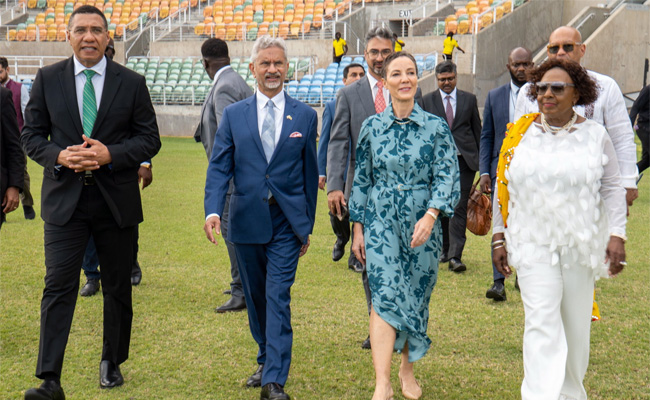
Kingston (PTI): External Affairs Minister S Jaishankar on Monday met Jamaican Prime Minister Andrew Holness and discussed ways to further deepen "political, economic and people-to-people cooperation."
Jaishankar also conveyed greetings from Prime Minister Narendra Modi to Holness.
"Pleased to call on Prime Minister @AndrewHolnessJM in Kingston. Conveyed the greetings of PM @narendramodi," Jaishankar posted on X.
"Discussed deepening our political, economic and people-to-people cooperation. Value his commitment towards further strengthening India-Jamaica relations," the post further read.
Also, the external affairs minister handed over 10 BHISHM (Bharat Health Initiative for Sahyog Hita & Maitri) Cubes as a gift to Jamaica.
"Formally handed over 10 BHISHM Cubes as a gift from India to Jamaica, in the presence of PM @AndrewHolnessJM, Health Minister @christufton and FM @kaminajsmith," Jaishankar posted on X.
"The BHISHM Cube mobile hospital system, designed for rapid deployment, will help Jamaica during disasters and emergencies. The gift of these cubes is a statement of friendship, a commitment to disaster preparedness, and an outcome of innovation," the post said.
Jaishankar arrived in Kingston on Saturday evening, marking the first leg of his nine-day tour of Jamaica, Suriname, and Trinidad and Tobago, aimed at further strengthening India's strategic and cultural ties with the Caribbean nations.
Earlier in the day, he interacted with the Indian diaspora and discussed India's ongoing transformation in infrastructure, human development and technology-driven governance and entrepreneurship with them.
He also highlighted the cricket bond between both countries as India gifted a scoreboard to Jamaica.
A scoreboard was dedicated at Sabina Park in Kingston. It is the home of the Jamaica cricket team and is the only Test cricket ground in the Caribbean island nation.
The minister expressed hope that the new scoreboard would witness many memorable innings, including those symbolising the enduring friendship between the two countries.
Cricket has long been a strong cultural bridge between India and Jamaica, which is part of the West Indies cricket team.
Jamaican players, including Chris Gayle, Courtney Walsh and Michael Holding, have played a major role in shaping the legacy of West Indies cricket in the international arena, contributing to its dominance in earlier decades and its continued global appeal.