Russian general was killed by bomb in Moscow. Ukraine official says secret service was behind it

Moscow (AP/PTI): A senior Russian general was killed Tuesday by a bomb hidden in a scooter outside his apartment building in Moscow, a day after Ukraine's security agency levelled criminal charges against him.
A Ukrainian official said the country's security service carried out the attack.
Lt. Gen. Igor Kirillov, the chief of the military's nuclear, biological and chemical protection forces, was killed as he left for his office.
Kirillov's assistant also died in the bombing, which was triggered remotely, according to Russian news reports. Images from the scene showed shattered windows and scorched and blackened brickwork.
Kirillov was under sanctions from several countries, including the UK and Canada, for his actions in Moscow's war in Ukraine. On Monday, Ukraine's Security Service, or SBU, opened a criminal investigation against him, accusing him of directing the use of banned chemical weapons.
An official with the SBU said the agency was behind the attack. The official, who spoke on condition of anonymity because they were not authorised to release the information, described Kirillov as a “war criminal and an entirely legitimate target.”
The SBU has said it recorded more than 4,800 occasions when Russia used chemical weapons on the battlefield since its full-scale invasion in February 2022. In May, the US State Department said in a statement that it had recorded the use of chloropicrin, a poison gas first deployed in World War I, against Ukrainian troops.
Russia has denied using any chemical weapons in Ukraine and, in turn, has accused Kyiv of using toxic agents in combat.
Kirillov, who took his current job in 2017, was one of the most high-profile figures to level those accusations. He held numerous briefings to accuse the Ukrainian military of using toxic agents and planning to launch attacks with radioactive substances — claims that Ukraine and its Western allies rejected as propaganda.
Since Russia invaded Ukraine, several prominent figures have been killed in targeted attacks.
Darya Dugina, a commentator on Russian TV channels and the daughter of Kremlin-linked nationalist ideologue Alexander Dugin, died in a 2022 car bombing that investigators suspected was aimed at her father.
Vladlen Tatarsky, a popular military blogger, died in April 2023, when a statuette given to him at a party in St. Petersburg exploded. A Russian woman, who said that she presented the figurine on orders of a contact in Ukraine, was convicted in the case and handed a 27-year sentence.
In December 2023, Illia Kiva, a former pro-Moscow Ukrainian lawmaker who fled to Russia, was shot and killed near Moscow. The Ukrainian military intelligence lauded the killing, warning that other “traitors of Ukraine” would share the same fate.
On Dec. 9, an explosive device was placed under a car in the Russian-occupied Ukrainian city of Donetsk, reportedly targeting Sergei Yevsyukov, the former head of the Olenivka Prison where dozens of Ukrainian prisoners of war died in a missile strike in July 2022. One other was injured in the blast. Russian authorities said they detained a suspect in the attack.
Let the Truth be known. If you read VB and like VB, please be a VB Supporter and Help us deliver the Truth to one and all.
“Goli maro…” slogan raised as ABVP-linked group disrupts play at University of Hyderabad
Hyderabad: A group allegedly linked to the Akhil Bharatiya Vidyarthi Parishad (ABVP) disrupted a theatre performance at the University of Hyderabad on Sunday evening. The group is also accused of vandalising property and assaulting students.
Slogans such as “Desh ke gaddaron ko, goli maro…” were raised during the incident, according to eyewitnesses.
According to the Observer Post, the disruption happened as Mahesh Elkunchwar's play Holi was being staged at the Department of Theatre Arts' GB Hall. The group reportedly objected to certain portions of the play, claiming that some phrases hurt religious sentiments.
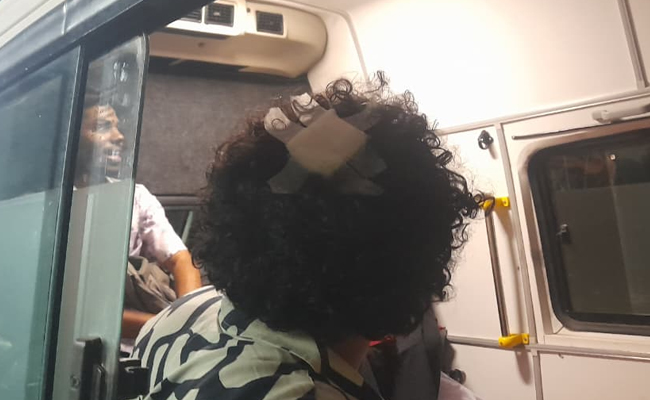
According to accounts from those present, the situation escalated when individuals forced their way into the venue after damaging fixtures and breaking glass panels outside the auditorium. Students attempting to intervene were reportedly assaulted, and a guest faculty member was allegedly threatened.
Several students sustained injuries and were provided initial treatment at the campus health centre before being shifted to a nearby hospital.
Police later arrived at the scene, brought the situation under control, and escorted those inside the hall to safety. Witnesses said tensions remained high, with some members of the group continuing to raise slogans during the evacuation.