Russians are voting in an election that holds little suspense after Putin crushed dissent
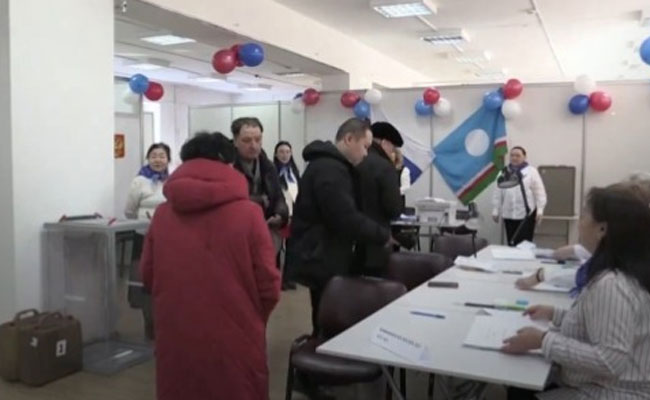
Moscow (AP/PTI): Voters headed to the polls in Russia on Friday for a three-day presidential election that is all but certain to extend President Vladimir Putin's rule by six more years after he stifled dissent.
The election takes place against the backdrop of a ruthless crackdown that has crippled independent media and prominent rights groups and given Putin full control of the political system.
It also comes as Moscow's war in Ukraine enters its third year. Russia has the advantage on the battlefield, where it is making small, if slow, gains. Ukraine, meanwhile, has made Moscow look vulnerable behind the front line: Long-range drone attacks have struck deep inside Russia, while high-tech drones have put its Black Sea fleet on the defensive.
Voters are casting their ballots Friday through Sunday at polling stations across the vast country's 11 time zones, as well as in illegally annexed regions of Ukraine. Russians also can vote online, the first time the option has been used in a presidential contest; more than 200,000 people in Moscow voted online soon after the polls opened, authorities said.
The election holds little suspense since Putin, 71, is running for his fifth term virtually unchallenged. His political opponents are either in jail or in exile abroad, and the fiercest of them, Alexei Navalny, died in a remote Arctic penal colony last month. The three other candidates on the ballot are low-profile politicians from token opposition parties that toe the Kremlin's line.
Observers have little to no expectation that the election will be free and fair. Beyond the fact that voters have been presented with little choice, the possibilities for independent monitoring are very limited.
Only registered candidates or state-backed advisory bodies can assign observers to polling stations, decreasing the likelihood of independent watchdogs. With balloting over three days in nearly 100,000 polling stations in the country, any true monitoring is difficult anyway.
"The elections in Russia as a whole are a sham. The Kremlin controls who's on the ballot. The Kremlin controls how they can campaign. To say nothing of being able to control every aspect of the voting and the vote-counting process," said Sam Greene, director for Democratic Resilience at the Center for European Policy Analysis in Washington.
Ukraine and the West have also condemned Russia for holding the vote in Ukrainian regions that Moscow's forces have seized and occupied.
In many ways, Ukraine is at the heart of this election, political analysts and opposition figures say. They say Putin wants to use his all-but-assured electoral victory as evidence that the war and his handling of it enjoys widespread support. The opposition, meanwhile, hopes to use the vote to demonstrate their discontent with both the war and the Kremlin.
The Kremlin banned two politicians from the ballot who sought to run on an antiwar agenda and attracted genuine albeit not overwhelming support, thus depriving the voters of any choice on the "main issue of Russia's political agenda," said political analyst Abbas Gallyamov, who used to work as Putin's speechwriter.
Russia's scattered opposition has urged those unhappy with Putin or the war to show up at the polls at noon on Sunday, the final day of voting, in protest. The strategy was endorsed by Navalny not long before his death.
"We need to use election day to show that we exist and there are many of us, we are actual, living, real people and we are against Putin. ... What to do next is up to you. You can vote for any candidate except Putin. You could ruin your ballot," his widow, Yulia Navalnaya, said.
How well this strategy will work remains unclear.
Golos, Russia's renowned independent election observer group, said in a report this week that authorities were "doing everything so that the people don't notice the very fact of the election happening."
The watchdog described the campaign ahead of the vote as "practically unnoticeable" and "the most vapid" since 2000, when Golos was founded and started monitoring elections in Russia.
Putin's campaigning was cloaked in presidential activities, and other candidates were "demonstrably passive," the report said.
State media dedicated less airtime to the election than in 2018, when Putin was last elected, according to Golos. Instead of promoting the vote to ensure a desired turnout, authorities appear to be betting on pressuring voters they can control for instance, Russians who work in state-run companies or institutions to show up at the polls, the group said.
The watchdog itself has also been swept up in the crackdown: Its co-chair, Grigory Melkonyants, is in jail awaiting trial on charges widely seen as an attempt to pressure the group ahead of the election.
"The current elections will not be able to reflect the real mood of the people," Golos said in the report. "The distance between citizens and decision-making about the fate of the country has become greater than ever."
Let the Truth be known. If you read VB and like VB, please be a VB Supporter and Help us deliver the Truth to one and all.
Telangana rains: Four farmers dead, three injured as sheds collapse in Mancherial
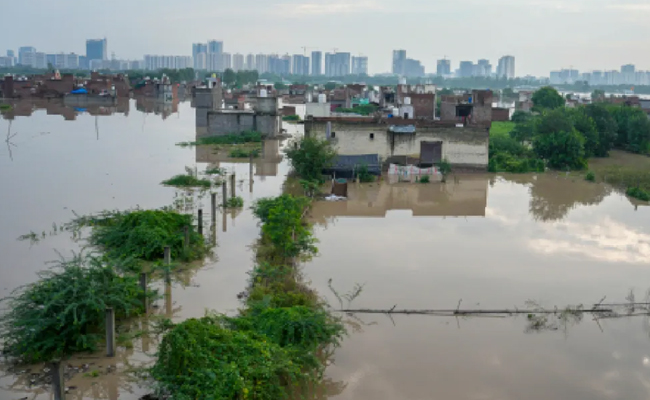
Karimnagar (Telangana) (PTI): Four farmers died, and three others were injured after tin-roofed sheds and dilapidated structures collapsed in two separate incidents in Mancherial district of Telangana, officials said on Wednesday.
The incidents occurred in two villages of Luxettipet mandal late on Tuesday night, when the farmers were taking shelter in the structures following heavy rain and strong winds.
According to officials, two people died when a shed caved in at Kothuru village.
In a separate incident in Gampalapalli village, two more persons died after another structure collapsed, police and district authorities said.
The three injured were shifted to a hospital in Karimnagar for treatment, police said.
Preliminary reports indicate that unseasonal rains accompanied by strong winds weakened the structures, leading to the collapses.
Authorities are assessing the situation, and further investigation is underway.