Secret documents reveal how China mass detention camps work
Beijing, Nov 25: The Chinese government has detained more than a million Uighurs, Kazakhs and other ethnic minorities for what it calls voluntary job training.
But a newly revealed classified blueprint shows that the camps Beijing runs in China's far west are instead secret centers for forced ideological and behavioral re-education.
The confidential documents, leaked to a consortium of international journalists, lay out the Chinese government's deliberate strategy to lock up minorities, most of whom are Muslims, to rewire their thoughts and even the language they speak.
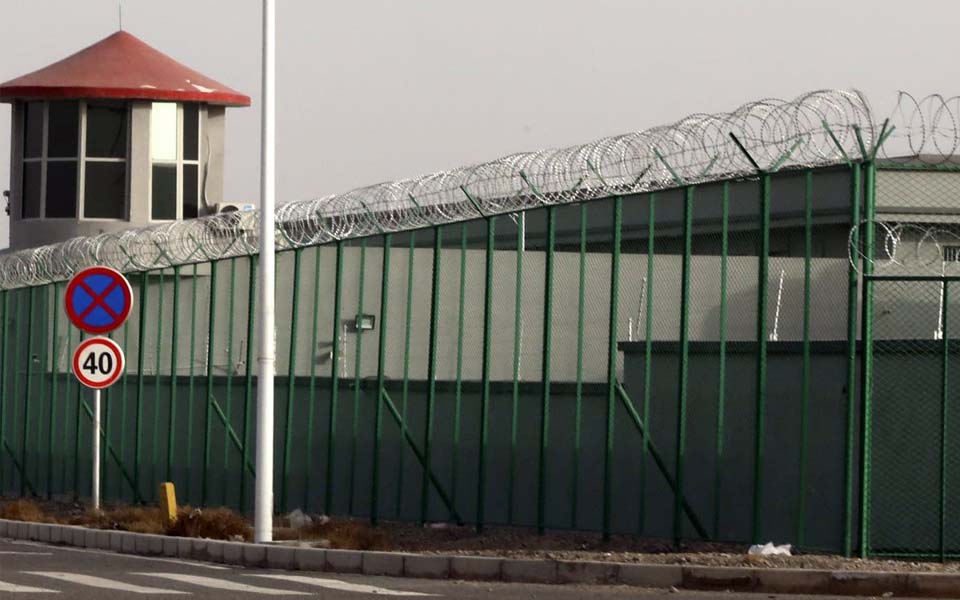
The documents stipulate watch towers, double-locked doors and blanket video surveillance "to prevent escapes."

A sample of classified Chinese government documents leaked to a consortium of news organizations, is displayed for a picture in New York, Friday, Nov. 22, 2019. Beijing has detained more than a million Uighurs, ethnic Kazakhs and other Muslim minorities for what it calls voluntary job training. The confidential documents lay out the Chinese government’s deliberate strategy to lock up ethnic minorities to rewire their thoughts and even the language they speak. (AP Photo/Richard Drew)
They describe an elaborate scoring system that grades detainees on how well they speak the dominant Mandarin language, memorise ideology and adhere to strict rules on everything down to bathing and using the toilet.
They also show how Beijing is pioneering a new form of social control using data and artificial intelligence.
With the help of mass surveillance technology, computers issued the names of tens of thousands of people for interrogation or detention in just one week, including university students and party officials who wouldn't need vocational training.
Taken as a whole, the documents give the most significant description yet of how the mass detention camps work in the words of the Chinese government itself.
Experts say they spell out a vast system that targets, surveils and grades entire ethnicities to forcibly assimilate them especially Uighurs, a Turkic minority of about 10 million with their own language and culture.
"They confirm that this is a form of cultural genocide," said Adrian Zenz, a leading security expert in the far western region of Xinjiang, where many Uighurs live.
"It really shows that from the onset, the Chinese government had a plan."
Zenz said the documents echo the aim of the camps as outlined in a 2017 report from a local branch of the Xinjiang Ministry of Justice: To "wash brains, cleanse hearts, support the right, remove the wrong."
China has struggled for decades to control Xinjiang, where hundreds, both Uighurs and Han Chinese, have died in terror attacks, reprisals and race riots.
In 2014, Chinese President Xi Jinping launched what he called a "People's War on Terror" in response to terror attacks carried out by radical Uighur militants.
In late 2016, the crackdown intensified dramatically when Xi named Chen Quanguo, a hardline official transferred from Tibet, as Xinjiang's new head. Most of the documents were issued in 2017.
"Since the measures have been taken, there's no single terrorist incident in the past three years," said a written response from the Chinese Embassy in the United Kingdom.
"Xinjiang is much safer....The so-called leaked documents are fabrication and fake news."
The statement said that religious freedom and the personal freedom of detainees was "fully respected" in Xinjiang.
The documents came from an anonymous source, and the International Consortium of Investigative Journalists verified them by consulting experts, cross-checking content and comparing signatures.
They consist of a notice with guidelines for the camps, four bulletins on how to use technology to target people, and a court case sentencing a local Uighur party official to 10 years in prison for telling colleagues not to say dirty words, watch porn or eat without praying.
Issued to rank-and-file officials by the powerful Xinjiang Communist Party Political and Legal Affairs Commission, the documents confirm what is known about the camps from the testimony of Uighurs and Kazakhs, satellite imagery and highly restricted visits by journalists to the region.
Erzhan Qurban, a Chinese-born ethnic Kazakh, was held for nine months because he had spent time abroad in Kazakhstan.
Qurban said he was locked in a cell with 10 others last year, forced to sit rigidly for hours and forbidden to pray or even talk.
"It wasn't education, it was just punishment," said Qurban.
"I was treated like an animal."
Other detainees have said there was torture or rape at the camps.
The documents show direct links between the internment camps and the extreme digital surveillance in Xinjiang.
One document states that the purpose of the surveillance is "to prevent problems before they happen."
This is done through a system called the Integrated Joint Operations Platform or IJOP, built by a state-owned military contractor.
The IJOP spat out the names of people considered suspicious for behaviour that includes going abroad, asking others to pray or using cell phone apps that cannot be monitored by the government.
These people were then called in for questioning and funneled into different parts of the system, from house arrest to detention centers with three levels of monitoring to prison.
Once inside, the documents show, detainees are subject to forced indoctrination.
The first item listed as part of the curriculum is ideological education.
It is partly rooted in the ancient Chinese belief in transformation through education - taken before to terrifying extremes during the mass thought reform campaigns of Mao Zedong's Cultural Revolution.
The indoctrination goes along with "manner education," where behaviour is dictated, including ensuring "timely haircuts and shaves," "regular change of clothes" and "bathing once or twice a week."
Let the Truth be known. If you read VB and like VB, please be a VB Supporter and Help us deliver the Truth to one and all.
AIITA welcomes Karnataka’s ban on obscene songs in school events
Bhatkal: The Karnataka unit of the All India Ideal Teachers Association (AIITA) has welcomed the Karnataka government’s decision to strictly ban school children from dancing to obscene songs during educational and cultural programmes in government, aided, and private schools across the state.
AIITA Karnataka State President M. R. Manvi congratulated the government for taking what he termed an important step to preserve the sanctity of education.
“Such decisions to safeguard the dignity of school children and uphold the values of education are the need of the hour. This rule should not be limited to government schools alone but must be strictly implemented in all private educational institutions as well,” he said.
He further urged the government to address other concerns within school programmes.
“The government should not only prohibit obscene dances in the name of school anniversaries, but also ensure that plays and dialogues that incite religious hatred are avoided. Schools should be centres of harmony, not platforms for spreading hatred,” he added.
According to a recent circular issued by the Department of School Education and Literacy, obscene dances are adversely affecting the mental health and moral values of students.
In this regard, schools have been advised to use songs that promote nationalism, positive thinking, the greatness of Kannada culture, and value-based traditions instead of inappropriate content during programmes.
The circular also emphasises that students should be dressed in decent attire.
AIITA also backed the department’s warning that disciplinary action would be taken against head teachers if such guidelines are violated. The association has further demanded that district Deputy Directors of Public Instruction strictly monitor the implementation of these rules.