Several European Union nations halt UK flights, fearing Covid-19 variant
New coronavirus strain up to 70% more transmissible
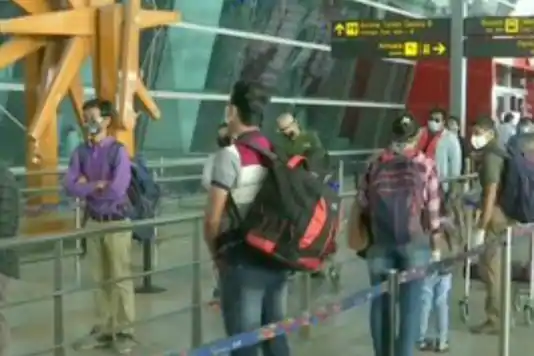
Berlin, Dec 20: Several European Union nations moved to banned flights from the UK on Sunday and others were considering similar action, in a bid to block a new strain of coronavirus sweeping across southern England from establishing a strong foothold on the continent.
France, Germany, the Netherlands, Belgium, Austria and Italy all announced restrictions on UK travel, hours after British Prime Minister Boris Johnson announced that Christmas shopping and gatherings in southern England must be canceled because of rapidly spreading infections blamed on the new coronavirus variant.
Johnson immediately put those regions into a strict new Tier 4 restriction level, upending Christmas plans for millions.
France banned all travel from the UK for 48 hours from midnight Sunday, the prime minister's office announced. The French statement said the short two-day period would buy authorities time to find a common doctrine on how to deal with the threat.
It specified that flows of people or transport to the UK are not affected.
The German government said it was banning flights coming from Britain in reaction to the new coronavirus strain. The transportation ministry said all UK.flights with the exception of cargo flights were no longer allowed to land in Germany starting at midnight Sunday. It didn't immediately say how long the flight ban would last, but news agency dpa reported it would be in place at least until Dec. 31.
Germany, which holds the rotating EU presidency, also called a special crisis meeting on Monday to coordinate the response to the virus news among the bloc's 27 member states.
The Netherlands banned flights from the U.K. for at least the rest of the year while Belgium issued a flight ban for 24 hours starting at midnight and also halted train links to Britain, including the Eurostar. Austria and Italy said they would halt flights from the U.K. but did not say exactly when that would take place.
Italy's health minister, Roberto Speranza, said an order signed Sunday blocks flights from Britain and prohibits entry into Italy by anyone who has been in the UK in the last 14 days. The order bans plane travel until Jan. 6.
The Czech Republic imposed stricter quarantine measures from people arriving from Britain.
High-speed train operator Eurostar canceled its trains between London, Brussels and Amsterdam beginning Monday, but kept trains operating on the London-to-Paris route.
Johnson said Saturday that a fast-moving new variant of the virus that is 70% more transmissible than existing strains appeared to be driving the rapid spread of new infections in London and southern England in recent weeks.
But he stressed there's no evidence to suggest it is more lethal or causes more severe illness, or that vaccines will be less effective against it.
Belgian Prime Minister Alexander De Croo said Sunday he was issuing the flight ban for 24 hours starting at midnight out of precaution. There are a great many questions about this new mutation, he said, adding he hoped to have more clarity by Tuesday.
Beyond Europe, Israel also said it was banning flights from Britain, Denmark and South Africa because those were the countries where the mutation is found.
The World Health Organization tweeted late Saturday that it was "in close contact with U.K. officials on the new #COVID19 virus variant" and promised to update governments and the public as more is learned.
The new strain was identified in southeastern England in September and has been spreading in the area ever since, a WHO official told the BBC on Sunday.
What we understand is that it does have increased transmissibility, in terms of its ability to spread, said Maria Van Kerkhove, WHO's technical lead on COVID-19.
Studies are under way to better understand how fast it spreads and and whether it's related to the variant itself, or a combination of factors with behavior, she added.
She said the strain had also been identified in Denmark, the Netherlands and Australia, where there was one case that didn't spread further.
The longer this virus spreads, the more opportunities it has to change, she said.
So we really need to do everything we can right now to prevent spread." Viruses mutate regularly, and scientists have found thousands of different mutations among samples of the virus causing COVID-19. Many of these changes have no effect on how easily the virus spreads or how severe symptoms are.
British health authorities said that while the variant has been circulating since September, it wasn't until the last week that officials felt they had enough evidence to declare that it has higher transmissibility than other circulating coronaviruses.
Patrick Vallance, the British government's chief scientific adviser, said officials are concerned about the new variant because it contained 23 different changes, an unusually large number of variants affecting how the virus binds to and enters cells in the body.
Officials aren't certain whether it originated in the U.K., Vallance added. But by December, he said it was causing over 60% of infections in London.
US President-elect Joe Biden's nominee for US surgeon general said Sunday that the emergence of the new strain doesn't change the public health guidance on precautions for reducing the spread of the virus, such as wearing masks, social distancing and washing hands.
Let the Truth be known. If you read VB and like VB, please be a VB Supporter and Help us deliver the Truth to one and all.
MP boat tragedy: Death toll climbs to 12; search on for one missing person
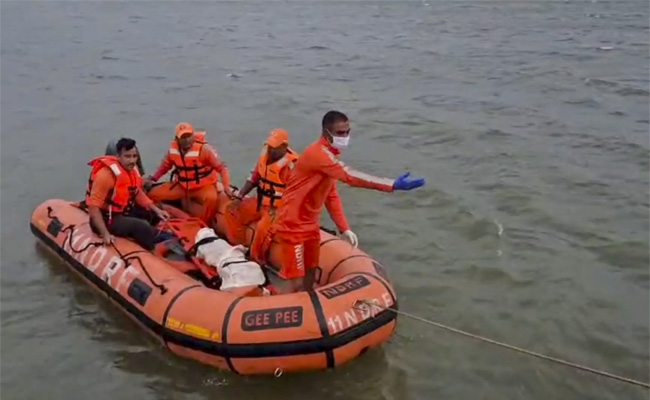
Jabalpur (PTI): The body of a 5-year-old boy was recovered from the Bargi Dam in Madhya Pradesh's Jabalpur district on Sunday morning, taking the death toll in the cruise boat tragedy to 12, while search continued for one missing person, police said.
The boat, around 20 years old and operated by the state tourism department, capsized during a storm on Thursday evening.
The body of Mayuram (5) has been fished out of the dam. Search is underway for Kamraj (aged around 50), an employee of the Ordnance Factory in Khamaria, Bargi police station house officer (SHO) Neelesh Dohare told PTI.
More than 200 rescuers, including around 20 Army divers airlifted from Agra, National Disaster Response Force, State Disaster Response Force and local divers, were searching for the man 40-50 feet deep in the water in a radius of 5 km, according to police.
Of the 41 identified passengers on board the ill-fated vessel, 28 were rescued after the incident, police earlier said.
The CCTV footage near the boarding point showed 43 people heading towards the boat, while the identities of 41 passengers have been confirmed so far, they said.
The state government on Friday ordered a probe into the tragedy and dismissed three crew members. It also banned the operation of similar vessels in the state.