Several Indians face deportation as ‘Pay to Stay’ visa racket busted in US
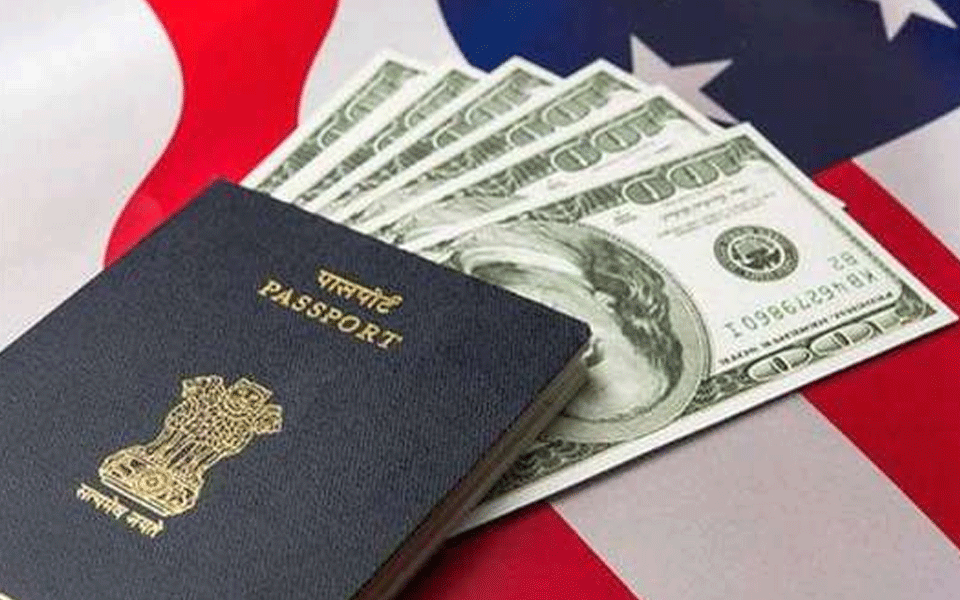
Washington, Jan 31: Several foreigners, including from India, face deportation from the US after authorities busted a "pay to stay" visa racket and arrested eight persons on charges of fraudulently facilitating at least 600 immigrants to illegally remain in the country.
In late-night and pre-dawn raids, the US Immigration and Customs Enforcement (ICE) agents arrested eight foreigners all of whom are either Indian nationals or Indian Americans for aiding foreign nationals to remain in the United States illegally by actively recruiting them to enrol into a fake university in Farmington Hills in Metro Detroit.
Without the knowledge of the conspirators, the university was operated by special agents of the Homeland Security Investigations (HIS) as part of an undercover operation, from a small building in Detroit area. Information made available on the website of this university in particular those related to admissions leaves a lot of questions.
Simultaneously, the ICE also has started detaining foreign students of this fake university and started the process of their deportation.
"Vast majority" of those arrested and detained are Indian nationals, an ICE official told PTI.
"Special agents from ICE's Homeland Security Investigations arrested eight on criminal charges as part of an investigation into potential abuses of the US student visa system," the official said.
In their late 20s or early 30s, those arrested by the ICE include Barath Kakireddy, Suresh Kandala, Phanideep Karnati, Prem Rampeesa, Santosh Sama, Avinash Thakkallapally, Aswanth Nune, and Naveen Prathipati. Six of them were arrested in Detroit area while the other two in Virginia and Florida.
According to an indictment unsealed in a local court Wednesday, these eight individuals helped at least 600 foreign nationals stay in the US illegally.
"As part of this investigation, numerous foreign nationals face administrative immigration violations. Those individuals will be placed in removal proceedings, and ICE will seek to maintain them in its custody pending the outcome of those proceedings," the ICE official told PTI.
The Indian Embassy here and its consulates are in touch with student organisations and offered help. It is also in touch with US authorities.
According to the indictment, from February 2017 to January 2019, a group of foreign citizens, conspired with each other and others to fraudulently facilitate hundreds of foreign nationals in illegally remaining and working in the US by actively recruiting them to enrol into the university.
The university was part of a federal law enforcement undercover operation designed to identify recruiters and entities engaged in immigration. The university had no staff, no teachers, and conducted no real classes.
As part of the scheme, the indictment said, the defendants and recruiters assisted foreign citizen "students" in fraudulently obtaining immigration documents from the school and facilitated the creation of false student records, including transcripts, for the purpose of deceiving immigration authorities.
The illegal documents obtained as a result of the conspirators' actions were based on false claims, false statements, and fraud since the purported foreign students had no intention of attending school, nor attended a single class, and were not bona fide students, federal prosecutors said.
Noting that all participants in the scheme knew that the school had no instructors or actual classes, the ICE said the defendants intended to help shield and hide their customers "students" from US immigration authorities for money and collectively profited in excess of a quarter of a million dollars as a result of their scheme.
"We are all aware that international students can be a valuable asset to our country, but as this case shows, the well-intended international student visa programme can also be exploited and abused," stated US Attorney Matthew Schneider.
"Homeland Security Investigations special agents uncovered a nationwide network that grossly exploited US immigration laws," said Special Agent Charge Francis.
"Each of the foreign citizen who enrolled and made tuition payments to the university knew that they would not attend accrual classes, earn credits or make progress towards an actual degree in a particular field of study a pay to stay scheme," the indictment said.
"Rather their intent was to fraudulently maintain their student visa status and to obtain work authorisation under the CPT (Curricular Practical Training) programme," it said.
This is the second such case when Department of Homeland Security has used a fake university to unearth a fake student visa racket. In 2016, the ICE had arrested some 21 people for similar charges for a fake University of Northern New Jersey.
Meanwhile, social media chatter on various platform in particular those from Andhra Pradesh and Telangana -- indicated that the ICE raids were carried out in various cities across the US -- Columbus Ohio; Houston in Texas, Atlanta in Georgia, St Louis in Missouri and New York and New Jersey.
In a statement posted on its website Reddy & Neumann group of immigration attorney said that it has received multiple reports that the ICE raided multiple worksites containing CPT students authorised by the University of Farmington, located in Farmington Hills, Michigan.
Let the Truth be known. If you read VB and like VB, please be a VB Supporter and Help us deliver the Truth to one and all.
Online fraud: Hotel chef from Udupi cheated of over Rs 1 lakh by WhatsApp contact
Udupi: Udupi City Police have registered a case of online fraud after a 62-year-old hotel chef was allegedly cheated of Rs 1.13 lakh by a woman who befriended him on WhatsApp, claiming to be based in London.
The victim, identified as Pandu Kariappa Poojary, a resident of Kuthpadi in Udupi, was working at a hotel in Mangaluru.
He reportedly came into contact with a woman identifying herself as Emilda William on WhatsApp. During their interactions, she told Poojary that she planned to start a cosmetics and hotel business in India and would meet him during a visit to Mangaluru.
On April 7, Emilda sent Poojary a flight ticket from London to Delhi via WhatsApp. The following day, Poojary received a phone call from a woman who informed him that Emilda had arrived at Delhi airport carrying a demand draft worth Rs 5 crore along with other items. The caller allegedly asked him to pay Rs 70,000.
Subsequently, Poojary also received a call from Emilda, who was reportedly crying and spoke about the situation. Believing the claims, he transferred a total of Rs 1,13,300 in phases using a scanner. He later realised that he had been cheated.