Shigeru Ishiba's coalition loses majority in Japan's upper house election
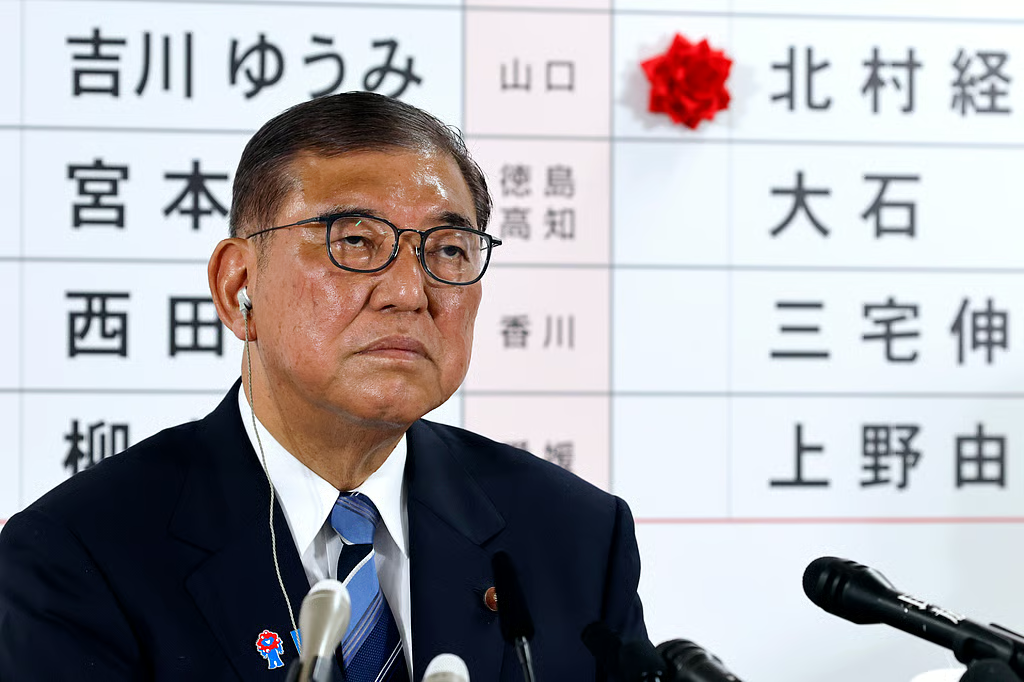
Tokyo (AP): Japanese Prime Minister Shigeru Ishiba's ruling coalition failed on Monday to secure a majority in the 248-seat upper house in a crucial parliamentary election, further shaking the stability of his government as Japan faces challenges such as rising prices and high US tariffs.
Ishiba's Liberal Democratic Party and its junior coalition partner Komeito, which needed to win 50 seats on top of the 75 seats they already have to retain their majority, won 47 seats. It was three seats short of a majority and a retreat of 19 seats from before the vote.
The loss is another blow to Ishiba's coalition, making it a minority in both houses following its October defeat in the lower house election, and worsening Japan's political instability. It was the first time the LDP has lost a majority in both houses of parliament since the party's formation in 1955.
Despite the loss, Ishiba expressed determination to stay on and not create a political vacuum to tackle challenges such as U.S. tariff threats, but he could face calls from within his party to step down or find another coalition partner.
“I will fulfil my responsibility as head of the No. 1 party and work for the country,” he said.
Ishiba had set the bar low, wanting a simple majority of 125 seats, which means his LDP and its Buddhist-backed junior coalition partner Komeito needed to win 50 seats. Exit poll results released seconds after the ballots closed Sunday night mostly showed a major setback for Ishiba's coalition.
The LDP alone won 39 seats, better than most exit poll projections of 32, and still the No. 1 party in the parliament, known as the Diet. But Ishiba said the coalition's poor showing was because his government's measures to combat price increases had yet to reach many people.
“It's a tough situation. I take it humbly and sincerely,” Ishiba told a live interview with NHK.
The poor performance in the election will not immediately trigger a change of government because the upper house lacks the power to file a no-confidence motion against a leader, but it will certainly deepen uncertainty over his fate and Japan's political stability. Ishiba could face calls from within the LDP party to step down or find another coalition partner.
Economic worries frustrate voters
Soaring prices, lagging incomes and burdensome social security payments are the top issues for frustrated, cash-strapped voters. Stricter measures targeting foreign residents and visitors also emerged as a key issue, with a surging right-wing populist party leading the campaign.
Sunday's vote comes after Ishiba's coalition lost a majority in the October lower house election, stung by past corruption scandals, and his unpopular government has since been forced into making concessions to the opposition to get legislation through parliament. It has been unable to quickly deliver effective measures to mitigate rising prices, including Japan's traditional staple of rice, and dwindling wages.
Trade talks with Washington
US President Donald Trump has added to the pressure, complaining about a lack of progress in trade negotiations and the lack of sales of US autos and American-grown rice to Japan despite a shortfall in domestic stocks of the grain. A 25% tariff due to take effect Aug. 1 has been another blow for Ishiba.
Ishiba resisted any compromise before the election, but the prospect of a breakthrough after the election is just as unclear because the minority government would have difficulty forming a consensus with the opposition.
Populism gains traction
Frustrated voters were rapidly turning to emerging populist parties. The eight main opposition groups, however, were too fractured to forge a common platform as a united front and gain voter support as a viable alternative.
The emerging populist party Sanseito stands out with the toughest anti-foreigner stance, with its “Japanese First” platform that proposes a new agency to handle policies related to foreigners. The party's populist platform also includes anti-vaccine, anti-globalism and favours traditional gender roles.
Conservative opposition groups, especially the DPP and Sanseito, gained significant ground at the Liberal Democrats' expense, while the centrist top opposition CDPJ was sluggish. The DPP quadrupled to 17 seats from four, according to interim results reported by Japanese media. Sanseito surged to 14 from just one.
Sanseito leader, former local assembly member and a Self-Defense Force reserve personnel, told NHK said he is open to cooperate with the ruling bloc on conservative policies while waiting to gain more seats in the other house in a next election and form a multi-party coalition as in Europe.
None of the opposition parties said that they were open to cooperating with the governing coalition. CDPJ leader Yoshihiko Noda told NHK that his priority is to form an alliance among the opposition. “Public opinion clearly said no' to the Ishiba government,” Noda said.
The spread of xenophobic rhetoric in the election campaign and on social media triggered protests by human rights activists and alarmed foreign residents.
A choice between stability or change
The LDP has almost continuously dominated Japan's postwar politics, contributing to its political stability and social conformity. But voters are divided between stability and change, with some voicing concern about escalating xenophobia.
Yuko Tsuji, a 43-year-old consultant who came to a polling station inside a downtown Tokyo gymnasium with her husband, said they both support LDP for stability and unity. They voted “for candidates who won't fuel division."
“If the ruling party doesn't govern properly, the conservative base will drift toward extremes. So I voted with the hope that the ruling party would tighten things up,” she said.
Self-employed Daiichi Nasu, 57, who came to vote with his dog, said he hopes for a change toward a more inclusive and diverse society, with more open immigration and gender policies such as allowing married couples to keep separate surnames.
“That's why I voted for the CDPJ,” he said. “I want to see progress on those fronts.”
Let the Truth be known. If you read VB and like VB, please be a VB Supporter and Help us deliver the Truth to one and all.
Fire at mass marriage event attended by Dy CM Shivakumar, nobody affected

Raichur (Karnataka) (PTI): Fire broke out near the stage of the mass marriage event that was attended by Deputy Chief Minister D K Shivakumar here, police said on Sunday.
Nobody was affected, and the fire was immediately put out, they said.
The fire was noticed shortly after Shivakumar and other dignitaries left the stage, and Forest Minister Eshwaran Khandre was speaking to the media at the venue in Sindhanur, officials said.
According to officials, wires, speakers, and cloth materials near the stage caught fire, allegedly due to a short circuit.
Police personnel present at the spot quickly swung into action and extinguished the fire.
The programme was halted for some time and resumed later, they said.
Several ministers, legislators and political leaders from the region, and actor Sudeep had attended the event.