Shihab Chottur enters Pakistan to complete his journey on foot to Saudi Arabia for Hajj

Lahore, Feb 7: An Indian national, who was earlier denied a visa by a Pakistani court, entered the country on Tuesday to complete his marathon journey on foot to Saudi Arabia to perform Hajj.
Shihab Chottur, 29, arrived in Pakistan via the Wagah border and was welcomed by Sarwar Taj, who had filed a writ petition in the Supreme Court on behalf of Shihab, and Bhagat Singh Memorial Foundation Pakistan chairman Imtiaz Rashid Qureshi.
Qureshi told PTI that Shihab was very happy to get the visa to continue his journey to Mecca.
"He has brought a message of love, friendship and brotherhood," Qureshi said, adding he wanted to organise an event in Shihab's honour on the premises of Lahore High Court but could not do so because of security issues.
Shihab, who hails from Kerala, embarked on a 3,000-km journey on foot in October last year from his home state to the Wagah border where he was stopped by Pakistan's immigration authorities as he did not have a visa.
"Shihab pleaded before the immigration authorities that he was going to perform Hajj on foot and had already travelled 3,000 kms and should be allowed to enter the country on humanitarian grounds. He wanted a transit visa to reach Saudi Arabia via Iran," a Federal Investigation Agency official had said.
Hajj is an annual Islamic pilgrimage to Mecca in Saudi Arabia, considered the holiest city for Muslims.
Taj, a resident of Lahore, filed a petition in the Lahore High Court (LHC) requesting that Shihab be granted a transit visa to allow him to travel to Saudi Arabia.
He argued that just like the Pakistan government issues visas to Sikh pilgrims from India to take part in the birth anniversary of Guru Nanak and on other occasions, it should also grant a visa to Shihab.
The LHC dismissed his petition, observing that the "petitioner was not related to the Indian citizen, nor did he hold his power of attorney to approach the court."
Taj later challenged the decision in the Supreme Court of Pakistan.
View this post on Instagram
Let the Truth be known. If you read VB and like VB, please be a VB Supporter and Help us deliver the Truth to one and all.
Karnataka health dept mandates heat stroke units across hospitals
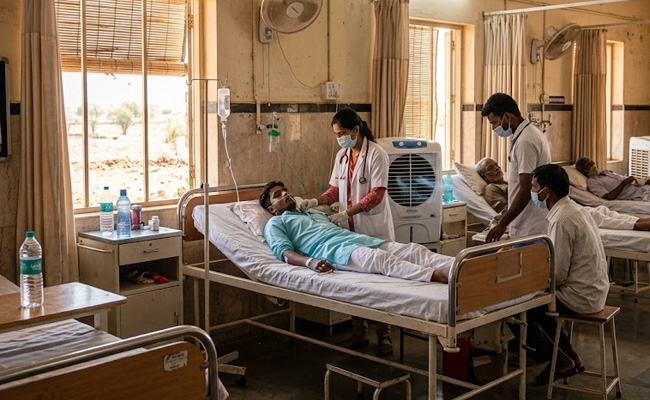
Bengaluru (PTI): The Karnataka government on Friday directed state-run health facilities to set up dedicated ‘heat stroke management rooms’ to address risks from extreme temperatures, officials said.
In a circular issued, the Commissionerate of Health and Family Welfare Services said community health centres should earmark two beds, taluk hospitals five beds, and district hospitals 10 beds for heat stroke management.
The circular, issued under the National Action Plan on Heat-Related Illnesses, stated that these facilities must be made operational every year, including in 2026, from March 1 to July 31.
All doctors and paramedical staff have been instructed to undergo training in the management of Heat-Related Illnesses (HRI).
It also directed all health institutions to establish ORS corners and equip heat stroke management rooms with essential facilities such as fans, ice cubes, and thermometers.
All health facilities at every level have been instructed to submit daily reports on HRI cases through the Integrated Health Information Platform (IHIP), the circular said.
The health department said the measures aim to prevent heat stroke-related complications and deaths amid rising temperatures and has directed authorities concerned to submit compliance reports on implementation.