Sikh fighter pilot memorial in UK to honour Indians who fought in World Wars
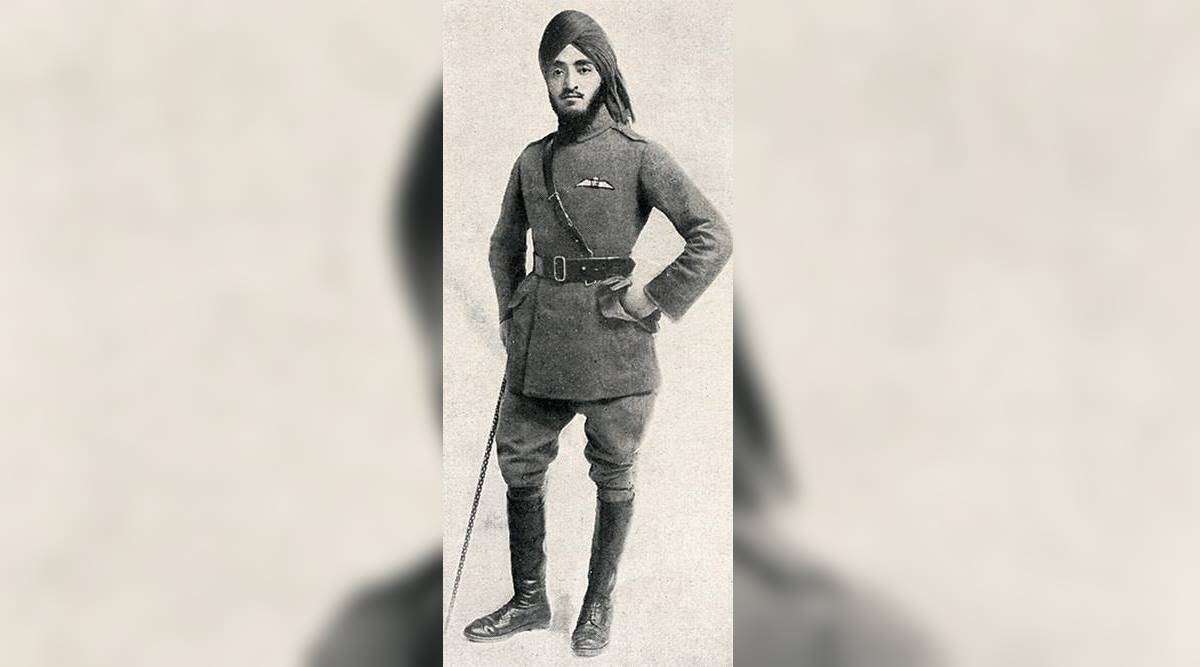
London, Mar 7: The design for a sculpture of an early 20th century Sikh fighter pilot, cricketer and golfer from Oxford University has been approved for a new memorial to be erected in the England port city of Southampton in memory of all Indians who fought in the World Wars.
Hardit Singh Malik first arrived in the UK in 1908 as a 14-year-old to Balliol College at the University of Oxford and went on to become a member of the Royal Flying Corps during World War I. As the first Indian and turbaned pilot with a specialised helmet, he became famous as the "Flying Sikh".
As such the statue to the legendary World War I hero, Hardit Singh Malik, the world's first Royal Flying Corps (now the Royal Air Force) Sikh, turbaned fighter pilot will be emblematic for the broader Sikh contributions in the British armed forces of World War I and II, with Malik's extraordinary accomplishments as a touchstone' for the whole Sikh community and other of its lesser-known heroes, notes the One Community Hampshire & Dorset (OCHD) organisation behind the campaign for the memorial, which was approved by the Southampton City Council last year.
Malik also played cricket for Sussex and was also the Indian Ambassador to France after a long and distinguished career in the Indian Civil Service. But it is as a fighter pilot during 1917-19 that he is best known.
I am truly overwhelmed by the striking beauty and power of the exceptional design of the memorial, which captures the spirit and endeavour of this great RAF fighter pilot, Hardit Singh Malik, so well. It gives me great happiness to learn that the design is approved by the community, said Lord Rami Ranger, Chairman of the British Sikh Association and Chief Patron of OCHD.
This project certainly speaks for itself; strongly furthering community cohesion and integration, and testifying to the major contribution our Sikh and broader ethnic minority communities make to our country, as we live in such a vibrant multicultural society here in Southampton, said Pritheepal Singh, OCHD CEO and Director.
The memorial will be created by English sculptor Luke Perry, who is associated with other memorials such as the Lions of the Great War monument in Smethwick in the West Midlands region of England, which depicts a turbaned Sikh soldier to honour the sacrifices made by millions of South Asian service personnel who fought for Britain in the World Wars. His design for the latest memorial was finalised earlier this month and also received the backing of the Council of Southampton Gurdwaras.
Monuments such as this are a vital part of the fight for equal representation. These artworks are long overdue thanks and recognition to the communities from around the world who have supported Britain in its past and continue to do so in vital roles, not just in the armed forces but our health care and every aspect of modern life, said Perry.
The public statue of Hardit Singh Malik embodies the spirit of inclusivity representing the will to breaking the glass ceiling' at the intersection of two World Wars and minority enrolment in the RAF: a significant feat for an Indian at the time, added Dr Sanjukta Ghosh, Artistic Director at the School of Oriental and African Studies (SOAS) South Asia Institute and OCHD Advisor.
An online Go Fund Me fundraiser is also inviting funds for the memorial, the unveiling of which is expected to be accompanied by educational resources, a book and a documentary covering several educational themes.
Let the Truth be known. If you read VB and like VB, please be a VB Supporter and Help us deliver the Truth to one and all.
Indian startup's 'Drishti' satellite launched aboard SpaceX rocket
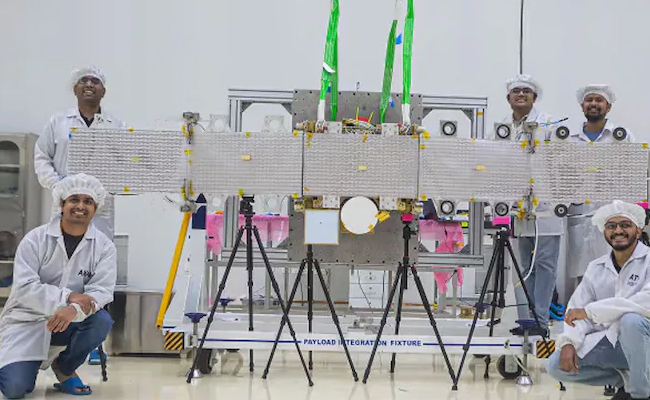
New Delhi (PTI): Bengaluru-based space start-up GalaxEye's Mission Drishti satellite was launched on Sunday aboard SpaceX's Falcon 9 rocket from California.
Mission Drishti is the world's first OptoSAR satellite, integrating electro-optical (EO) and synthetic aperture radar (SAR) sensors into a single operational platform, according to the company.
While EO sensors capture high-resolution images during sunlight and clear skies, SAR sensors provide all-weather and all-time images, using radar pulses.
In a statement, Suyash Singh, founder and CEO of GalaxEye, said, "With the satellite (Mission Drishti) now successfully in orbit, our immediate focus is on completing its commissioning. As we move through this phase, we are already witnessing strong global interest in the differentiated datasets enabled by our OptoSAR payload."
The satellite will help address long-standing limitations of conventional systems and enable more reliable and consistent data acquisition across diverse environmental conditions, the company said.
As a dual-use Earth observation satellite, the mission will support use cases across defence, agriculture, disaster management, maritime monitoring, and infrastructure planning.
The satellite is also expected to complement India's broader initiatives, including the 29 active Earth Observation satellites outlined in ISRO's recent annual report.
The launch came after five years of indigenous research and development, and extensive environmental testing and performance validation of the Mission Drishti.
In a statement, Lt Gen AK Bhatt (Retd), director general of Indian Space Association (ISpA), said, "GalaxEye has achieved what only a few global players have, which is seamlessly combining optical and SAR capabilities on a single platform to enable persistent, all-weather intelligence."
What stands out is not just the technology, but its broader impact on how downstream applications will increasingly define value in the space economy, particularly in Earth observation, where timely, decision-grade insights are critical," he added.
ISpA is the premier industry association of space and satellite companies in the country.
Union Minister Jitendra Singh also took note of the Mission Drishti launch, saying the development marked a significant milestone in India's space journey.
In a post on X, the minister said, "The successful launch of the world's first OptoSAR satellite, and the largest privately-built satellite in the country, reflects the immense potential of our young innovators driving nation-building."
GalaxEye aims to scale up Mission Drishti to a constellation of 10 satellites by 2030, developing a robust and sovereign Earth observation infrastructure for India.