Sikh man, acquitted in 1985 Air India bombings, shot dead in Canada; police investigate motive
Toronto (PTI): The Canadian police have said they are still working to determine the motive behind the targeted killing of Ripudaman Singh Malik, a 75-year-old Sikh man acquitted in the tragic 1985 Air India Kanishka terrorist bombing case.
Malik was shot dead in Surrey, British Columbia on Thursday. Malik and co-accused Ajaib Singh Bagri were acquitted in 2005 of mass murder and conspiracy charges related to the two bombings in 1985 that killed 331 people, the CBC News said.
The report cited a witness who said he heard three shots and pulled Malik from his red Tesla bleeding from a neck wound.
Another witness from a nearby business identified that the victim of the shooting was Malik.
Surrey Royal Canadian Mounted Police (RCMP) said a man shot at that location at around 9:30 am succumbed to his injuries at the scene. They say it appears to be a targeted shooting and are not releasing the victim's name.
The police said they located a suspect vehicle which was engulfed in fire, the report added.
Another report in ABC News said that while police had not initially released the victim's identity, it confirmed it after Malik's son, Jaspreet Malik, posted a statement on social media about his father's shooting.
The media will always refer to him as someone charged with the Air India bombing, Malik's son wrote on Facebook.
He said that his father had been wrongly charged in the case and the court concluded that "there was no evidence against him".
The media and RCMP [Royal Canadian Mounted Police] never seemed to accept the court's decision and I pray today's tragedy is not related, he said.
In a statement, the Integrated Homicide Investigation Team said: "We are aware of Mr Malik's background, though at this time we are still working to determine the motive. We can confirm that the shooting appears to be targeted and there is not believed to be any further risk to the public."
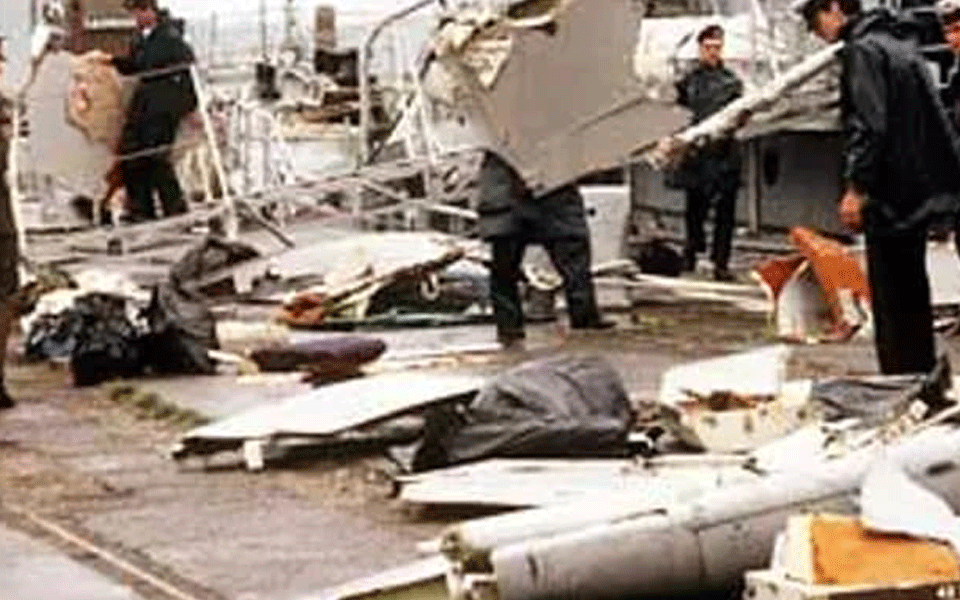
The 1985 Air India bombing is among the worst terrorist attacks in Canadian history and in the history of the airline.
On June 23, 1985, the Air India flight 182, carrying 329 people, including 268 Canadian citizens and 24 Indian citizens, flew from Toronto and stopped in Montreal from where it was en route to London and then onwards to its final destination Bombay.
The plane was flying 31,000 feet above the Atlantic Ocean when a suitcase bomb exploded in the front cargo, killing all on board.
Another bomb was meant to be planted in an Air India flight scheduled to take off from Japan but it exploded at Tokyo's Narita airport killing two baggage handlers.
The CBC News report said that reaction to Malik's death was mixed. While Malik's friends said they lost a hero of the Sikh community, former British Columbia premier Ujjal Dosanjh, a former acquaintance of Malik's, said he was a controversial figure.
"One of the other complicating factors is he made a recent visit to India where he wrote a letter in support of [Prime Minister] Modi and his policies and I think that may have reverberated and had implications within the community," Dosanjh said in the report.
The report added that in recent years, Malik had served as chairman with Khalsa School and managed two of the private schools' campuses in Surrey and Vancouver. He was also president of the Vancouver-based Khalsa Credit Union (KCU), which has more than 16,000 members.
He is survived by his wife, five children, four daughters-in-law, and eight grandchildren.
Inderjit Singh Reyat was convicted on various charges and spent 30 years in prison for helping to make the bombs, and for lying during trials, including Malik's. He was released in 2016 after serving two-thirds of his perjury sentence.
Reyat was the only person convicted for the Kanishka bombing blamed on Khalistani extremists seeking revenge for the Indian Army's action at the Golden Temple to flush out militants in 1984.
Let the Truth be known. If you read VB and like VB, please be a VB Supporter and Help us deliver the Truth to one and all.
3 women die after giant tree falls on them in Odisha’s Koraput
Koraput (PTI): Three women died and another was injured after a giant tree fell on them following thunderstorms in Odisha’s Koraput district, police said on Tuesday.
The incident took place on Monday evening when they were in a market at Pedabayalu in Nandapur block near the Andhra-Odisha border.
The tree was uprooted due to strong winds amid rain and thunderstorms, a police officer said.
Two women died on the spot and another in hospital, he said.
Nandapur BDO Durga Prasad Dora and MLA Rama Chandra Kadam visited the spot, and assured the victims’ families of government support.