Sirisena seeks Supreme Court's opinion for six-year term
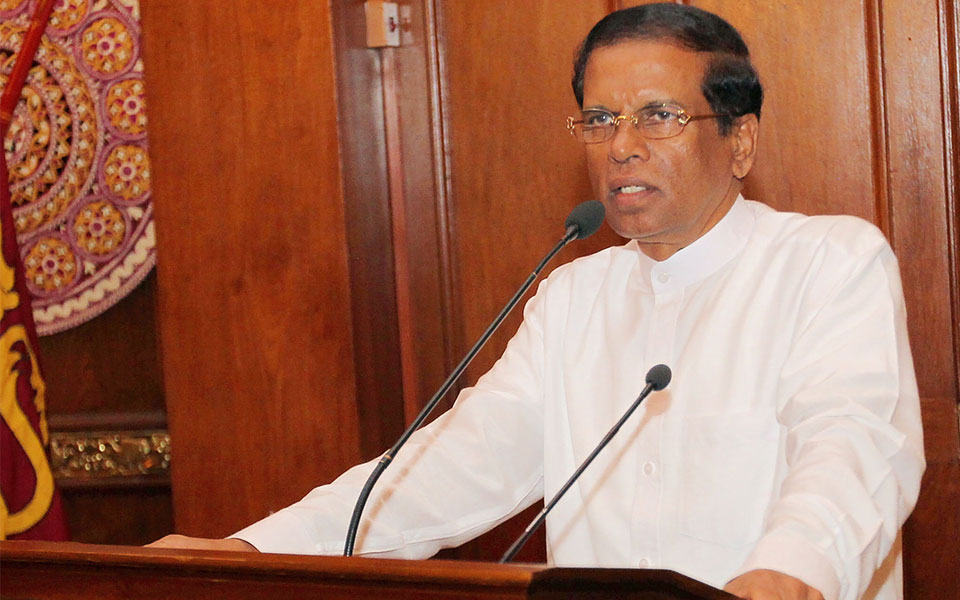
Colombo: In an unusual move, Sri Lankan President Maithripala Sirisena has sought the Supreme Court's opinion if he could be the president for six years, a request which contradicts the amendment he introduced to reduce the presidential term to five years.
Sirisena, 66, spearheaded the 19th amendment (19A) to the Constitution in 2015 to prune the presidential term from six to five years.
The president's term should end in 2020, but has sought the Supreme Court's opinion if he could continue until 2021.
The Registrar of the Supreme Court yesterday informed the members of legal fraternity that the consideration by the apex Court has been listed for January 11, officials said.
It said the President had requested an opinion which read, "whether in terms of provisions of the Constitution, I as the person elected and succeeding to the office of President and having assumed such office in terms of Article 32 (1) of the Constitution on January 9, 2015, have any impediment to continue in the office of President for a period of 6 years from January 9, 2015".
The request stands in direct contrast to Sirisena's action of backing the civil society's demand to abolish the presidency when he offered to be the Opposition's common candidate in 2015.
Instead of abolishing it, Sirisena introduced the 19A amendment which reduced the presidential term to five years while taking away the absolute control over the dissolution of parliament.
Sirisena's announcement has come amidst the ongoing differences with his coalition partner, the United National Party (UNP) which is headed by Prime Minister Ranil Wickremesinghe, Sirisena's main backer in the 2015 election against former President Mahinda Rajapaksa.
Sirisena defeated Rajapaksa with a clear reform agenda in 2015.
The President of late has criticised the UNP publicly and some party members have also been critical of him.
Let the Truth be known. If you read VB and like VB, please be a VB Supporter and Help us deliver the Truth to one and all.
T'gana RTC strike: Talks between govt, employees successful

Hyderabad (PTI): Talks between employees of Telangana State Road Transport Corporation (RTC) who were on strike and the state government concluded successfully on Friday as the government agreed to the key demands of the workmen.
Following a day-long marathon of talks between the leaders of the employees' Joint Action Committee (JAC) and the cabinet sub-committee, the government announced after midnight that it acceded to the demands, including a merger of RTC with the government, 11 per cent pay revision and elections to the employees' unions.
A committee comprising officials and employee leaders would be appointed over the merger of RTC with the government, it said.
The RTC management has also agreed to address the remaining issues as well, an official release said.
The employees would call off their strike and the RTC buses would hit the roads shortly, it said.
The employees had been on an indefinite strike since April 22 over a series of demands, including the merger of RTC with the government.
Earlier in the day, a driver of the RTC, who attempted suicide on April 23 during the strike, died at a hospital here in the early hours of Friday.
Shankar Goud, a 55-year-old driver, set himself ablaze by pouring petrol at Narsampet in Warangal district when the employees were staging a protest on Thursday in support of their demands.
Goud suffered serious burns, was initially admitted to a state-run hospital in Warangal, and later shifted to a super-speciality hospital in Hyderabad for advanced treatment.
"He succumbed (to injuries) at about 1.30 am on Friday," a senior official said.
The driver’s body was taken to his relative’s village, Muttojipet in Warangal district, for funeral rites.
Tension prevailed in Muttojipet as his family members and RTC employees attempted to take the body to the Narsampet bus station, where he worked, to enable his colleagues to pay their last respects. However, police did not permit this, citing law-and-order concerns.
This led to a deadlock before the funeral could proceed.
Union Minister Bandi Sanjay Kumar criticised the Telangana government for not allowing the body to be taken to the Narsampet bus station.
Kumar, Minister of State (Home), visited Muttojipet village in Warangal district, where the funeral was held, and paid homage to Goud.
“They (family members) want to take the body to the bus depot for five minutes. Is the RTC bus depot in Pakistan or Bangladesh? They are emotionally attached to taking the body there. The government is hurting sentiments and creating fear among RTC employees,” Kumar told reporters.
He also expressed anger at the police for not allowing the body to be taken to the bus station and staged a protest, according to a release from his office.
RTC employees and BJP workers attempted to take the mortal remains in an ambulance to Narsampet, but were stopped by the police.
Later, after discussions with the police, the family members and RTC employees agreed to conduct the funeral in the village.
Sanjay Kumar, stating he would abide by the family’s decision, left the village after the funeral was conducted there.
Transport Minister Ponnam Prabhakar said an ex gratia of Rs 10 lakh, a house, and a government job would be provided to the kin of Goud.
Chief Minister A Revanth Reddy expressed shock over the employee’s death and conveyed deep condolences to the grieving family, according to the release.
The RTC employees’ JAC had earlier announced an agitation programme from April 24 to 29, including silent marches and submission of memorandums to MLAs and other leaders.