Soldiers detain Guinea's president, dissolve government
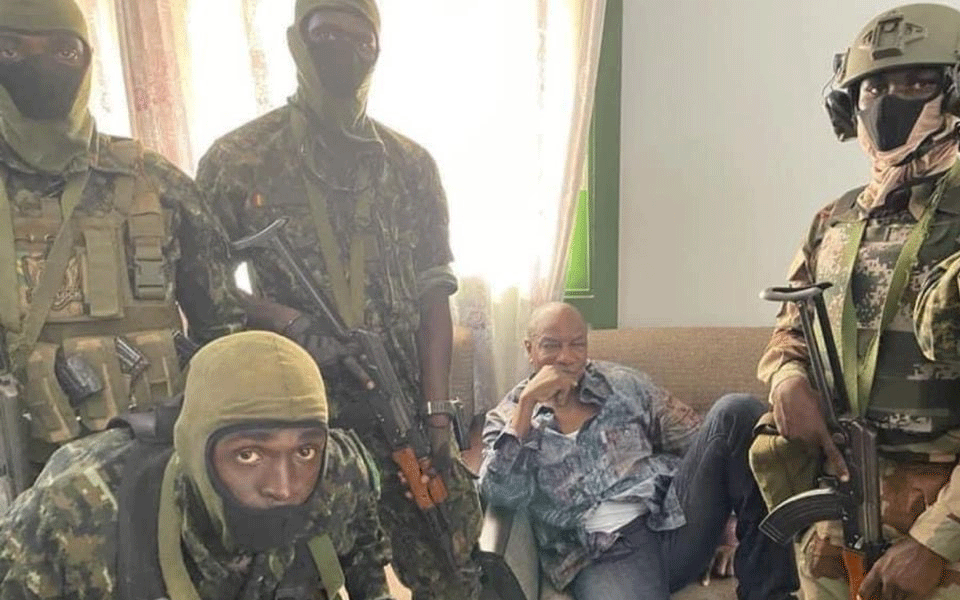
Conakry (Guinea)(AP): Mutinous soldiers in the West African nation of Guinea detained President Alpha Conde on Sunday after hours of heavy gunfire rang out near the presidential palace in the capital, then announced on state television that the government had been dissolved in an apparent coup d'etat.
The country's borders were closed and its constitution was declared invalid in the announcement read aloud on state television by army Col. Mamadi Doumbouya, who told Guineans: "The duty of a soldier is to save the country."
"We will no longer entrust politics to one man. We will entrust it to the people," said Doumbouya, draped in a Guinean flag with about a half dozen other soldiers flanked at his side.
It was not immediately known, though, how much support Doumbouya had within the military or whether other soldiers loyal to the president of more than a decade might attempt to wrest back control.
The junta later announced plans to replace Guinea's governors with regional commanders at an event Monday and warned: "Any refusal to appear will be considered rebellion" against the country's new military leaders.
The West African regional bloc known as ECOWAS quickly condemned the developments, threatening sanctions if Conde was not immediately released. UN Secretary-General Antonio Guterres tweeted that he strongly condemned "any takeover of the government by force of the gun."
The US State Department warned against violence and urged authorities in Guinea to avoid "extra-constitutional" actions that "will only erode Guinea's prospects for peace, stability, and prosperity."
Spokesman Ned Price added in a statement that the junta's "actions could limit the ability of the United States and Guinea's other international partners to support the country."
Conde's whereabouts had been unknown for hours after the intense fighting Sunday in downtown Conakry until a video emerged showing the 83-year-old leader tired and disheveled in military custody.
The junta later released a statement saying Conde was in contact with his doctors. But they gave no timeline for releasing him other than to do say: "Everything will be fine. When the time comes, we will issue a statement."
Conde, in power for more than a decade, had seen his popularity plummet since he sought a third term last year, saying that term limits did not apply to him. Sunday's dramatic developments underscored how dissent had mounted within the military as well.
Doumbouya, who had been the commander of the army's special forces unit, called on other soldiers "to put themselves on the side of the people" and stay in their barracks. The army colonel said he was acting in the best interests of the nation, citing a lack of economic progress by leaders since the country gained independence from France in 1958.
"If you see the state of our roads, if you see the state of our hospitals, you realize that after 72 years, it's time to wake up," he said. "We have to wake up."
Observers, though say the tensions between Guinea's president and the army colonel stemmed from a recent proposal to cut some military salaries.
On Sunday morning, heavy gunfire broke out near the presidential palace and went on for hours, sparking fears in a nation that already has seen multiple coups and presidential assassination attempts. The Defense Ministry initially claimed that the attack had been repelled by security forces, but uncertainty grew when there was no subsequent sign of Conde on state television or radio.
The developments that followed closely mirrored other military coup d'etats in West Africa: The army colonel and his colleagues seized control of the airwaves, professing their commitment to democratic values and announcing their name: The National Committee for Rally and Development.
It was a dramatic setback for Guinea, where many had hoped the country had turned the page on military power grabs.
Conde's 2010 election victory the country's first democratic vote ever was supposed to be a fresh start for a country that had been mired by decades of corrupt, authoritarian rule and political turmoil. In the years since, though, opponents said Conde too failed to improve the lives of Guineans, most of whom live in poverty despite the country's vast mineral riches of bauxite and gold.
The year after his first election he narrowly survived an assassination attempt after gunmen surrounded his home overnight and pounded his bedroom with rockets. Rocket-propelled grenades landed inside the compound and one of his bodyguards was killed.
Violent street demonstrations broke out last year after Conde organized a referendum to modify the constitution. The unrest intensified after he won the October election, and the opposition said dozens were killed during the crisis.
In neighbouring Senegal, which has a large diaspora of Guineans who opposed Conde, news of his political demise was met with relief.
"President Alpha Conde deserves to be deposed. He stubbornly tried to run for a third term when he had no right to do so," said Malick Diallo, a young Guinean shopkeeper in the suburbs of Dakar.
"We know that a coup d'etat is not good," said Mamadou Saliou Diallo, another Guinean living in Senegal. "A president must be elected by democratic vote. But we have no choice. We have a president who is too old, who no longer makes Guineans dream and who does not want to leave power."
Let the Truth be known. If you read VB and like VB, please be a VB Supporter and Help us deliver the Truth to one and all.
Karnataka by-polls: Cong ahead in Bagalkot, BJP leads in Davanagere South
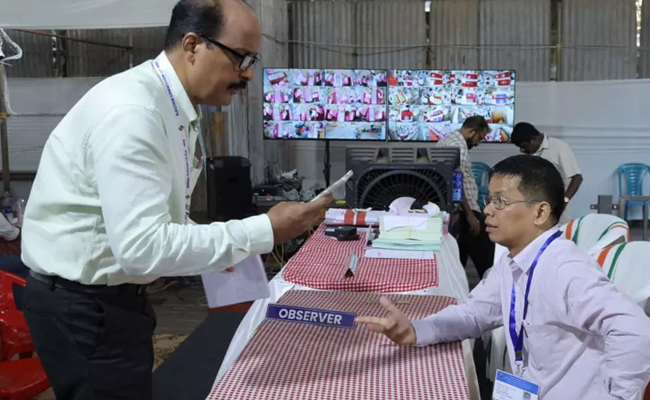
Bengaluru (PTI): Trends show Congress and BJP have maintained leads respectively in Karnataka's Bagalkot and Davanagere South Assembly seats, where counting of votes is underway on Monday, for the bypolls held for two seats on April 9.
The polls were necessitated by the deaths of senior Congress MLAs H Y Meti (Bagalkot) and Shamanur Shivashankarappa (Davanagere South).
According to the Election Commission, Congress party's Umesh Meti was ahead of BJP's Veerabhadrayya Charantimath by a margin of 9,969 votes in Bagalkot.
In Davanagere South, BJP's Srinivas T Dasakariyappa was leading over Congress party's Samarth Mallikarjun by a margin of 8,539 votes.
Nine and 25 candidates were in the fray, respectively in the Bagalkot and Davanagere South Assembly segments.