South Korean military: North Korea's latest launches were missiles
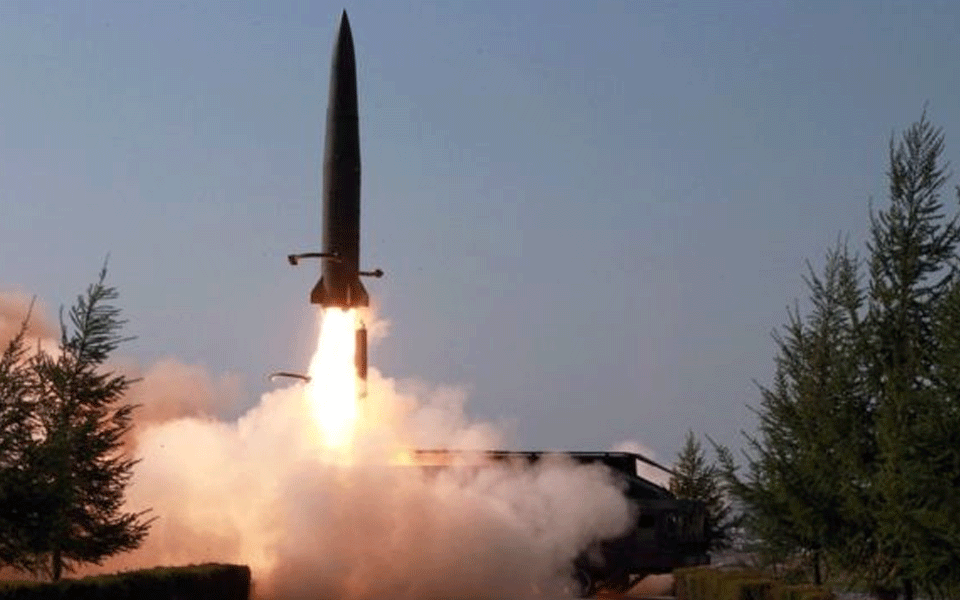
Seoul: The US and South Korean militaries evaluated the two projectiles North Korea flew Thursday as short-range missiles, a South Korean military official said Friday, a day after the North's second launch in five days raised jitters about an unravelling detente between the Koreas and the future of nuclear negotiations between Washington and Pyongyang.
The weapons flew 420 kilometers (260 miles) and 270 kilometers (167 miles), respectively, on an apogee of 45 to 50 kilometers (28 to 31 miles), according to Seoul's Joint Chiefs of Staff and Defense Ministry.
The launches were seen as Pyongyang's brushback pitch toward Washington over deadlocked nuclear negotiations as they continue to struggle with mismatched demands in sanctions relief and disarmament.
North Korea's state-run Korean Central News Agency said Friday that leader Kim Jong Un helped guide the weapons tests on Thursday and learned about "various long-range strike means," but the statement from the propaganda services didn't specify the type of missiles fired.
Pyongyang's official Rodong Sinmun newspaper published photos that showed Kim, equipped with binoculars and smiling widely, observing the firing of rocket artillery and what appeared to be a short-range ballistic missile fired from a launch vehicle.
Experts say the missile was identical to the one the North launched on Saturday, which appeared to be a solid-fuel missile modeled after Russia's Iskander short-range ballistic missile system. The Rodong Sinmun photos showed the North used a tracked launch vehicle on Thursday, unlike Saturday when it used a wheeled vehicle.
Some analysts say that the new missile would be potentially capable of delivering warheads and striking targets within the entire Korean Peninsula, considering the range and capabilities of the Iskander and North Korea's recent advancements in missile technology.
The South Korean military official said the South Korean and U.S. militaries are jointly analyzing more details from the launch, including whether the missiles fired on Thursday were the same weapons the North tested on Saturday. He didn't want to be named, citing office rules.
What was launched Thursday is a crucial detail, as North Korea is banned by the United Nations from testing ballistic missiles. A major missile test could result in more sanctions, and the North's so far unsuccessful push for large-scale sanctions relief is at the heart of the current diplomatic impasse with Washington.
South Korea's military initially said Thursday that at least one projectile was launched from the Sino-ri area of North Pyongan province, an area known to have one of North Korea's oldest missile bases where a brigade operates mid-range Rodong missiles. It later said there were two launches from the nearby town of Kusong, where North Korea conducted its first successful flight tests of its Hwasong-12 intermediate-range missile and Hwasong-14 intercontinental ballistic missile, both in 2017.
Kusong is also home to missile test facilities that were critical to the development of North Korea's solid-fuel Pukguksong-2, which was successfully flight-tested for the first time in February 2017, in the North's first missile test after President Donald Trump took office.
The latest launches came as U.S. Special Representative for North Korea Stephen Biegun visited South Korea, and hours after the North described its firing of rocket artillery and an apparent short-range ballistic missile on Saturday as a regular and defensive military exercise. North Korea also ridiculed South Korea for criticizing those launches.
Trump told reporters the weapons were smaller, short-range missiles, but: "Nobody's happy about it." He has met with Kim at two summits but said Thursday at the White House: "I don't think they're ready to negotiate."
South Korean President Moon Jae-in urged North Korea to refrain from actions that could impede diplomacy. In an interview with the KBS television network, Moon also said Seoul will explore various options to help revive the talks, including providing food aid to the North and pushing for his fourth summit with Kim.
Moon's office earlier said the North Korean launches were "very concerning" and detrimental to efforts to improve inter-Korean ties and ease military tensions on the Korean Peninsula.
Some analysts have said that if North Korea resumes testing the kind of longer-range banned ballistic weapons that it fired in unusually large numbers in 2017 when many feared a U.S.-North Korea standoff could end in war it may signal that North Korea is turning away from diplomacy.
The tensions in 2017 were followed by a surprising diplomatic outreach by North Korea in 2018, when Kim attended summits with the South Korean and Chinese presidents and with Trump. But North Korea has not received what it wants most from its summitry: relief from punitive sanctions imposed over its nuclear and missile programs.
Let the Truth be known. If you read VB and like VB, please be a VB Supporter and Help us deliver the Truth to one and all.
AIITA welcomes Karnataka’s ban on obscene songs in school events

Bhatkal: The Karnataka unit of the All India Ideal Teachers Association (AIITA) has welcomed the Karnataka government’s decision to strictly ban school children from dancing to obscene songs during educational and cultural programmes in government, aided, and private schools across the state.
AIITA Karnataka State President M. R. Manvi congratulated the government for taking what he termed an important step to preserve the sanctity of education.
“Such decisions to safeguard the dignity of school children and uphold the values of education are the need of the hour. This rule should not be limited to government schools alone but must be strictly implemented in all private educational institutions as well,” he said.
He further urged the government to address other concerns within school programmes.
“The government should not only prohibit obscene dances in the name of school anniversaries, but also ensure that plays and dialogues that incite religious hatred are avoided. Schools should be centres of harmony, not platforms for spreading hatred,” he added.
According to a recent circular issued by the Department of School Education and Literacy, obscene dances are adversely affecting the mental health and moral values of students.
In this regard, schools have been advised to use songs that promote nationalism, positive thinking, the greatness of Kannada culture, and value-based traditions instead of inappropriate content during programmes.
The circular also emphasises that students should be dressed in decent attire.
AIITA also backed the department’s warning that disciplinary action would be taken against head teachers if such guidelines are violated. The association has further demanded that district Deputy Directors of Public Instruction strictly monitor the implementation of these rules.