South Korean police question presidential security chief as rift over detaining president deepens
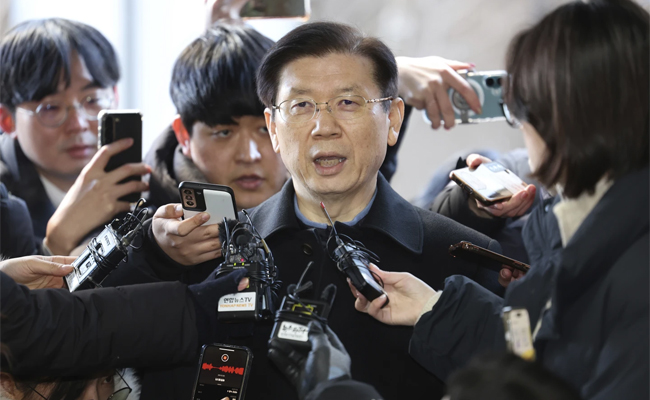
Seoul (AP): South Korean police questioned the chief of the presidential security service on Friday as the two agencies clashed over attempts to detain impeached President Yoon Suk Yeol.
The Corruption Investigation Office for High-Ranking Officials and police are planning a second attempt to bring Yoon into custody as they jointly investigate whether his brief martial law declaration on Dec 3 amounted to an attempted rebellion. The presidential security service blocked an earlier attempt to detain Yoon at his official residence, which he has not left for weeks.
Park Jong-joon, the presidential security chief, says that his duty is to protect the president and warned of “bloodshed,” as critics said that his agency is becoming Yoon's private army.
Park ignored two summonses before appearing for questioning on Friday over allegations of obstructing justice, a week after his forces repelled dozens of anti-corruption and police investigators from Yoon's official residence.
The anti-corruption office and police have vowed to make a second, more forceful effort to detain Yoon, warning that members of the presidential security staff could be arrested if they get in the way.
The embattled president remains holed up at his official residence in Seoul, where the presidential security service has fortified the grounds with barbed wire and rows of vehicles blocking the roads.
Yoon made a short-lived declaration of martial law and deployed troops to surround the National Assembly on Dec. 3, which lasted only hours before lawmakers managed to get through the blockade and voted to lift the measure.
His presidential powers were suspended when the opposition-dominated Assembly voted to impeach him on Dec. 14 and accused him of rebellion. His fate now rests with the Constitutional Court, which has begun deliberating on whether to formally remove Yoon from office or reject the charges and reinstate him.
There's also speculation that police may attempt to detain Park and other leaders of the presidential security service before trying again to execute the detainment warrant against Yoon, which was renewed by a Seoul court on Tuesday.
Speaking to reporters upon arriving for police questioning, Park again criticized the efforts to detain Yoon, saying that the investigation should proceed in a manner “appropriate for the status of an incumbent president” and the “dignity of the nation.”
“Many citizens are surely deeply concerned about the possible conflict and confrontation between government agencies,” Park said. “I came here today with the belief that under no circumstances should there be any physical clashes or bloodshed, and am hoping to prevent such incidents from occurring.”
Park said he made several calls to the country's acting leader, Deputy Prime Minister Choi Sang-mok, urging him to mediate an alternative approach with law enforcement and also made similar requests to Yoon's lawyers, but did not receive a satisfactory response.
Yoon's lawyers accused the police of trying to undermine the leadership of the presidential security service.
“This is an abnormal move that displays a disregard for national security,” the lawyers said in a texted statement.
While the presidential security act mandates protection for Yoon, it does not authorize the service to block court-ordered detainments and some legal experts say the presidential security service's action last week may have been illegal.
Asked in parliament about the presidential security service's effort to block the detention, National Court Administration head Cheon Dae-yeop said Friday that “resistance without a legitimate reason can constitute a crime, such as obstruction of official duties.”
Although the president himself has wide-ranging immunity from prosecution while in office, that does not extend to allegations of rebellion or treason.
Yoon's lawyers have questioned the legitimacy of a new detention warrant against Yoon issued by the Seoul Western District Court, arguing that the anti-corruption agency lacks legal authority to investigate rebellion charges or order police to detain suspects.
They also argue that detention and search warrants against Yoon cannot be enforced at his residence, citing a law that protects locations potentially linked to military secrets from search without the consent of the person in charge - which would be Yoon.
Yoon's lawyers have urged the agency to either indict the president or seek a formal arrest warrant, a process that requires a court hearing. However, they have said that Yoon would only comply with an arrest warrant issued by the Seoul Central District Court, which handles most key requests in high-profile cases.
They accuse the agency of deliberately choosing another court with an allegedly favourable judge, even though the official residence is located in the jurisdiction of the Western District Court.
Let the Truth be known. If you read VB and like VB, please be a VB Supporter and Help us deliver the Truth to one and all.
Punjab CM Mann meets President Murmu, seeks cancellation of membership of 6 RS members
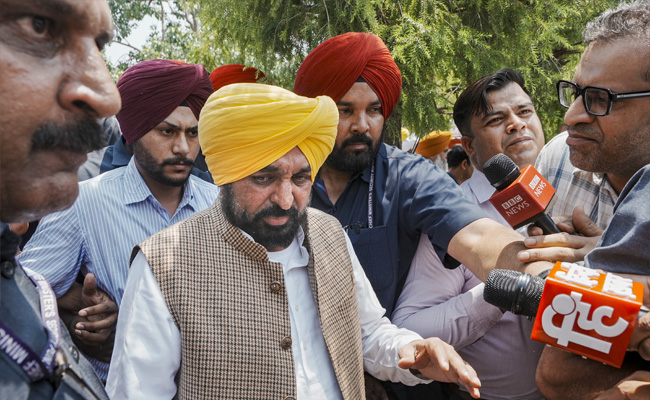
Chandigarh (PTI): Chief Minister Bhagwant Mann on Tuesday met President Droupadi Murmu, demanding the termination of the membership of six Rajya Sabha MPs from Punjab who defected to the BJP and also pressed for the introduction of a constitutional provision allowing for the recall of members.
Accompanied by party MLAs and ministers, Mann visited Rashtrapati Bhavan in Delhi.
This meeting followed a significant setback for the Aam Aadmi Party (AAP) on April 24, when seven of its 10 Rajya Sabha MPs -- Raghav Chadha, Ashok Mittal, Sandeep Pathak, Harbhajan Singh, Rajendra Gupta, Vikramjit Sahney and Swati Maliwal -- quit and merged with the BJP, alleging that the party had strayed from its principles, values and core morals. Six of the seven MPs who left AAP hailed from Punjab.
After he met with the President, Mann addressed the media here, describing the departure of the seven MPs as a "murder" of the Constitution. He stated, "Seven MPs merging with another party is completely unconstitutional. I spoke to Rashtrapati ji in detail."
Mann pointed out that he told the President that the BJP holds only two MLA seats (in Punjab), yet now has six MPs in the Rajya Sabha. He questioned, "How can this be possible? Isn't it a mockery of the Constitution?
"If they are such revolutionaries at heart, then they should have resigned from their six seats. The AAP could have sent someone else," Mann said, taking a swipe at them.
He emphasised the need for a recall provision in the Constitution, referencing MP Raghav Chadha's previous demands for such a measure when members fail to meet public expectations.
"Have you lived up to the expectations of the people?" Mann challenged the MPs during his statement.
Mann also presented a letter to the President, signed by all AAP MLAs. He differentiated between the terms 'elected' and 'selected,' stating, "They were 'selected.' Therefore, their membership should be cancelled."
The President assured Mann that she would consult constitutional experts before responding.
Earlier in the day, Mann, along with party MLAs, departed for Delhi from Chandigarh.
Speaking to reporters in Chandigarh, Mann affirmed that all AAP MLAs stand united with the party. "Only I have been given time for the meeting," Mann said.
"The President is the guardian of the Constitution. She is the constitutional head of the country," he added.
Later in a post on X in Hindi, Mann said, "Our struggle to protect Punjab's rights and interests continues. Today, along with all AAP MLAs, I have left to discuss Punjab's burning issues and present the state's strong voice before the President.
As your public servant, our government remains fully committed to Punjab's prosperity and the safeguarding of the rights of every section of society."
The MLAs and ministers gathered at the chief minister's residence in the morning before heading to Delhi, carrying placards that read 'Punjab Mann De Naal' and 'Punjab's Traitors.'
The legislators left for Delhi in buses.
Mann had previously sought an appointment with the President to meet with party MLAs and demand the "recall" of the Rajya Sabha MPs who defected to the BJP. However, only Mann was given a time slot for the meeting.