South Korean president apologises, saying he won't shirk responsibility for attempt at martial law
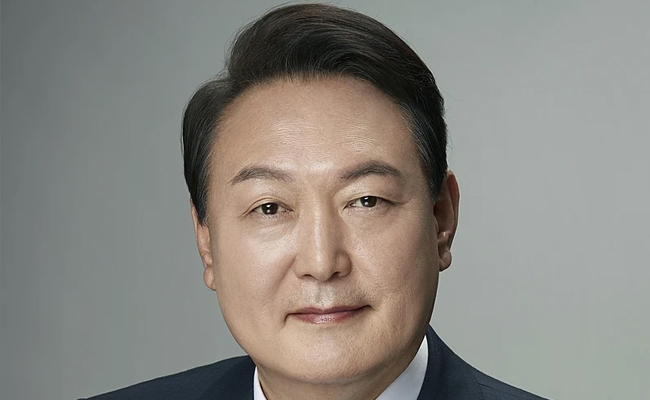
Seoul (AP/PTI): South Korea's president apologised Saturday for public anxiety caused by his short-lived attempt to impose martial law earlier this week hours ahead of a parliamentary vote on impeaching him.
Yoon Suk Yeol said in a brief televised address Saturday morning he won't shirk legal or political responsibility for the declaration and promised not to make another attempt to impose it.
He said he would leave it to his conservative political party to chart a course through the country's political turmoil, “including matters related to my term in office."
South Korean lawmakers are set to vote later Saturday on impeaching President Yoon over his short-lived attempt to impose martial law, as protests grew nationwide calling for his removal.
It wasn't immediately clear whether the motion submitted by opposition lawmakers would get the two-thirds majority required for Yoon to be impeached. But it appeared more likely after the leader of Yoon's own party on Friday called for suspending his constitutional powers, describing him as unfit to hold the office and capable of taking more extreme action, including renewed attempts to impose martial law.
Impeaching Yoon would require support from 200 of the National Assembly's 300 members. The opposition parties that jointly brought the impeachment motion have 192 seats combined.
That means they would need at least eight votes from Yoon's People Power Party. On Wednesday, 18 members of the PPP joined a vote that unanimously cancelled martial law 190-0 less than three hours after Yoon declared the measure on television, calling the opposition-controlled parliament a “den of criminals” bogging down state affairs.
The vote took place as hundreds of heavily-armed troops encircled the National Assembly in an attempt to disrupt the vote and possibly to detain key politicians.
Parliament said Saturday that it would meet at 5 pm. It will first vote on a bill appointing a special prosecutor to investigate influence peddling allegations surrounding Yoon's wife, and then on impeaching Yoon.
The turmoil resulting from Yoon's bizarre and poorly-thought-out stunt has paralyzed South Korean politics and sparked alarm among key diplomatic partners, including neighboring Japan and Seoul's top ally the United States, as one of the strongest democracies in Asia faces a political crisis that could unseat its leader.
Opposition lawmakers claim that Yoon's martial law declaration amounted to a self-coup and drafted the impeachment motion around rebellion charges.
The PPP decided to oppose impeachment at a lawmakers' meeting, despite pleas by its leader Han Dong-hun, who isn't a lawmaker and has no vote.
Following a party meeting on Friday, Han stressed the need to suspend Yoon's presidential duties and power swiftly, saying he "could potentially put the Republic of Korea and its citizens in great danger.”
Han said he had received intelligence that during the brief period of martial law Yoon ordered the country's defence counterintelligence commander to arrest and detain unspecified key politicians based on accusations of “anti-state activities."
Hong Jang-won, first deputy director of South Korea's National Intelligence Service, later told lawmakers in a closed-door briefing that Yoon called after imposing martial law and ordered him to help the defence counterintelligence unit to detain key politicians.
The targeted politicians included Han, opposition leader Lee Jae-myung and National Assembly speaker Woo Won Shik, according to Kim Byung-kee, one of the lawmakers who attended the meeting.
The Defence Ministry said it had suspended the defence counterintelligence commander, Yeo In-hyung, who Han alleged had received orders from Yoon to detain the politicians. The ministry also suspended Lee Jin-woo, commander of the capital defence command, and Kwak Jong-geun, commander of the special warfare command, over their involvement in enforcing martial law.
Former Defence Minister Kim Yong Hyun, who has been accused of recommending Yoon to enforce martial law, has been placed under a travel ban and faces an investigation by prosecutors over rebellion charges.
Vice Defence Minister Kim Seon Ho, who became acting defence minister after Yoon accepted Kim Yong Hyun's resignation on Thursday, has testified to parliament that it was Kim Yong Hyun who ordered troops to be deployed to the National Assembly after Yoon imposed martial law.
Let the Truth be known. If you read VB and like VB, please be a VB Supporter and Help us deliver the Truth to one and all.
EC role, Hindu vote consolidation among factors for BJP win in Bengal polls: J-K CM Omar
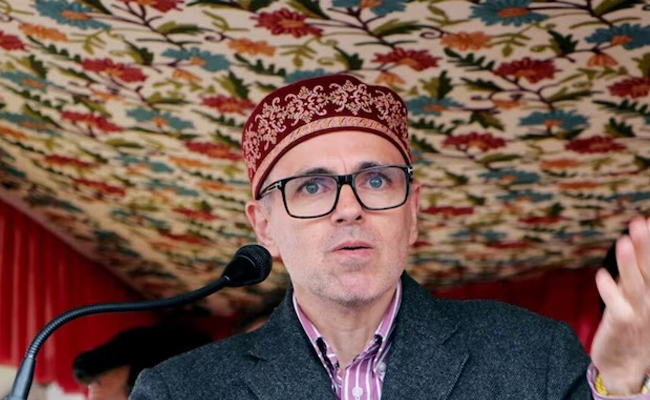
Srinagar (PTI): Jammu and Kashmir Chief Minister Omar Abdullah on Tuesday attributed the BJP's West Bengal win to a "significant role" played by the Election Commission (EC), alongside a consolidation of Hindu votes and a fractured minority mandate.
Abdullah also said the INDIA bloc needs to define its role in the political landscape of the country and make it clear whether the opposition alliance was limited to the parliamentary elections or extended to the state elections as well.
Talking to PTI Videos, Abdullah hinted that the EC has compromised its neutrality by conducting the Special Intensive Revision (SIR) in West Bengal and linked it to the BJP's gains in the state, claiming large-scale deletion of legitimate voters.
On the performance of the BJP in the just concluded assembly elections, Abdullah said the saffron party has almost nothing to show in southern states.
"So then you look at West Bengal and Assam. Yes, the BJP improved its tally in Assam. There are various reasons for that. You know as well as I do, what those are. West Bengal, I think we need to look at the results very carefully," he said.
"The easiest explanation for the West Bengal result is the serious curtailing of voter list," Abdullah said.
"Voters found their names deleted. People who served in uniform and fought for this country on the borders, who were considered Indian citizens all their lives, were suddenly held to a higher standard and not allowed to vote. Something is not right," he said.
While alleging that the EC played a "significant part" in the results, the chief minister admitted the outcome was multifaceted and noted a consolidation of over 60 per cent of the Hindu vote towards the BJP and a "significant fracture" in the minority vote, particularly in seats where Muslims constitute over 50 per cent of the population.
"There is no doubt that the role of the Election Commission played a significant part in the results but we will also have to look at the other factors," he said.
He said the results of West Bengal cannot be compared to those in other states. "The situation was unique to West Bengal. The SIR that was done, the way in which the voter lists were changed, the sort of minute scrutiny that the Election Commission subjected West Bengal to, the role of the central investigative agencies.
"All of these are situations that at least in recent electoral history of India are unique to West Bengal. So to suggest that we can learn lessons from West Bengal and implement them in other parts of the country, I think would not be correct," he said.
Abdullah had recently said that if the West Bengal results throw a surprise, the role of EC will come under scrutiny.
However, during Tuesday's interview, the chief minister said he still maintains that electronic voting machines (EVMs) do not lead to vote theft.
"What we saw in West Bengal...I know there are a lot of people who believe that the EVMs themselves are flawed. I am not a proponent of that conspiracy theory.
"But I do believe that the Election Commission has done itself no favours in the way in which it has gone about both the process of delimitation and the process of finalisation of electoral rolls," he said and cited the example of delimitation exercise in Jammu and Kashmir or Assam.
"These are clear examples of how the process was done to benefit one party or in the case of Jammu and Kashmir, one party and its allies. And the results speak for themselves. You created seven new seats in Jammu and Kashmir and out of those six seats were won by the BJP. You redrew assembly constituencies to benefit one particular party or its allies. And the same is true for West Bengal as well," he said.
Referring to the INIDA bloc, he said the election results were no new message for the alliance.
"We need to decide what the INDIA bloc is for. Is it only for Parliament or for state elections as well?" he asked.
"What happened in West Bengal is unfortunate. The Congress and TMC fought against each other. Now the Congress agrees with Mamata Banerjee that 100 seats were stolen, but the fact is they fought each other," he said.
Despite the friction, Abdullah reaffirmed the "pre-eminent position" of the Congress within the opposition alliance, dismissing the idea of any other party assuming the mantle.
"The Congress is the only party other than the BJP with a pan-India presence. All of us acknowledge this," he stated.
"To suggest someone else can assume a leadership role would be incorrect. Kharge Sahib is the president of the Congress, and by virtue of that, he assumes leadership of the INDIA bloc meetings. That is the way it should be," the chief minister said.
Abdullah said any 'Common Minimum Programme' would depend on whether the opposition alliance decides to fight state assembly elections collectively, noting that he would share his specific views with the bloc internally rather than through the media.