South Korea's President Yoon Suk Yeol removed from office over declaration of martial law
Seoul (AP): South Korea's Constitutional Court removed impeached President Yoon Suk Yeol from office on Friday, ending his tumultuous presidency and setting up an election to find a new leader, four months after he threw South Korean politics into turmoil with an ill-fated declaration of martial law.
The unanimous verdict capped a dramatic fall for Yoon, a former star prosecutor who went from political novice to president in 2022, just a year after he entered politics.
In a nationally televised verdict, the court's acting chief Moon Hyung-bae said the eight-member bench upheld Yoon's impeachment because his martial law decree seriously violated the constitution and other laws.
“The defendant not only declared martial law, but also violated the constitution and laws by mobilizing military and police forces to obstruct the exercise of legislative authority,” Moon said, “Ultimately, the declaration of martial law in this case violated the substantive requirements for emergency martial law.”
“Given the grave negative impact on constitutional order and the significant ripple effects of the defendant's violations, we find that the benefits of upholding the constitution by removing the defendant from office far outweigh the national losses from the removal of a president,” the justice concluded.
Protesters erupt in jubilation and sorrow
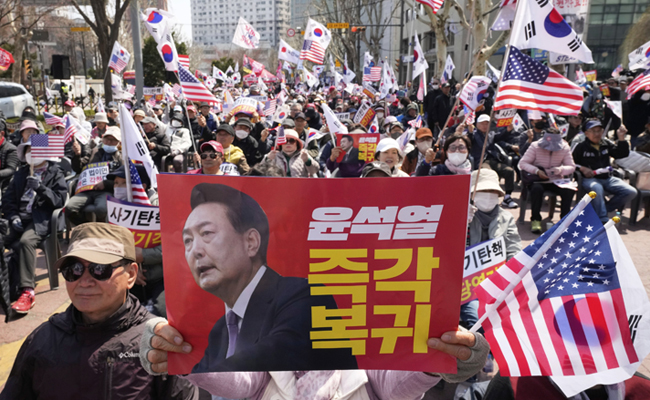
At an anti-Yoon rally near the old royal palace that dominates downtown Seoul, people erupted into tears and danced when the verdict was announced. Two women wept as they hugged and an old man near them leapt to his feet and screamed with joy.
The crowd later began marching through Seoul streets. Some people were dressed in cute blue bear costumes, a protest mascot that uses the opposition's colours.
Outside Yoon's official residence, thousands of supporters cried and screamed when they saw the news of the verdict on a giant TV screen. They waved South Korean and U.S. flags and chanted slogans.
“We will absolutely not be shaken!” a protest leader shouted on stage. “Anyone who accepts this ruling and prepares for an early presidential election is our enemy.”
No major violence was immediately reported.
Korea faces an election with deep divisions
An election will be held within two months to repalce Yoon, but a festering national divide over Yoon's impeachment will likely continue and could complicate South Korea's efforts to deal with President Donald Trump's “America First” policies and North Korea's expanding ties with Russia, observers say.
One of Yoon's lawyers, Yoon Kap-keun, called the ruling “completely incomprehensible” and a “pure political decision,” but the former president did not immediately issue a statement. Yoon's ruling People Power Party said it would accept the decision.
Prime Minister Han Duck-soo, the country's acting leader, in a televised speech vowed to ensure “there are no gaps in national security and diplomacy” and maintain public safety and order. Han was appointed prime minister, the country's No.2 official, by Yoon.
“Respecting the will of our sovereign people, I will do my utmost to manage the next presidential election in accordance with the constitution and the law, ensuring a smooth transition to the next administration,” Han said.
Surveys show Lee Jae-myung, leader of the main liberal opposition Democratic Party, is the early favorite to win the by-election to choose Yoon's successor. Lee is facing trials for corruption and other charges.
Lee welcomed the ruling and credited the South Korean people for “protecting our democratic republic.”
“The courage of the people who stood in the face of guns, swords and tanks, along with the bravery of troops who refused to obey unjust orders, has led to this great revolution of light,” Lee said.
Crisis started with a night of chaos four months ago
Martial law lasted only six hours, but left behind a political crisis, rattling financial markets and unsettling the country's diplomatic partners. In January, Yoon was separately arrested and indicted by prosecutors on alleged rebellion in connection with his decree, a charge that carries the death penalty or a life sentence if convicted.
Under Yoon's decree, the first of its kind in more than 40 years, hundreds of soldiers were dispatched to the assembly, election offices and other sites. Special operations soldiers smashed windows at the National Assembly and scuffled with citizens gathered to protest, shocking South Koreans and evoking traumatic memories of military rule.
Enough lawmakers, including some from the ruling party, managed to enter the assembly to vote down his decree unanimously.
No major violence occurred during the brief period of martial law, but some senior military and police officers sent to the assembly have testified that Yoon ordered them to drag out lawmakers to block a vote on his decree or to detain his political rivals. Yoon says the troops were deployed to the assembly simply to maintain order.
Yoon, 64, a conservative, was impeached by the liberal opposition-controlled National Assembly on Dec. 14. The assembly accused him of violating the constitution and other laws by suppressing assembly activities, attempting to detain politicians, and undermining peace across the country.
In his final testimony at the Constitutional Court hearing, Yoon said his decree was a desperate attempt to draw public support of his fight against the “wickedness” of the Democratic Party, which had obstructed his agenda, impeached top officials and slashed the government's budget bill. He earlier called the National Assembly “a den of criminals” and “anti-state forces.”
Yoon still faces criminal charges
Some experts say Yoon may have imposed military rule to head off a possible independent investigation into scandals involving his wife, Kim Keon Hee.
Without presidential immunity, Yoon could face other criminal charges, such as abuse of power. He's the first South Korean president to be arrested or indicted while in office.
Yoon served as prosecutor-general under his predecessor, liberal President Moon Jae-in, before joining the now-ruling party in 2021 following disputes with Moon allies. A public image as strong-minded and uncompromising helped him defeat Lee in the close-fought 2022 presidential election. But after becoming president, Yoon has faced criticism that he refused to replace officials implicated in scandals and vetoed many bills passed by the assembly.
On foreign policy, Yoon pushed hard to bolster South Korea's military alliance with the United States and overcome long-running disputes with Japan over historical traumas. He said that a greater Seoul-Washington-Tokyo security partnership is essential to coping with North Korea's growing nuclear threats. Critics of Yoon accused him of unnecessarily provoking North Korea and neglecting relations with China, South Korea's biggest trading partner.
Let the Truth be known. If you read VB and like VB, please be a VB Supporter and Help us deliver the Truth to one and all.
Maharashtra sets up state vaccination task force to strengthen immunisation programme

Mumbai (PTI): The Maharashtra government has set up a State Vaccination Task Force to strengthen the regular immunisation programme and review the progress of related campaigns, a health department official said on Monday.
The State Vaccination Task Force will comprise at least 29 members and will be headed by the administrative head of the health department, he informed.
The government has also constituted separate district-level and municipal vaccination task forces to improve implementation and address challenges at the grassroots level, he said.
Municipal task forces, chaired by respective civic commissioners, have been constituted in view of the vast urban population in Maharashtra and the role of civic bodies in implementing different health programmes.
The district-level task forces will function under the chairmanship of collectors.
"Complete immunisation of children at the appropriate age is an extremely simple, cost-effective and highly effective measure to reduce child mortality and the prevalence of diseases among kids. Immunisation is a powerful tool for reducing illness in children," maintained the official.
To ensure full vaccination of all children, the state government implements various campaigns from time to time as per the central government guidelines, he pointed out.
"Active participation and cooperation of other relevant government departments are essential (in making these campaigns successful)," according to the official.
The state-level body will review the regular immunisation programme, associated campaigns and vaccine-preventable diseases in detail. It will also conduct focused assessments of high-risk districts and municipal corporations, including vacancies at district, municipal and sub-district levels, availability of cold chain equipment, resource gaps and training requirements, he noted.
The state task force will review allocation and utilisation of funds for immunisation and ensure timely action by officers concerned based on reports from district and municipal task forces and state-level monitoring mechanisms, the official said.
It will also ensure active coordination and participation of other government departments in immunisation drives, while district and municipal task forces will carry out similar functions at their respective levels, the official added.