SpaceX capsule and NASA crew make 1st splashdown in 45 years
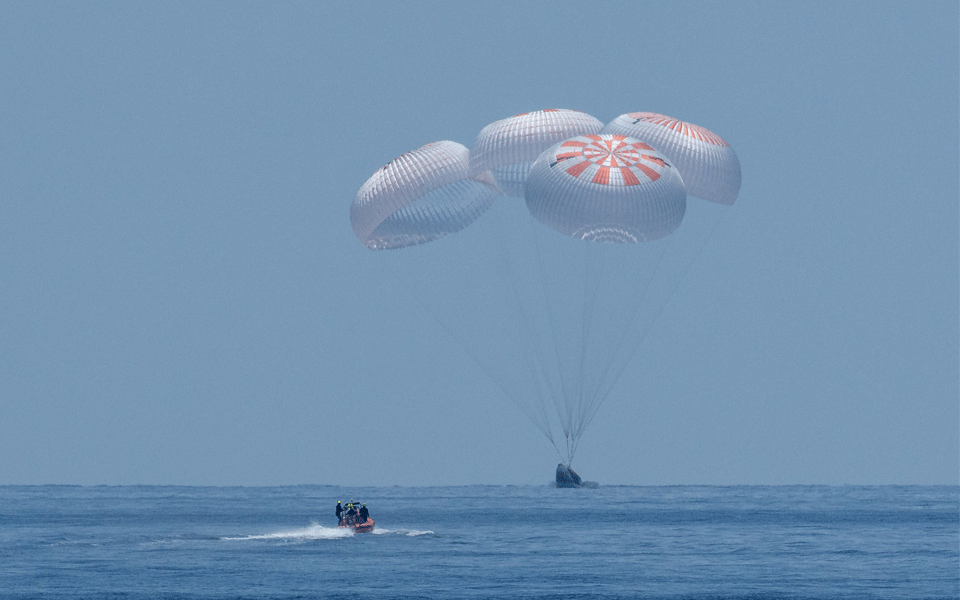
Cape Canaveral (US): Two NASA astronauts returned to Earth on Sunday in a dramatic, retro-style splashdown, their capsule parachuting into the Gulf of Mexico to close out an unprecedented test flight by Elon Musk's SpaceX company.
It was the first splashdown by US astronauts in 45 years, with the first commercially built and operated spacecraft to carry people to and from orbit. The return clears the way for another SpaceX crew launch as early as next month and possible tourist flights next year.
Test pilots Doug Hurley and Bob Behnken arrived back on Earth in their SpaceX Dragon capsule named Endeavour, less than a day after departing the International Space Station and two months after blasting off from Florida.
The capsule parachuted into the calm gulf waters about 40 miles off the coast of Pensacola, hundreds of miles from Tropical Storm Isaias pounding Florida's Atlantic coast.
Welcome back to planet Earth and thanks for flying SpaceX, said Mission Control from SpaceX headquarters.
It's a little bit overwhelming to see everybody here considering the things that have gone on the last few months since we've been off planet," Hurley said after arriving back home in Houston Sunday evening where they were greeted by a small masked-gathering of family and officials, including Musk. Musk had rushed to Houston from SpaceX headquarters in Hawthorne, California, to welcome them. He was clearly moved and relieved while addressing the group.
I'm not very religious, but I prayed for this one, he said. The astronauts' ride back to Earth was fast, bumpy and hot, at least on the outside.
The spacecraft went from a screaming orbital speed of 17,500 mph (28,000 kph) to 350 mph (560 kph) during atmospheric reentry, and finally to 15 mph (24 kph) at splashdown. Peak heating during descent was 3,500 degrees Fahrenheit (1,900 degrees Celsius). The anticipated top G forces felt by the crew: four to five times the force of Earth's gravity.
Within a half-hour of splashdown, the scorched and blistered 15-foot capsule was hoisted aboard a SpaceX recovery ship with a staff of more than 40, including doctors and nurses.
To keep the returning astronauts safe in the pandemic, the recovery crew quarantined for two weeks and were tested for the coronavirus.
The opening of the hatch was held up briefly by extra checks for toxic rocket fumes outside the capsule. After medical checkups, the astronauts were flown by helicopter to Pensacola and then to Houston.
There was one unexpected problem that could have endangered the operation: Once the capsule was in the water, private boats "just made a beeline for it, and got too close, said NASA Administrator Jim Bridenstine, promising to do better next time at keeping sightseers on pleasure boats safely away. NASA video showed one vessel flying a large campaign flag for President Donald Trump.
The Coast Guard in Pensacola said it had deployed two vessels to keep the public at least 10 miles away from the capsule. Trump and Vice President Mike Pence, who both attended the launch, congratulated the SpaceX and NASA teams.
Great to have NASA Astronauts return to Earth after very successful two month mission. Thank you to all! Trump tweeted.
The last time NASA astronauts returned from space to water was on July 24, 1975, in the Pacific, the scene of most splashdowns, to end a joint U.S.-Soviet mission known as Apollo-Soyuz.
The Mercury and Gemini crews in the early to mid-1960s parachuted into the Atlantic, while most of the later Apollo capsules hit the Pacific. The lone Russian splashdown was in 1976 on a partially frozen lake amid a blizzard following an aborted mission; the harrowing recovery took hours.
Gemini and Apollo astronaut Thomas Stafford the commander of the last crew to splash down watched the reentry on TV from his Florida home. While pleased with the crew's safe return, he wasn't overly impressed. It's what we did over 50 years ago," he said.
Its throwback splashdown aside, SpaceX made history with the mission, which launched May 30 from NASA's Kennedy Space Center.
It was the first time a private company launched people into orbit and also the first launch of NASA astronauts from home turf in nearly a decade. Hurley was the pilot of NASA's last space shuttle flight in 2011 and the commander of this SpaceX flight.
NASA turned to SpaceX and also Boeing to build capsules and ferry astronauts to and from the space station, following the retirement of the shuttles.
Until Hurley and Behnken rocketed into orbit, NASA astronauts relied on Russian rockets. SpaceX already had experience hauling cargo to the space station, bringing those capsules back to a Pacific splashdown.
We are entering a new era of human spaceflight where NASA is no longer the purchaser, owner and operator of all the hardware. We're going to be a customer, one customer of many," Bridenstine said from Johnson Space Center in Houston.
"I would love to see a fleet of crew Dragons servicing not just the International Space Station but also commercial space stations. SpaceX President Gwynne Shotwell called the mission a springboard to doing even harder things, like collaborating on astronaut flights to the moon and then Mars.
A Houston company run by a former NASA official, meanwhile, has partnered with SpaceX to send three customers to the space station in fall 2021.
Let the Truth be known. If you read VB and like VB, please be a VB Supporter and Help us deliver the Truth to one and all.
Remarks against St Francis Xavier: Right-wing speaker Gautam Khattar gets bail

Panaji (PTI): A court in Goa on Saturday granted bail to right-wing speaker Gautam Khattar, who was arrested after he allegedly made derogatory comments against St Francis Xavier.
Judicial Magistrate First Class, Vasco, granted regular bail to Khattar, currently admitted to Goa Medical College and Hospital at Bambolim for treatment of chest pain after he was shifted from the District Hospital in Mapusa two days back.
A row erupted after a video of remarks by Khattar, the founder of Sanatan Mahasangh, at an event on April 18 in the presence of Swami Brahmeshanand, State Transport Minister Mauvin Godinho and BJP MLAs Sankulp Amonkar and Daji (Krishna) Salkar, went viral.
St Francis Xavier is revered as the patron saint of Goa.
The controversial remarks led to the Vasco Police registering an FIR against Khattar on charges of hurting religious sentiments and creating enmity between groups.
He was detained in Kullu, Himachal Pradesh, by local police. His custody was later handed over to the Goa Crime Branch, according to officials.