Spain virus toll tops 1,000, nearly 20,000 infected
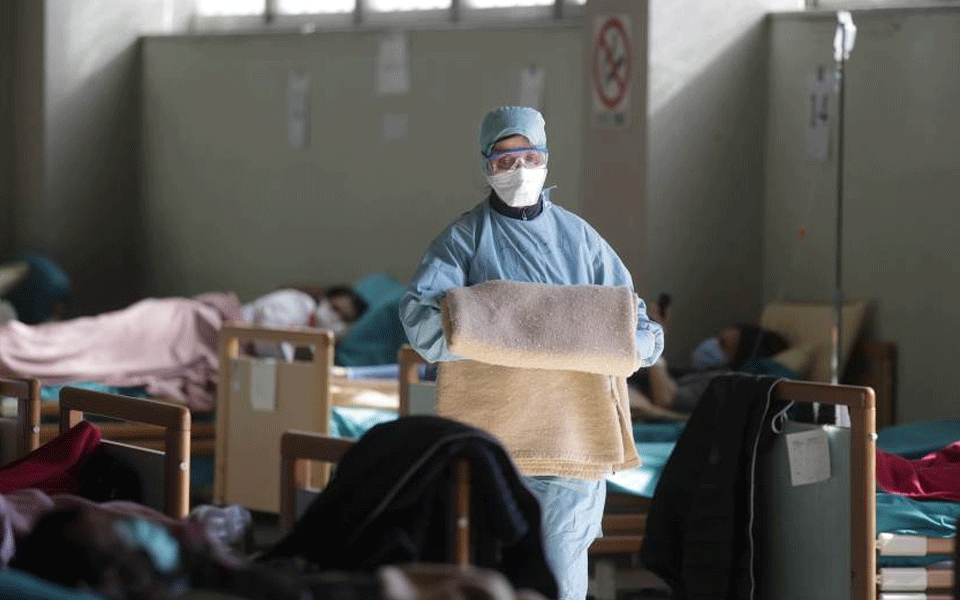
Madrid: The coronavirus death toll rose to 1,002 in Spain on Friday after 235 people died in 24 hours, and the number of cases approached 20,000, the health ministry said.
The spiralling number of infections has propelled Spain into the top four worst-hit countries in the world -- with the figures growing as the country steps up its capacity for testing.
Over the past seven days, the number of deaths has risen 10-fold, the figures show.
Since the last update around midday on Thursday, another 2,833 infections have been confirmed, taking the overall number of cases to 19,980, the ministry's emergencies coordinator Fernando Simon said.
But he said it was "very likely that the figures underestimated the overall number" of people with the virus, saying the testing laboratories were "overwhelmed" which could skew the numbers.
Of those diagnosed, 52 percent were in hospital and around six percent were being treated in intensive care.
Madrid remains the worst-hit area, accounting for 7,165 cases, or 36 per cent of the total infections in Spain, while the number of deaths in the capital rose to 628 -- around 63 per cent of the national total.
Government figures show that 1,585 cases have recovered, three-quarters of whom are in the Madrid region.
Meanwhile, Madrid and Barcelona announced on Friday they would set up field hospitals in their biggest exhibition halls to deal with the anticipated growth in the number of patients.
In Madrid, the IFEMA conference centre would be fitted with 5,500 hospital beds, part of it dedicated to an intensive care unit, while a section of the Fira de Barcelona centre would be similarly equipped, city authorities said.
Over the last few hours, a total of 2,640 troops had disinfected the country's main airports and ports along with retirement homes and prisons, General Miguel Angel Villarroya, chief of the defence staff, told the same news conference.
On Thursday, police arrested 55 people for not respecting the lockdown that was put in place at the weekend, under which Spain's 46 million population can only leave home to shop for food or medicine, go to the hospital or go to work.
National police chief Jose Angel Gonzalez said there was "a rising trend" in the number of people defying the stay-home order, warned that police were operating with a policy of "zero tolerance".
Let the Truth be known. If you read VB and like VB, please be a VB Supporter and Help us deliver the Truth to one and all.
Man arrested with Rs 2.54-crore heroin in Mumbai

Mumbai (PTI): Police have arrested a man and seized over 500 grams of heroin worth Rs 2.54 crore in the illicit market from him in Mumbai, officials said on Friday.
The police's Anti-Narcotics Cell (ANC) made the drug seizure in Santacruz in the western suburbs. The operation was conducted by the Kandivali unit of the ANC on Thursday as part of a special crackdown against drug trafficking in the area, they said.
Acting on specific inputs, an ANC team conducted a raid in Santacruz (East) and intercepted a man. During a search, the team recovered 508 grams of high-grade heroin from his possession, an official said.
The seized contraband, a highly addictive, opioid drug derived from morphine, is estimated to be worth Rs 2.54 crore in the international market, he informed.
Following the seizure, a case was registered against the man under relevant sections of the Narcotic Drugs and Psychotropic Substances (NDPS) Act, 1985, and he was formally placed under arrest in the early hours of Friday.
The police are currently investigating the source of the drug and trying to identify the intended recipients of the consignment, he said.