Sri Lanka identifies outfit behind blasts; says all suicide bombers Lankan nationals
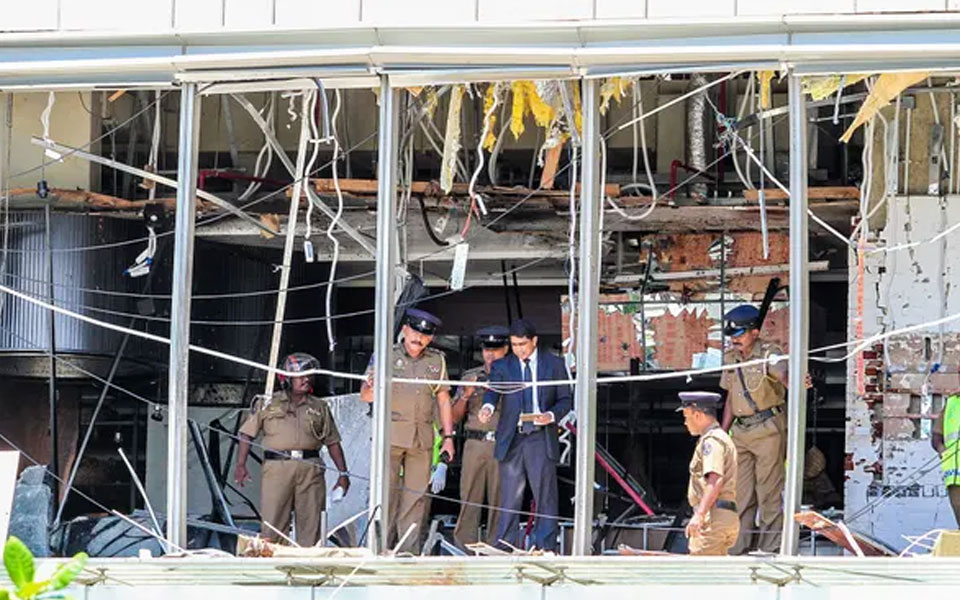
Colombo: A local outfit identified as the National Tawheed Jamath is suspected of plotting the deadly Easter blasts that killed 290 people and wounded 500 others in the worst terror attack in the country's history, a top Sri Lankan minister said on Monday.
Health Minister and the government spokesman, Rajitha Senaratne, also said that all suicide bombers involved in the blasts are believed to be Sri Lankan nationals.
Speaking at a press conference here, the minister said that the Chief of National Intelligence had warned the Inspector General of Police (IGP) regarding the probable attacks before April 11.
"On April 4, international intelligence agencies had warned of these attacks. The IGP was informed on April 9," Senaratne said. He said that the local outfit identified as the National Tawheed Jamath is suspected of plotting the deadly explosions.
"There may be international links to them," he added. Senaratne sought resignation of police chief Pujith Jayasundera in view of the major security lapse.
Rauff Hakeem, a government minister and the leader of the main Muslim party - Sri Lanka Muslim Congress, said that it was lamentable that no preventive action had been taken despite the inputs.
"They have known this..., the names have been given, identified, but (they) took no action," he added.
Two Sri Lankan Muslim groups - the All Ceylon Jamiyyathul Ulama and the National Shoora Council - have condemned the blasts and offered condolences to the Christian community.
They have urged that all culprits be brought to book.
Seven suicide bombers were involved in eight blasts that targeted St Anthony's Church in Colombo, St Sebastian's Church in Negombo and Zeon Church in Batticaloa when the Easter Sunday mass were in progress. The explosions also struck three five-star hotels in Colombo - the Shangri-La, the Cinnamon Grand and the Kingsbury.
No group has claimed responsibility for Sunday's attacks, but police have so far arrested 24 people.
Let the Truth be known. If you read VB and like VB, please be a VB Supporter and Help us deliver the Truth to one and all.
AIITA welcomes Karnataka’s ban on obscene songs in school events
Bhatkal: The Karnataka unit of the All India Ideal Teachers Association (AIITA) has welcomed the Karnataka government’s decision to strictly ban school children from dancing to obscene songs during educational and cultural programmes in government, aided, and private schools across the state.
AIITA Karnataka State President M. R. Manvi congratulated the government for taking what he termed an important step to preserve the sanctity of education.
“Such decisions to safeguard the dignity of school children and uphold the values of education are the need of the hour. This rule should not be limited to government schools alone but must be strictly implemented in all private educational institutions as well,” he said.
He further urged the government to address other concerns within school programmes.
“The government should not only prohibit obscene dances in the name of school anniversaries, but also ensure that plays and dialogues that incite religious hatred are avoided. Schools should be centres of harmony, not platforms for spreading hatred,” he added.
According to a recent circular issued by the Department of School Education and Literacy, obscene dances are adversely affecting the mental health and moral values of students.
In this regard, schools have been advised to use songs that promote nationalism, positive thinking, the greatness of Kannada culture, and value-based traditions instead of inappropriate content during programmes.
The circular also emphasises that students should be dressed in decent attire.
AIITA also backed the department’s warning that disciplinary action would be taken against head teachers if such guidelines are violated. The association has further demanded that district Deputy Directors of Public Instruction strictly monitor the implementation of these rules.