Sri Lanka police lifts nationwide curfew, arrests 60 people for anti-Muslim riots
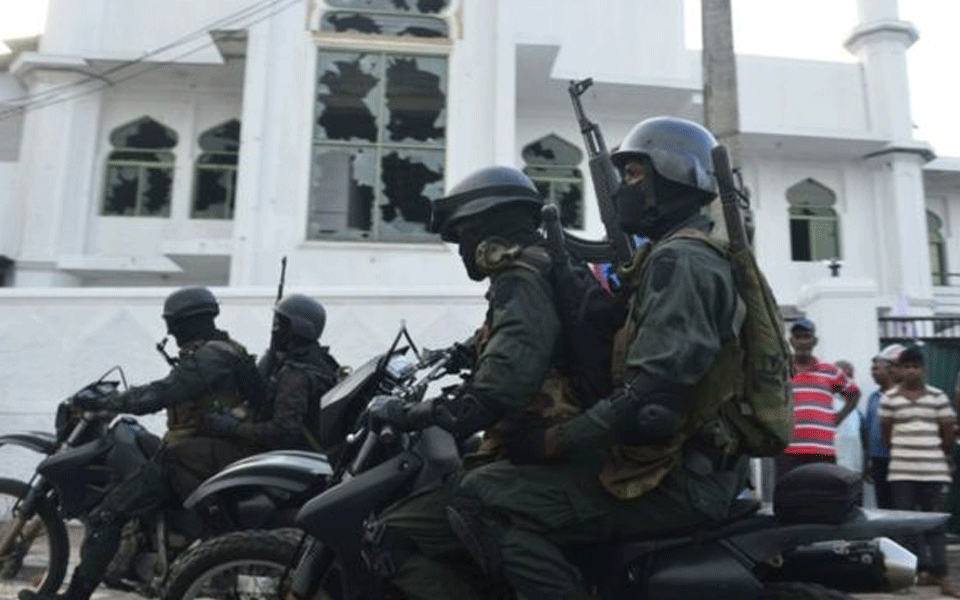
Colombo: Sri Lankan authorities said they have arrested 60 people linked to the communal riots as a nationwide curfew was lifted on Wednesday in the island nation, which witnessed Sinhalese mob attacks on Muslim-owned shops and businesses in the aftermath of the deadly Easter blasts.
The government imposed the island-wide curfew on Monday after the violence against the Muslim community, who account for 10 per cent of the country's population. The curfew was briefly lifted on Tuesday before being reimposed for a second straight night following reports of fresh violence in some parts of the country.
"The curfew imposed in the North-western Province and Gampaha Police division was removed at 6 am Wednesday while the curfew in the other areas of the island ended at 4 am," police media spokesman's office stated.
The situation in the province is returning to normalcy, authorities said. There were no incidents of violence overnight and groups of people responsible for taking part in mob attacks have been arrested, they said.
"Thirty-three suspects arrested in connection with the anti-Muslim riots have been remanded and over 60 people have been arrested. The suspects can be sentenced to 10 years in prison under the International Covenant on Civil and Political Rights (ICCPR), police spokesman Ruwan Gunasekara said.
The police media spokesman said the illegal activities committed by the persons engaged in violence will be noted in their police certificates.
The academic activities of all schools and all the state institutions in the province were resumed on Wednesday, the Wayamba Province Governor Peshala Jayaratne said.
The recent violence is a fresh backlash from the Easter attacks where nine suicide bombers, including a woman, carried out a series of devastating blasts that tore through three churches and three luxury hotels, killing 258 people and injuring over 500 others.
Muslims said that rioters went about destroying their properties and setting fire to them even after curfew hours. They accused the security forces and the police for becoming silent watchers to the rioting.
Muslim political parties said at least one person was killed in the riots. The attacks come during the Muslim holy fasting month of Ramazan.
The government also reimposed a ban on social media following the violent clashes. The government which blocked Facebook and WhatsApp on Tuesday extended the blockade to Twitter.
The social media blockade is meant to prevent the spread of rumours and hate comments, the Telecommunications Regulatory Authority said. Sri Lanka has a population of 21 million which is a patchwork of ethnicities and religions, dominated by the Sinhalese Buddhist majority.
Muslims account for 10 per cent of the population and are the second-largest minority after Hindus. Around seven per cent of Sri Lankans are Christians.
Let the Truth be known. If you read VB and like VB, please be a VB Supporter and Help us deliver the Truth to one and all.
AIITA welcomes Karnataka’s ban on obscene songs in school events
Bhatkal: The Karnataka unit of the All India Ideal Teachers Association (AIITA) has welcomed the Karnataka government’s decision to strictly ban school children from dancing to obscene songs during educational and cultural programmes in government, aided, and private schools across the state.
AIITA Karnataka State President M. R. Manvi congratulated the government for taking what he termed an important step to preserve the sanctity of education.
“Such decisions to safeguard the dignity of school children and uphold the values of education are the need of the hour. This rule should not be limited to government schools alone but must be strictly implemented in all private educational institutions as well,” he said.
He further urged the government to address other concerns within school programmes.
“The government should not only prohibit obscene dances in the name of school anniversaries, but also ensure that plays and dialogues that incite religious hatred are avoided. Schools should be centres of harmony, not platforms for spreading hatred,” he added.
According to a recent circular issued by the Department of School Education and Literacy, obscene dances are adversely affecting the mental health and moral values of students.
In this regard, schools have been advised to use songs that promote nationalism, positive thinking, the greatness of Kannada culture, and value-based traditions instead of inappropriate content during programmes.
The circular also emphasises that students should be dressed in decent attire.
AIITA also backed the department’s warning that disciplinary action would be taken against head teachers if such guidelines are violated. The association has further demanded that district Deputy Directors of Public Instruction strictly monitor the implementation of these rules.