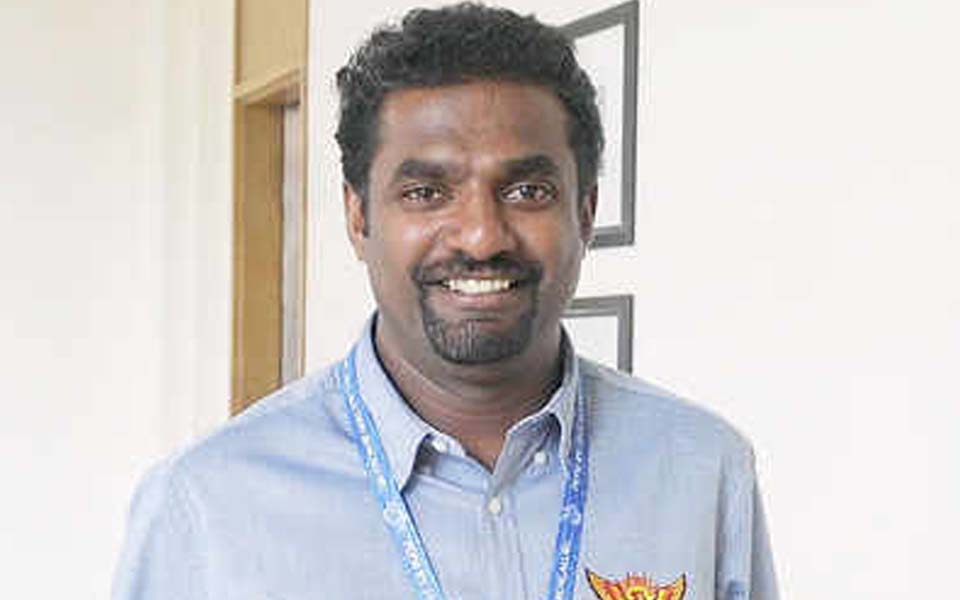
Colombo, Nov 27: Sri Lankan spin legend Muttiah Muralitharan is set to play a different innings as governor of the country's Tamil-dominated Northern Province after President Gotabaya Rajapaksa "personally invited" him to accept the post, a media report said on Wednesday.

The 47-year-old ace spinner, the record holder for highest wickets in Test cricket (800), is among the three new governors tipped to be appointed by Gotabaya Rajapaksa, who registered a thumping victory in the November 16 presidential election.

"President Gotabaya Rajapakse had personally invited Muralidharan to accept the post of the Governor of the Northern Province," the Daily Mirror quoted Presidential Secretariat sources as saying.

Muralitharan is to be appointed as the governor of the Northern Province, while Anuradha Yahampath would become the governor of the Eastern Province and Tissa Vitharana will take charge as the governor of the North Central Province, the report said.

Yahampath is the chairperson of the Nationalist Entrepreneurs Association and a Director of a reputed garment export company.

Vitharana is a former minister and the leader of the Lanka Sama Samaja Party (LSSP), a Trotskyist political party. He is also a specialist doctor.

Muralitharan married Madhimalar Ramamurthy, a Chennai native, in March 2005. He was rated the greatest Test match bowler ever by Wisden Cricketers' Almanack in 2002. He retired from Test cricket in 2010.

Let the Truth be known. If you read VB and like VB, please be a VB Supporter and Help us deliver the Truth to one and all.


New Delhi (PTI): The Union Cabinet on Friday approved Rs 11,718 crore for conducting the Census of India, 2027, which would include the caste enumeration for the first time.

Addressing a briefing, Information and Broadcasting Minister Ashwini Vaishnaw said the cabinet, chaired by Prime Minister Narendra Modi, approved the proposal to conduct the Census which will be the first digital exercise.

Around 30 lakh enumerators would be involved in the entire exercise.

The 16th edition of the Census since Independence will also provide an option of self enumeration to the citizens.

The decadal exercise which was scheduled to take place in 2021 got postponed due to the outbreak of the COVID-19 pandemic across the country.

The minister said the Census will be conducted in two phases -- house-listing and housing census from April to September, 2026; and population enumeration (PE) in February 2027.

For Ladakh and snow-bound non-synchronous areas of the Union Territory of Jammu and Kashmir and states of Himachal Pradesh and Uttarakhand, the PE exercise shall be conducted in September, 2026, the minister said.

ALSO READ: Govt has powers to cap airfares but it is not single-way solution: Aviation Minister Naidu

"This will become the first-ever digital census," Vaishnaw told reporters.

Around 30 lakh enumerators will visit each and every household and canvass a separate questionnaire for houselisting and housing census and population enumeration. It will generate 1.02 crore human days of employment, the minister said.

Vaishnaw said the entire digital census system has been created as a very robust system and all personal data protection laws will be applicable. The census will collect the micro-level data of every individual and household and present a macro-level data, he added.

"Data of the micro-level will be collected from each household and a macro picture will be present. Individual data will be kept confidential while the macro-level data of the Census will be published," the minister said.

"All the Census functionaries will be paid a suitable honorarium for the work of the Census as they will be doing this work in addition to their regular duties," a government statement said.

The Census 2027 will also capture caste data electronically in the PE phase, Vaishnaw said.

In the first-ever digital Census, data will be collected using mobile applications that will be available for both Android and iOS versions.

Use of a mobile app for data collection and the central portal for monitoring purposes will ensure better quality data, Vaishnaw said.

Data dissemination will be much better and in a user-friendly way so that all queries on required parameters for policy-making will be available with a click of a button, he said.

"A dedicated portal, namely Census Management & Monitoring System (CMMS), has been developed for managing and monitoring the entire Census process on a real-time basis," a government statement said.

Census-as-a-Service (CaaS) will deliver data to ministries in a clean, machine-readable and actionable format, he said.

The largest administrative and statistical exercise in the world will be done using a mobile app for data collection and the central portal for monitoring purposes will ensure better quality data.

"The current endeavour would be to make available the coming Census data at the shortest possible time across the country. Efforts will also be made to disseminate Census results with more customised visualisation tools. Data sharing to all, up to the lowest administrative unit i.e. village/ ward level," the statement said.

Houselisting block (HLB) creator web map application will be another innovation for Census 2027 which will be used by the charge officers.

ALSO READ: Shivakumar says cricket matches at Chinnaswamy stadium allowed to protect Bengaluru's image

The statement said around 18,600 technical manpower will be engaged for about 550 days at the local levels which would imply that around 1.02 crore man-days employment would be generated.

"Further, the provision of technical manpower at the charge/ district/ state-level will also result in capacity-building as the nature of the job will be related to digital data handling, monitoring and coordination. This will also help in the future employment prospects of these persons," it said.

The provision of technical manpower at various levels will also result in capacity-building as the nature of the job will be related to digital data handling, monitoring and coordination.

"This will also help in the future employment prospects of these persons," the statement said.

The mammoth exercise is the biggest source of primary data at the village, town and ward-level providing micro-level data on various parameters including housing condition, amenities and assets, demography, religion, SC and ST, language, literacy and education, economic activity, migration and fertility.

The last comprehensive caste-based count was done by the Britishers between 1881 and 1931. Caste was excluded from all Census operations conducted since Independence.

The decision to include caste enumeration in the upcoming Census was taken by the Cabinet Committee on Political Affairs chaired by Prime Minister Narendra Modi on April 30.

In 2010, then prime minister Manmohan Singh had assured the Lok Sabha that the matter of caste census would be considered in the cabinet.

However, the previous Congress-led government opted for a survey instead of a caste census, known as the Socio-Economic and Caste Census (SECC).

The population of the country according to the Census 2011 was 1,210.19 million of which 623.72 million (51.54 per cent) were males and 586.46 million (48.46 per cent) were females.