Sri Lanka's army chief in controversy over election ad
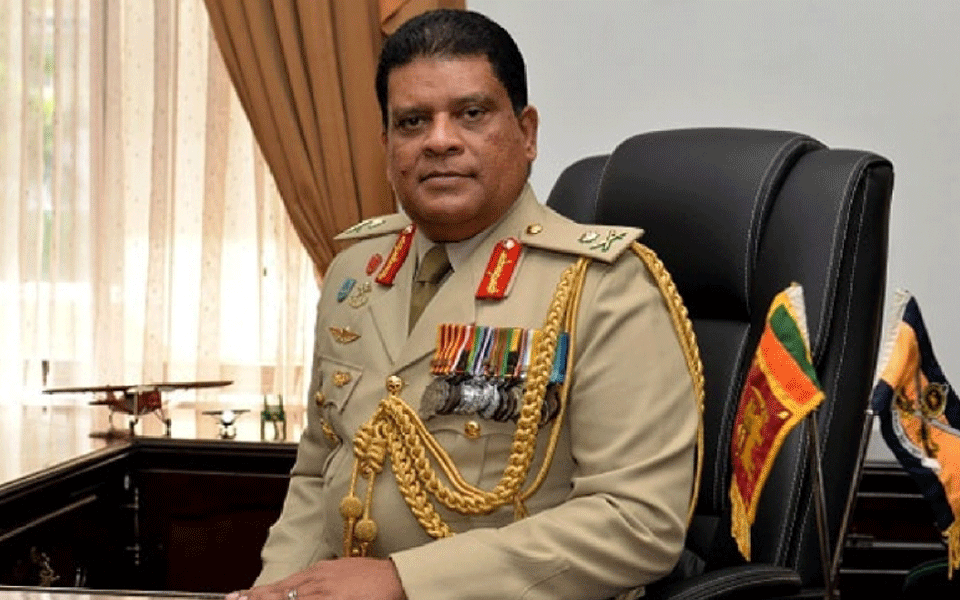
Colombo: Sri Lanka's election chief said Wednesday that he has asked for an explanation from the defense ministry on why the army commander features in an advertisement promoting a candidate for next month's presidential election.
The advertisement, which appeared in a newspaper last weekend, had comments made by Lt Gen Shavendra Silva, the current army chief, in 2009 praising presidential candidate Gotabaya Rajapaksa for his role in ending the country's long civil war.
Rajapaksa was defence chief at the time, serving under his brother, then-President Mahinda Rajapaksa, and Silva was an army division commander. The advertisement includes a photo of Silva in uniform with his comments.
Election chief Mahinda Deshapriya criticised the advertisement and said he has sought an explanation from the secretary to the defence ministry on why the army chief was being used to promote a presidential candidate.
"We highly regret this advertisement," said Deshapriya, adding that "it could be an old statement, but it is regrettable that the rank and designation of the present army commander had been used."
Mahinda Rajapaksa has swept to victory in several elections by promoting himself as the leader who defeated the once invincible Tamil Tiger rebels in the long civil war.
Gotabaya Rajapaksa's popularity is on the increase after April's Easter attacks in Sri Lanka that killed 263 people and wounded 500. But to his opponents and critics, he is a feared defence official accused of condoning rape, torture and shadowy disappearances of critics.
On Tuesday, he said that if he wins the November 16 election, he won't recognise an agreement the government made with the UN human rights council to investigate alleged war crimes during the civil war.
If he does win and follows through with his comments, it would be a severe setback to Sri Lanka's post-war reconciliation process.
Let the Truth be known. If you read VB and like VB, please be a VB Supporter and Help us deliver the Truth to one and all.
AIITA welcomes Karnataka’s ban on obscene songs in school events
Bhatkal: The Karnataka unit of the All India Ideal Teachers Association (AIITA) has welcomed the Karnataka government’s decision to strictly ban school children from dancing to obscene songs during educational and cultural programmes in government, aided, and private schools across the state.
AIITA Karnataka State President M. R. Manvi congratulated the government for taking what he termed an important step to preserve the sanctity of education.
“Such decisions to safeguard the dignity of school children and uphold the values of education are the need of the hour. This rule should not be limited to government schools alone but must be strictly implemented in all private educational institutions as well,” he said.
He further urged the government to address other concerns within school programmes.
“The government should not only prohibit obscene dances in the name of school anniversaries, but also ensure that plays and dialogues that incite religious hatred are avoided. Schools should be centres of harmony, not platforms for spreading hatred,” he added.
According to a recent circular issued by the Department of School Education and Literacy, obscene dances are adversely affecting the mental health and moral values of students.
In this regard, schools have been advised to use songs that promote nationalism, positive thinking, the greatness of Kannada culture, and value-based traditions instead of inappropriate content during programmes.
The circular also emphasises that students should be dressed in decent attire.
AIITA also backed the department’s warning that disciplinary action would be taken against head teachers if such guidelines are violated. The association has further demanded that district Deputy Directors of Public Instruction strictly monitor the implementation of these rules.