Strong earthquake kills 31 people in central Philippine region hit by deadly storm just days ago
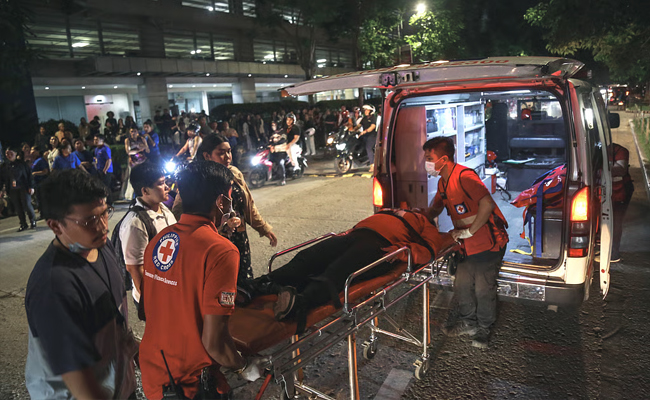
Manila (AP): An offshore earthquake of magnitude 6.9 collapsed walls of houses and buildings late Tuesday in a central Philippine province, killing at least 31 people, injuring many others and sending residents scrambling out of homes into darkness as the intense shaking cut off power, officials said.
The epicentre of the earthquake, which was set off by movement in a local fault at a depth of 5 kilometres, was about 19 kilometres northeast of Bogo, a coastal city of about 90,000 people in Cebu province where at least 14 residents died, disaster-mitigation officer Rex Ygot told The Associated Press by telephone.
The death toll in Bogo was expected to rise. Workers were trying to transport a backhoe to hasten search and rescue efforts in a cluster of shanties in a mountain village hit by a landslide and boulders, he said.
“It's hard to move in the area because there are hazards,” Glenn Ursal, another disaster-mitigation officer told The AP, adding some survivors were brought to a hospital.
At least 12 residents, mostly belonging to small families, died when they were hit by falling ceilings and walls of their houses, some while sleeping, in Medellin town near Bogo, Gemma Villamor, who heads the town's disaster-mitigation office, told The AP.
In San Remigio town, also near Bogo, five people, consisting of three coast guard personnel, a firefighter and a child, were killed separately by collapsing walls while trying to flee to safety from a basketball game that was disrupted by the quake, the town's vice mayor, Alfie Reynes, told the DZMM radio network.
Reynes appealed for food and water, saying San Remigio's water system was damaged by the earthquake.
Aside from houses in Bogo, the quake damaged a fire station and concrete and asphalt roads, firefighter Rey Cañete said.
“We were in our barracks to retire for the day when the ground started to shake and we rushed out but stumbled to the ground because of the intense shaking,” Cañete told The AP, adding that he and three other firemen sustained cuts and bruises.
A concrete wall in their fire station collapsed, Cañete said. He and fellow firefighters provided first-aid to at least three residents, who were injured by falling debris and collapsed walls.
Hundreds of terrified residents gathered in the darkness in a grassy field near the fire station and refused to return home hours after the earthquake struck in Bogo. Several business establishments visibly sustained damages and the asphalt and concrete roads where they passed had deep cracks, Cañete said, adding that an old Catholic church in Daanbantayan town near Bogo was also damaged.
Cebu Gov. Pamela Baricuatro said the extent of the damage and injuries in Bogo and outlying towns in the northern section of the province would not be known until daytime. “It could be worse than we think,” he said in a video message posted on Facebook.
The Philippine Institute of Volcanology and Seismology briefly issued a tsunami warning and advised people to stay away from the coastlines in Cebu and in the nearby provinces of Leyte and Biliran due to possible waves of up to 1 meter (3 feet).
Teresito Bacolcol, director of the institute, said the tsunami warning was later lifted with no unusual waves being monitored.
Cebu and other provinces were still recovering from a storm that battered the central region on Friday, leaving at least 27 people dead mostly due to drownings and falling trees, knocking out power in entire cities and towns and forcing the evacuation of tens of thousands of people.
The Philippines, one of the world's most disaster-prone countries, is often hit by earthquakes and volcanic eruptions due to its location on the Pacific “Ring of Fire,” an arc of seismic faults around the ocean. The archipelago is also lashed by about 20 typhoons and storms each year.
Let the Truth be known. If you read VB and like VB, please be a VB Supporter and Help us deliver the Truth to one and all.
Tribals, Scheduled Castes preserved India's identity and soul despite foreign invasions: Bhagwat
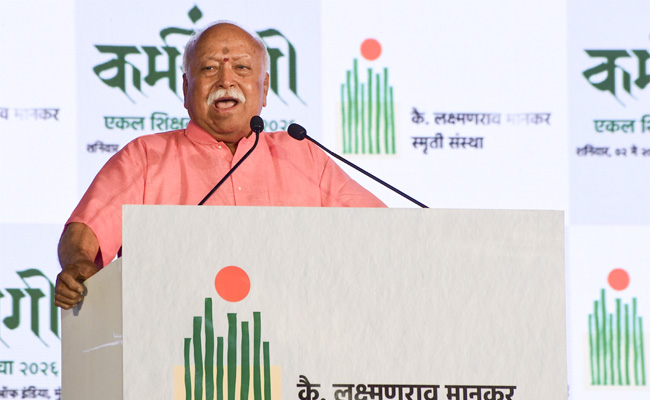
Mumbai (PTI): RSS chief Mohan Bhagwat has said that despite foreign invasions and hardships, tribal communities and Scheduled Castes preserved the country's identity and soul, stressing the need to integrate them into the mainstream development process.
He was speaking on Saturday at the Karmayogi awards ceremony in Mumbai, where Union Road Transport and Highways Minister Nitin Gadkari was also present.
"Human life is defined by giving back to the world, as we are all part of one great family. A person works and spends for the betterment of society, not as a favour, but out of duty. In serving others, we foster our own development. By helping others to thrive, we elevate ourselves and grow as human beings. This principle is the core value of this Indian land, commonly known as a Hindu society," Bhagwat said.
"This is the society's enduring ethos, which has survived for thousands of years. For various reasons, partly because of our indifference and partly because of foreign invasion, those who preserved this ethos paid a heavy price," he said.
The foreign invaders found that this ethos, this value system of the society is its soul and the key to keeping it alive. So they ensured that those who tried to preserve this soul would be uprooted and face extreme hardships, the Rashtriya Swayamsevak Sangh (RSS) chief noted.
But despite foreign invasions and hardships, tribal communities and Scheduled Castes preserved the country's identity and its soul, he said.
"Despite such adversities, the country's core identity remained intact among tribal communities and those belonging to SC and ST groups," he said, emphasising the need to integrate them into the mainstream development process while ensuring they receive equal access to services and facilities.
Referring to global developments, Bhagwat said the present world is "stumbling forward" and struggling to maintain balance, and asserted that India could emerge as a stabilising force.
The country must not only safeguard its own interests but also extend support to the world, he said.
"The world should get to see that the country is not only solving its own misery and sorrow but also helping the world to address similar issues," he said.
The RSS chief stressed that service to society is not a favour but a duty that contributes to one's own development.
Helping others grow also elevates individuals and strengthens the collective fabric of society, he said.
The so-called educated and developed sections have, over time, distanced themselves from these communities, Bhagwat pointed out, and called for the need to bridge this gap.
The identities preserved by these communities represent the true identity of Indian society, he said and underlined that without identity, existence itself is at risk.