Strong earthquake kills at least 12 in Ecuador, 1 in Peru
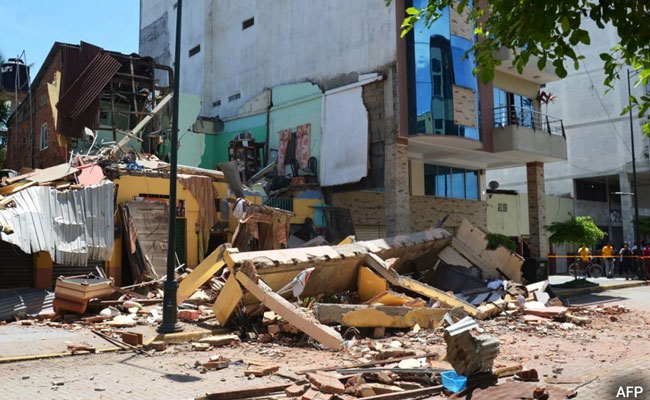
Quito (AP): A strong earthquake shook southern Ecuador and northern Peru on Saturday, killing at least thirteen people, trapping others under rubble, and sending rescue teams out into streets littered with debris and fallen power lines.
The U.S. Geological Survey reported an earthquake with a magnitude of about 6.8 that was centered just off the Pacific Coast, about 50 miles (80 kilometers) south of Guayaquil, Ecuador's second-largest city. Twelve of the victims died in Ecuador, while one died in Peru.
Ecuadorian President Guillermo Lasso told reporters the earthquake had "without a doubt ... generated alarm in the population." Meanwhile, Ecuador's Risk Management Secretary Cristian Torres in a radio interview said 11 of the victims died in the coastal state of El Oro and one in the highlands state of Azuay.
In Peru, the earthquake was felt from its northern border with Ecuador to the central Pacific coast. Peruvian Prime Minister Alberto Ot rola said a 4-year-old girl died from head trauma she suffered in the collapse of her home in the Tumbes region, on the border with Ecuador.
The victim in Azuay's Andean community of Cuenca was a passenger in a vehicle crushed by rubble from a house, according to the Risk Management Secretariat, Ecuador's emergency response agency.
In El Oro, the agency also reported that several people were trapped under rubble. In the community of Machala, a two-story home collapsed before people could evacuate, a pier gave way and a building's walls cracked, trapping an unknown number of people.
The agency said firefighters worked to rescue people while the National Police assessed damage, their work made more difficult by downed lines that interrupted telephone and electricity service.
Machala resident Fabricio Cruz said he was in his third-floor apartment when he felt a strong tremor and saw his television hit the ground. He immediately headed out.
"I heard how my neighbors were shouting and there was a lot of noise," said Cruz, a 34-year-old photographer. He added that when he looked around, he noticed the collapsed roofs of nearby houses.
Lasso said he would travel on Saturday to El Oro.
In Guayaquil, about 170 miles (270 kilometers) southwest of the capital, Quito, authorities reported cracks in buildings and homes, as well as some collapsed walls. Authorities ordered the closure of three vehicular tunnels in Guayaquil, which anchors a metro area of over 3 million people.
Videos shared on social media show people gathered on the streets of Guayaquil and nearby communities. People reported objects falling inside their homes.
One video posted online showed three anchors of a show dart from their studio desk as the set shook. They initially tried to shake it off as a minor quake but soon fled off camera. One anchor indicated the show would go on a commercial break, while another repeated, "My God, my God."
A report from Ecuador's Adverse Events Monitoring Directorate ruled out a tsunami threat.
Peruvian authorities said the old walls of an Army barracks collapsed in Tumbes.
Ecuador is particularly prone to earthquakes. In 2016, a quake centered farther north on the Pacific Coast in a more sparsely populated area of the country killed more than 600 people.
#UPDATE At least 12 people were killed, one was wounded and buildings were damaged in the earthquake that shook Peru and Ecuador earlier Saturday, Ecuador's presidency saidhttps://t.co/2iR3qNb74C pic.twitter.com/d23Gh9haCn
— AFP News Agency (@AFP) March 18, 2023
Let the Truth be known. If you read VB and like VB, please be a VB Supporter and Help us deliver the Truth to one and all.
T'gana RTC strike: Talks between govt, employees successful

Hyderabad (PTI): Talks between employees of Telangana State Road Transport Corporation (RTC) who were on strike and the state government concluded successfully on Friday as the government agreed to the key demands of the workmen.
Following a day-long marathon of talks between the leaders of the employees' Joint Action Committee (JAC) and the cabinet sub-committee, the government announced after midnight that it acceded to the demands, including a merger of RTC with the government, 11 per cent pay revision and elections to the employees' unions.
A committee comprising officials and employee leaders would be appointed over the merger of RTC with the government, it said.
The RTC management has also agreed to address the remaining issues as well, an official release said.
The employees would call off their strike and the RTC buses would hit the roads shortly, it said.
The employees had been on an indefinite strike since April 22 over a series of demands, including the merger of RTC with the government.
Earlier in the day, a driver of the RTC, who attempted suicide on April 23 during the strike, died at a hospital here in the early hours of Friday.
Shankar Goud, a 55-year-old driver, set himself ablaze by pouring petrol at Narsampet in Warangal district when the employees were staging a protest on Thursday in support of their demands.
Goud suffered serious burns, was initially admitted to a state-run hospital in Warangal, and later shifted to a super-speciality hospital in Hyderabad for advanced treatment.
"He succumbed (to injuries) at about 1.30 am on Friday," a senior official said.
The driver’s body was taken to his relative’s village, Muttojipet in Warangal district, for funeral rites.
Tension prevailed in Muttojipet as his family members and RTC employees attempted to take the body to the Narsampet bus station, where he worked, to enable his colleagues to pay their last respects. However, police did not permit this, citing law-and-order concerns.
This led to a deadlock before the funeral could proceed.
Union Minister Bandi Sanjay Kumar criticised the Telangana government for not allowing the body to be taken to the Narsampet bus station.
Kumar, Minister of State (Home), visited Muttojipet village in Warangal district, where the funeral was held, and paid homage to Goud.
“They (family members) want to take the body to the bus depot for five minutes. Is the RTC bus depot in Pakistan or Bangladesh? They are emotionally attached to taking the body there. The government is hurting sentiments and creating fear among RTC employees,” Kumar told reporters.
He also expressed anger at the police for not allowing the body to be taken to the bus station and staged a protest, according to a release from his office.
RTC employees and BJP workers attempted to take the mortal remains in an ambulance to Narsampet, but were stopped by the police.
Later, after discussions with the police, the family members and RTC employees agreed to conduct the funeral in the village.
Sanjay Kumar, stating he would abide by the family’s decision, left the village after the funeral was conducted there.
Transport Minister Ponnam Prabhakar said an ex gratia of Rs 10 lakh, a house, and a government job would be provided to the kin of Goud.
Chief Minister A Revanth Reddy expressed shock over the employee’s death and conveyed deep condolences to the grieving family, according to the release.
The RTC employees’ JAC had earlier announced an agitation programme from April 24 to 29, including silent marches and submission of memorandums to MLAs and other leaders.