Strong earthquake that sparked tsunami warning leaves 1 dead amid widespread panic in Philippines
Manila (AP): A powerful earthquake that shook the southern Philippines killed at least one villager and injured several others as thousands scrambled out of their homes in panic and jammed roads to higher grounds after a tsunami warning was issued, officials said Sunday.
The US Geological Survey reported that the quake Saturday night had a magnitude of 7.6 and struck at a depth of 32 km (20 miles). The Pacific Tsunami Warning Centre said it expected tsunami waves to hit the southern Philippines and parts of Indonesia, Palau and Malaysia, but later dropped its tsunami warning.
In Japan, authorities issued evacuation orders late Saturday in various parts of Okinawa prefecture, including for the entire coastal area, affecting thousands of people.
A pregnant woman died after she, her husband and daughter were hit by a 15-feet (4.5-metre) concrete wall that collapsed in their neighbourhood as the ground shook and prompted them to flee from their house in Tagum city in Davao del Norte province, the city's disaster-mitigation chief, Shieldon Isidoro, told The Associated Press.
Her husband and daughter were injured. Two other children and their parents jumped from a second-floor window in panic as their house swayed but were not injured after landing on a grassy lot, said Isidoro, who was at his home when the ground started to shake.
"Initially the swaying was weak. Then it quickly became stronger and I could hardly stand. My perfume bottles fell off a table, pictures on my wall swung and I heard people screaming outside: 'Get out, get out, earthquake, earthquake!'" Isidoro said.
While he feared the roof of his house would collapse on him, Isidoro said he was more worried that there could be many casualties in Tagum, a city of about 300,000 people, where he had led regular earthquake drills that he thought helped prevent more deaths and injuries.
Hundreds of patients were evacuated from a Tagum hospital but later were escorted back after an inspection showed no major damage to the building, officials said.
Thousands of residents stayed outside their homes for hours in many towns due to the earthquake and tsunami scare, including in some that were drenched by an overnight downpour, officials said.
Defense Secretary Gilberto Teodoro Jr told a news conference that authorities were assessing the quake's impact but initial reports indicated there were no major damages except for two damaged bridges and pockets of power outages. One death was reported with a few injuries, he said.
Teresito Bacolcol, the head of the Philippine Institute of Volcanology and Seismology, told The AP shortly after the quake hit that his agency advised residents along the coast of Surigao del Sur and Davao Oriental provinces, which were near the epicenter of the undersea quake, to immediately evacuate to higher ground or move farther inland.
Pictures posted on the Facebook account of Hinatuan town in Surigao del Sur province show residents fleeing to higher ground on foot or aboard cars, trucks, motorcycles and tricycle taxis overnight.
Many villagers who fled to evacuation centers returned to their homes on Sunday, officials said.
After undertaking inspections, civil aviation officials said there was no major damage in several airports in the south and there was no disruption in flights operations.
The Philippines, one of the world's most disaster-prone countries, is often hit by earthquakes and volcanic eruptions due to its location on the Pacific "Ring of Fire," an arc of seismic faults around the ocean. The archipelago is also lashed by about 20 typhoons and storms each year.
Let the Truth be known. If you read VB and like VB, please be a VB Supporter and Help us deliver the Truth to one and all.
CM Siddaramaiah alleges ‘criminal conspiracy’ in Sringeri recount, vows legal action
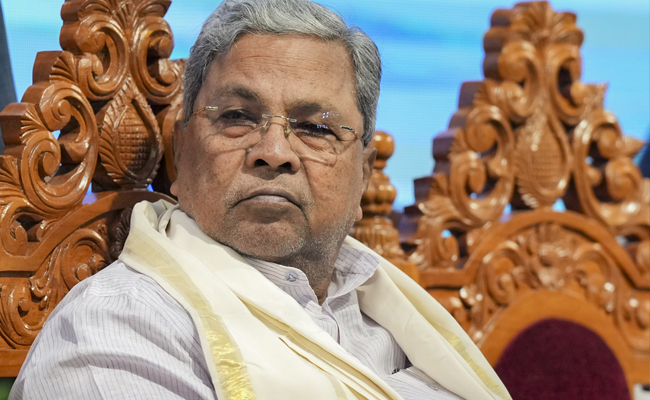
Bengaluru (PTI): Alleging a “criminal conspiracy” by BJP candidate D N Jeevaraj in the Sringeri Assembly poll recounting, Karnataka CM Siddaramaiah on Tuesday said the outcome was manipulated after valid postal ballot votes in favour of Congress leader T D Raje Gowda were tampered with during the recounting process.
Following a Karnataka High Court order on an election petition filed by Jeevaraj, challenging Raje Gowda’s election, the reverification and recounting were conducted on Saturday.
After the reverification and recount of postal ballots for the Sringeri Assembly constituency, votes polled in favour of Raje Gowda were reduced by 255, the returning officer said.
A report on the matter has been submitted to the Election Commission of India for further action, the officer added.
Congress leader Raje Gowda had won the 2023 Assembly polls from Sringeri by 201 votes, defeating his nearest rival Jeevaraj.
Addressing a press conference in Bengaluru, Siddaramaiah said the High Court had directed the recounting of postal ballots and that irregularities were noticed during the exercise conducted on May 2.
“This is a clear case of criminal conspiracy,” Siddaramaiah said, alleging that valid votes cast in favour of Raje Gowda were altered after being accepted by counting agents of all parties, including Congress, BJP, and JD(S).
He claimed that during the recounting of postal ballots, 255 votes were initially accepted as valid by all agents but were later tampered with by subordinate officials.
“There is a second mark on the votes polled in favour of Raje Gowda. They had accepted these as valid votes. Subsequently, another mark was made by officials. This is a clear case of criminal conspiracy,” he said.
When asked who was behind the alleged conspiracy, the CM replied, “It was hatched by Jeevaraj and others. It is planned.”
Siddaramaiah further alleged that the returning officer acted improperly by declaring the result despite the presence of an Election Commission observer during the recounting.
“Immediately after the counting, the returning officer announced the result. He should not have done so; this is against the law,” he said.
He pointed out that Raje Gowda had originally won by 201 votes, but after the recounting, the BJP candidate was declared the winner by 52 votes.
“The BJP has committed a criminal act of conspiracy. This is not vote chori but vote dacoity,” he alleged.
The CM said a police complaint had already been filed by Raje Gowda’s election agent, Sudhir Kumar, and emphasised the need for electoral integrity.
“We want transparency and free and fair elections. That is what our Constitution mandates,” he added.
Stating that the government would pursue legal remedies, Siddaramaiah said, “We are preparing an appeal challenging the returning officer’s announcement in a court of law.”
Responding to a separate query on elections in other states, the CM said there appeared to be an anti-incumbency factor in West Bengal, while results in Tamil Nadu were “surprising,” adding that Vijay’s party was emerging as the largest there.
Following the victory of party candidates in Bagalkote and Davanagere South, Siddaramaiah expressed confidence about future electoral prospects in Karnataka.
“Even in 2028, we will win the Assembly elections. We will come back,” the CM said.
Siddaramaiah added that he would order a forensic examination into the alleged tampering of postal ballots.