Strong quake hits eastern Indonesia; no tsunami warning
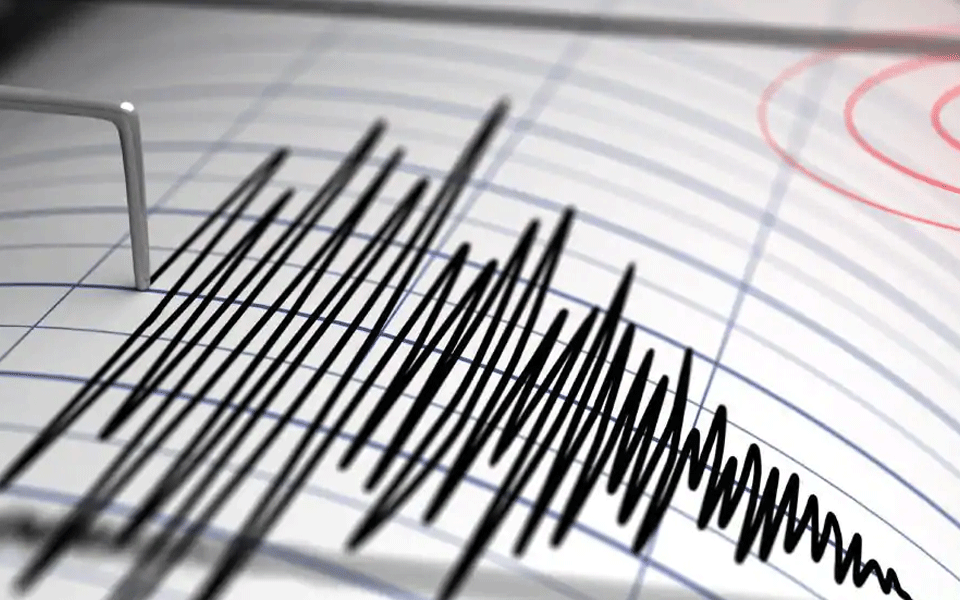
Jakarta: A strong and shallow earthquake hit Indonesia's easternmost Papua region on Saturday, but the epicenter was far from populated areas and there was no risk of a tsunami, officials said.
The US Geological Survey said the magnitude 6.1 quake struck at a depth of just 10 kilometers (6 miles). Shallow quakes tend to cause more damage than deeper ones.
Rahmat Triyono, who heads the earthquake and tsunami center at Indonesia's Meteorology, Climatology and Geophysics Agency, said there was no risk of a tsunami from the quake and there were no immediate reports of injuries or damage.
He said most residents in the West Papua provincial capital of Manokwari did not feel the quake.
With a population of around 877,000, West Papua is one of Indonesia's least populous provinces.
Indonesia, home to more than 260 million people, is prone to earthquakes and volcanic eruptions due to its location along the Pacific "Ring of Fire."
A powerful Indian Ocean quake and tsunami in 2004 killed a total of 230,000 people in a dozen countries, most of them in Indonesia.
Let the Truth be known. If you read VB and like VB, please be a VB Supporter and Help us deliver the Truth to one and all.
AIITA welcomes Karnataka’s ban on obscene songs in school events
Bhatkal: The Karnataka unit of the All India Ideal Teachers Association (AIITA) has welcomed the Karnataka government’s decision to strictly ban school children from dancing to obscene songs during educational and cultural programmes in government, aided, and private schools across the state.
AIITA Karnataka State President M. R. Manvi congratulated the government for taking what he termed an important step to preserve the sanctity of education.
“Such decisions to safeguard the dignity of school children and uphold the values of education are the need of the hour. This rule should not be limited to government schools alone but must be strictly implemented in all private educational institutions as well,” he said.
He further urged the government to address other concerns within school programmes.
“The government should not only prohibit obscene dances in the name of school anniversaries, but also ensure that plays and dialogues that incite religious hatred are avoided. Schools should be centres of harmony, not platforms for spreading hatred,” he added.
According to a recent circular issued by the Department of School Education and Literacy, obscene dances are adversely affecting the mental health and moral values of students.
In this regard, schools have been advised to use songs that promote nationalism, positive thinking, the greatness of Kannada culture, and value-based traditions instead of inappropriate content during programmes.
The circular also emphasises that students should be dressed in decent attire.
AIITA also backed the department’s warning that disciplinary action would be taken against head teachers if such guidelines are violated. The association has further demanded that district Deputy Directors of Public Instruction strictly monitor the implementation of these rules.