Sudan conflict: Over 56 killed in airstrikes and shelling across Greater Khartoum
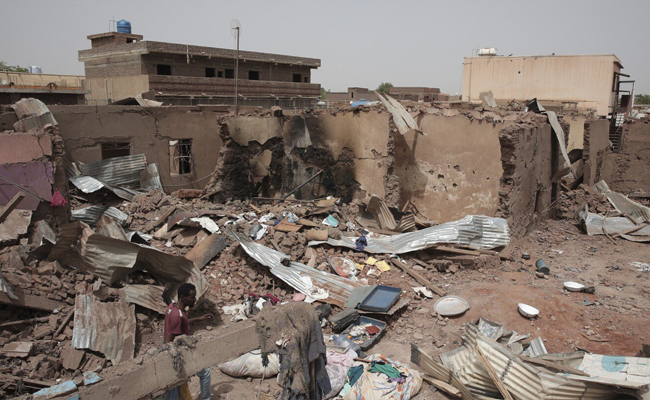
Khartoum: Intense fighting between Sudan’s regular army and the paramilitary Rapid Support Forces (RSF) escalated on Saturday, resulting in at least 56 deaths and numerous injuries due to airstrikes and artillery shelling across Greater Khartoum. The ongoing conflict, which began in April 2023, has intensified as the army attempts to reclaim the capital.
Attack on Omdurman market leaves 54 dead
An RSF attack on a crowded market in army-controlled Omdurman killed 54 people and injured 158, overwhelming Al-Nao Hospital—one of the last operational medical facilities in the city. Eyewitnesses reported that shells struck the centre of a vegetable market, causing heavy casualties. While the RSF denied responsibility, Doctors Without Borders (MSF) described the hospital as being in a state of "utter carnage."
Airstrikes and rising civilian toll
In another incident, an airstrike in an RSF-controlled area of Khartoum killed two civilians and wounded dozens, according to local emergency response teams. While the RSF has deployed drones in attacks, the Sudanese army continues to dominate aerial strikes. Both sides have been accused of indiscriminate attacks on civilian areas, worsening the humanitarian crisis.
The war has claimed tens of thousands of lives, displaced over 12 million people, and severely damaged Sudan’s healthcare system. MSF General Secretary Chris Lockyear, present at Al-Nao Hospital, reported dire conditions, with the morgue overflowing and a severe shortage of medical supplies, including blood donors and stretchers.
Army advances amid RSF resistance
The escalation follows the Sudanese army’s offensive across central Sudan. Having reclaimed Wad Madani, the army is now focusing on retaking Khartoum. However, the RSF still controls key routes, including the road between Wad Madani and Khartoum.
The army-allied Sudan Shield Forces announced the capture of multiple towns southeast of the capital. Their leader, Abu Aqla Kaykal, a former RSF commander, has been accused of atrocities both during his time with the paramilitary and in his current role with the army.
In recent weeks, the army has managed to break RSF blockades on several bases in Khartoum, forcing RSF fighters to retreat to the city's outskirts. The shelling in Omdurman reportedly originated from RSF positions in the western part of the city.
Humanitarian crisis worsens
Khartoum, once a thriving capital, has been devastated by nearly two years of war. A study by the London School of Hygiene and Tropical Medicine estimates that 26,000 people were killed in the city between April 2023 and June 2024.
The UN reports that 106,000 people in Khartoum are facing famine, while 3.2 million are experiencing extreme food shortages. Nationally, famine has been declared in five regions, mostly in Darfur, and is expected to worsen by May. With no end in sight, the conflict continues to devastate the nation, leaving millions in urgent need of humanitarian assistance.
Let the Truth be known. If you read VB and like VB, please be a VB Supporter and Help us deliver the Truth to one and all.
Rupee falls 20 paise to 95.43 against US dollar in early trade

Mumbai (PTI): The rupee depreciated 20 paise to 95.43 against US dollar in early trade on Tuesday as market sentiments remained fragile after renewed military exchanges between US and Iranian forces in the Gulf region.
Forex traders said investor anxiety due to instability in the Gulf is causing massive capital flight into safe-haven assets, with the US dollar acting as the primary beneficiary.
Moreover, Brent oil prices is hovering near USD 113 per barrel, maintaining pressure on oil-importing economies like India.
At the interbank foreign exchange market the rupee opened at 95.30 then lost ground to touch 95.43 against the US dollar, in initial trade, registering a fall of 20 paise over its previous close.
Rupee fell 39 paise to close at an all-time low of 95.23 against the US dollar on Monday.
"With oil boiling rupee on Monday fell to a closing low of 95.0875 and this morning the opening was still lower as it becomes more and more vulnerable when dollar index rises due to safe-haven buying and oil prices rise due to the continuous fighting in the Gulf Region," Anil Kumar Bhansali, Head of Treasury and Executive Director, Finrex Treasury Advisors LLP, said.
The higher oil prices will keep rupee sold off against the dollar as oil companies and FPIs intensify dollar buying, Bhansali added.
Meanwhile, the dollar index, which gauges the greenback's strength against a basket of six currencies, was trading at 98.51, up 0.15 per cent.
Brent crude, the global oil benchmark, was trading lower by 1.07 per cent at USD 113.22 per barrel in futures trade.
"Market sentiments remained fragile after renewed military exchanges between US and Iranian forces when Iranian forces launched fresh attacks in the Gulf as both sides sought to assert control over the strategic waterway," Bhansali said.
On the domestic equity market front, Sensex declined 361.62 points to 76,907.78 in early trade, while the Nifty dropped 134.90 points to 23,980.60.
Foreign Institutional Investors purchased equities worth Rs 2,835.62 crore on Monday, according to exchange data.