Sudan's generals battle for 3rd day; death toll soars to 185
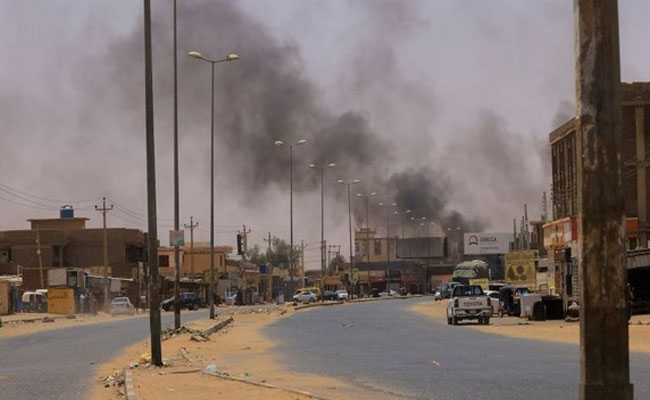
Khartoum (AP): As explosions and gunfire thundered outside, Sudanese in the capital Khartoum and other cities huddled in their homes for a third day Monday, while the army and a powerful rival force battled in the streets for control of the country.
At least 185 people have been killed and over 1,800 wounded since the fighting erupted, UN envoy Volker Perthes told reporters. The two sides are using tanks, artillery and other heavy weapons in densely populated areas.
Fighter jets swooped overhead and anti-aircraft fire lit up the skies as darkness fell.
The toll could be much higher because there are many bodies in the streets around central Khartoum that no one can reach because of the clashes. There has been no official word on how many civilians or combatants have been killed.
The doctors' syndicate earlier put the number of civilian deaths at 97.
The sudden outbreak of violence over the weekend between the nation's two top generals, each backed by tens of thousands of heavily armed fighters, trapped millions of people in their homes or wherever they could find shelter, with supplies running low and several hospitals forced to shut down.
Top diplomats on four continents scrambled to broker a truce, and the UN Security Council was set to discuss the crisis.
"Gunfire and shelling are everywhere," Awadeya Mahmoud Koko, head of a union for thousands of tea vendors and other food workers, said from her home in a southern district of Khartoum.
She said a shell stuck a neighbour's house Sunday, killing at least three people. "We couldn't take them to a hospital or bury them."
In central Khartoum, sustained gunfire erupted and white smoke rose near the main military headquarters, a major battle front. Nearby, at least 88 students and staffers have been trapped in the engineering college library at Khartoum University since the start of fighting, one of the students said in a video posted online Monday.
One student was killed during clashes outside and another wounded, he said. They do not have food or water, he said, showing a room full of people sleeping on the floor.
Even in a country with a long history of military coups, the scenes of fighting in the capital and its adjoining city Omdurman across the Nile River were unprecedented.
The turmoil comes just days before Sudanese were to celebrate Eid al-Fitr, the holiday marking the end of Ramadan, the Islamic month of fasting.
The power struggle pits Gen Abdel-Fattah Burhan, the commander of the armed forces, against Gen Mohammed Hamdan Dagalo, the head of the Rapid Support Forces, a paramilitary group.
The former allies jointly orchestrated an October 2021 military coup. The violence has raised the spectre of civil war just as Sudanese were trying to revive the drive for a democratic, civilian government after decades of military rule.
Under international pressure, Burhan and Dagalo had recently agreed to a framework agreement with political parties and pro-democracy groups, but the signing was repeatedly delayed as tensions rose over the integration of the RSF into the armed forces and the future chain of command.
The US, the UN and others have called for a truce. Egypt, which backs Sudan's military, and Saudi Arabia and the United Arab Emirates which forged close ties to the RSF in recent years as it sent thousands of fighters to support their war in Yemen have also called for both sides to stand down.
But both generals have thus far dug in, demanding the other's surrender and ruling out negotiations.
The European Union's foreign policy chief, Josep Borrell tweeted that the EU ambassador to Sudan "was assaulted in his own residency," without providing further details. EU officials did not immediately respond to requests for comment.
Dagalo, whose forces grew out of the notorious Janjaweed militias in Sudan's Darfur region, has portrayed himself as a defender of democracy and branded Burhan as the aggressor and a "radical Islamist." Both generals have a long history of human rights abuses and their forces have cracked down on pro-democracy activists.
Heavy gunbattles raged in multiple parts of the capital and Omdurman, where the two sides have brought in tens of thousands of troops, positioning them in nearly every neighbourhood.
Twelve hospitals in the capital area have been "forcefully evacuated" and are "out of service" because of attacks or power outages, the Sudan Doctors' Syndicate said, out of a total of around 20 hospitals. Four other hospitals outside the capital have also shut down, it added in a statement late Monday.
Hadia Saeed said she and her three children were sheltering in one room on the ground floor of their home for fear of the shelling as gunfire rattled across their Bahri district in north Khartoum. They have food for a few more days, but "after that we don't know what to do," she said.
Residents said fierce fighting with artillery and other heavy weapons raged Monday afternoon in the Gabra neighbourhood southwest of Khartoum. People were trapped and screaming inside their homes, said Asmaa al-Toum, a physician living in the area.
Fighting has been particularly fierce around each side's main bases and at strategic government buildings all of which are in residential areas.
The military on Monday claimed to have secured the main television building in Omdurman, fending off the RSF after days of fighting. State-run Sudan TV resumed broadcasting.
On Sunday, the RSF said it abandoned its main barracks and base, in Omdurman, which the armed forces had pounded with airstrikes. (
Let the Truth be known. If you read VB and like VB, please be a VB Supporter and Help us deliver the Truth to one and all.
Advocate found dead in car on Nainital court premises

Nainital (PTI): A 55-year-old advocate allegedly died by suicide after shooting himself inside his car at the Nainital district court parking lot here on Monday, police said.
According to the police, Puran Singh Bhakuni, a resident of Mallital, was found in the rear seat of his vehicle with a gunshot wound to his temple.
Police recovered a licensed pistol from his hand and a suicide note from the car’s dashboard. The note stated that Bhakuni was unwell and suffering from depression.
"We received information through lawyers around noon. The deceased was lying in the back seat with a pistol in his hand and blood near his ear," Circle Officer Anjana Negi said.
Forensic teams and ballistic experts reached the spot to collect evidence, as no witness reported hearing the gunshot.
Government counsel Sushil Sharma stated that Bhakuni left home at 9 am and was found dead at 9.30 am.
Sharma raised concerns over the circumstances, noting that the body was in the rear seat, and demanded a thorough probe to rule out foul play. Bhakuni, who worked as a notary, had married six months ago, he said.
Police took the body into custody and sent it for a postmortem to confirm the cause of death.
The forensic laboratory will examine the suicide note and the ballistics of the weapon, the police said, adding that the investigation is ongoing.