Sudan's PM announces resignation amid political deadlock
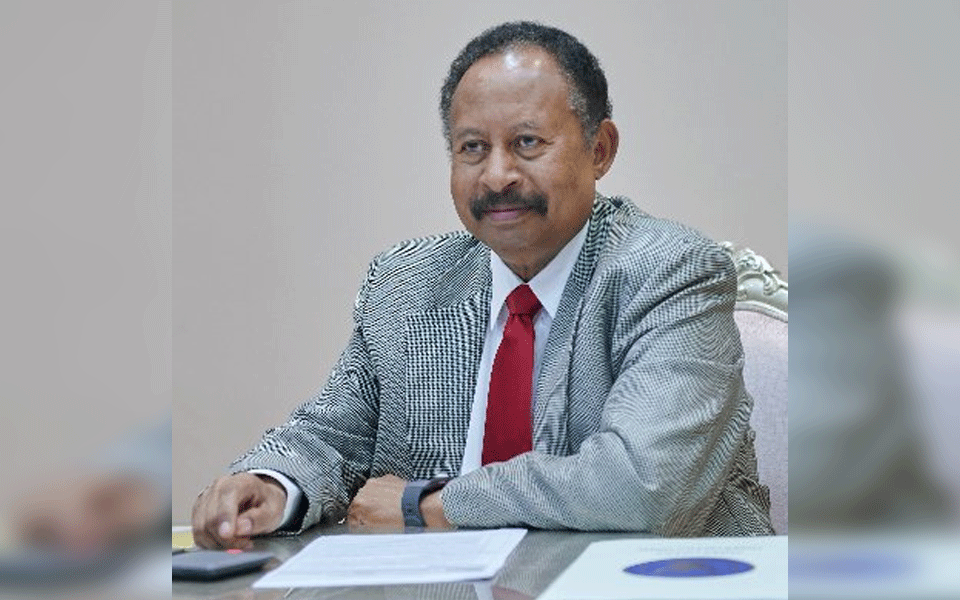
Cairo (AP): Sudan's Prime Minister Abdalla Hamdok announced his resignation Sunday amid a political deadlock and widespread pro-democracy protests following a military coup that derailed the country's fragile transition to democratic rule.
Hamdok, a former UN official seen as the civilian face of Sudan's transitional government, had been reinstated as prime minister in November as part of an agreement with the military following the October coup. In that time he had failed to name a Cabinet and his resignation throws Sudan into political uncertainty amid uphill security and economic challenges.
In a televised national address Sunday, Hamdok called for a dialogue to agree on a national charter and to draw a roadmap to complete the transition to democracy in accordance with the 2019 constitutional document governing the transitional period.
I decided to return the responsibility and declare my resignation as prime minister," he said, adding that his stepping down would allow a chance for another person to lead the nation and complete its transition to a civilian, democratic country. He did not name a successor.
The prime minister said his efforts to bridge the widening gap and settle disputes among the political forces have failed.
He warned that the ongoing political stalemate since the military takeover could become a full-blown crisis and damage the country's already battered economy.
I tried as much as I possibly could to prevent our country from sliding into a disaster. Now, our nation is going through a dangerous turning point that could threaten its survival unless it is urgently rectified, he said.
Hamdok's resignation comes amid a heavy security crackdown on protesters denouncing not only the takeover but the subsequent deal that reinstated him and sidelined the pro-democracy movement. He was returned to office in November amid international pressure in a deal that calls for an independent technocratic Cabinet under military oversight led by him.
I have had the honor of serving my country people for more than two years. And during his period I have sometimes done well, and I have sometimes failed, Hamdok said.
The Forces for the Declaration of Freedom and Change, an umbrella group of Sudanese political parties and pro-democracy organizations, has rejected the November deal and sa remains committed to ending military rule. The alliance accused Hamdok of allowing the military to dominate the government, and continued to organize anti-coup street protests which were met with heavy crackdown.
Over the past two weeks, there was increasing speculation that he would step down. National and international efforts have failed to convince him to stay in office.
The US State Department urged on Twitter Sudan's leaders to set aside differences, find consensus, and ensure continued civilian rule following Hamdok's resignation.
It also called for the appointment of the next premier and Cabinet to in line with the (2019) constitutional declaration to meet the people's goals of freedom, peace, and justice.
Hours before Hamdok's resignation speech, Sudanese security forces violently dispersed pro-democracy protesters, killing at least three people, according the the Sudan Doctors Committee, which is part of the pro-democracy movement. The group said dozens of protesters were injured.
The protests came despite tightened security and blocked bridges and roads in Khartoum and Omdurman. Internet connections were also disrupted ahead of the protests, according to advocacy group NetBlocs. Authorities have used such tactics repeatedly since the October 25 coup.
Sunday's fatalities have brought the death toll among protesters since the coup to at least 57, according to the medical group. Hundreds have also been wounded.
Let the Truth be known. If you read VB and like VB, please be a VB Supporter and Help us deliver the Truth to one and all.
Vartha Bharati–Sankalp predictions align closely with Karnataka bypoll results
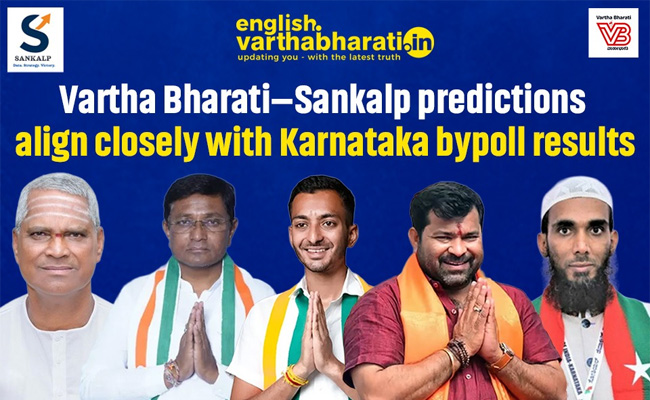
Bengaluru: The Vartha Bharati–Sankalp election analysis has shown a high level of accuracy in predicting the outcome of the recent Karnataka Assembly by-elections held in May 2026, correctly calling winners in both constituencies and closely estimating vote share trends.
The by-elections were held in Bagalkot and Davanagere South, drawing significant political attention as both seats were seen as key tests for the ruling Congress and opposition BJP.
According to the analysis, Vartha Bharati–Sankalp had made three major projections ahead of the results the winning party, vote share percentages, and margin of victory.
In both constituencies, the platform accurately predicted that the Congress would emerge victorious. The outcome matched the projections, with Congress candidates winning in Bagalkot and Davanagere South.
In terms of vote share, the predictions were largely in line with the final results. In Bagalkot, the BJP’s vote share was forecast in the range of 40 to 46 per cent, while the actual figure stood at 42.9 per cent. The Congress vote share, however, exceeded expectations, with the party securing 55.4 per cent against a projected range of 43 to 48 per cent.
The margin of victory in Bagalkot turned out to be significantly higher than anticipated. While the projection had placed the margin between 2,000 and 3,500 votes, the final margin was around 22,332 votes.
In Davanagere South, the predictions also remained largely accurate. The Congress vote share was projected between 43 and 51 per cent, and the final figure stood at 43.9 per cent. The BJP was expected to secure between 42 and 50 per cent but ended with 40.3 per cent.
The analysis had also identified the role of SDPI as a potential spoiler in the constituency. While its vote share was estimated around 6 per cent, the party eventually secured around 12 per cent of the vote.
The margin of victory in Davanagere South was predicted to be between 1,500 and 2,600 votes. The actual margin was higher at around 5,708 votes, though the contest remained relatively close as anticipated.
Overall, the performance of Vartha Bharati–Sankalp stood out for correctly identifying the winning parties in both seats and maintaining close accuracy in vote share estimates, with only limited deviations in specific cases.