Sunak, Trudeau underscore need for de-escalation of India-Canada row
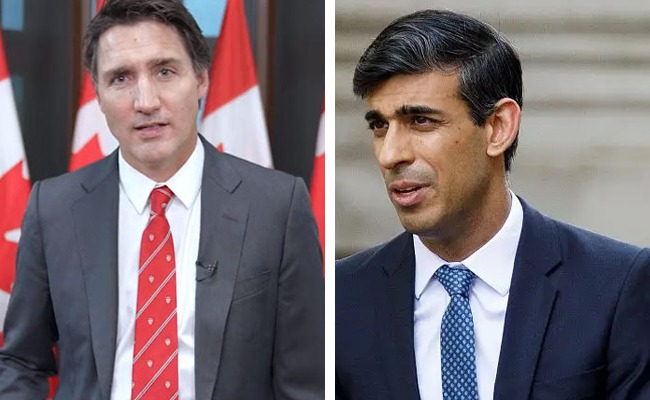
London (PTI): British Prime Minister Rishi Sunak and his Canadian counterpart Justin Trudeau have underscored the importance of de-escalation of the India-Canada diplomatic row and respect for the rule of law in a call, which was dominated by the standoff over the killing of a Sikh separatist leader in Canada in June.
According to a Downing Street statement, the British Indian leader spoke to Trudeau on Friday evening during which he was updated on the situation relating to Canadian diplomats in India. Both leaders agreed to stay in contact as Sunak reaffirmed the UK position of respect for the rule of law after Canada s allegation of Indian involvement in the killing of a pro-Khalistan wanted terrorist.
"Prime Minister Trudeau updated on the situation relating to Canadian diplomats in India," reads the Downing Street statement.
"The Prime Minister [Sunak] reaffirmed the UK's position that all countries should respect sovereignty and the rule of law, including the principles of the Vienna Convention on Diplomatic Relations. He hoped to see a de-escalation in the situation and agreed to remain in contact with Prime Minister Trudeau on the next steps," it said.
The Canadian Prime Minister's Office from Ottawa echoed the statement, saying that Trudeau provided an update on the current situation between Canada and India.
"The leaders emphasised respect for the Vienna Convention on Diplomatic Relations and the need to ensure the safety and security of their citizens. They underscored the importance of de-escalation in this context. Prime Minister Trudeau and Prime Minister Sunak agreed to remain in close contact and to continue working together to tackle global issues," the Canadian government statement reads.
The call comes in the wake of Trudeau's statement in the Canadian Parliament last month that its security forces were "actively pursuing credible allegations" linking Indian government agents to the murder of Khalistan Tiger Force leader Hardeep Singh Nijjar in British Columbia in June, an allegation strongly rejected by India as "absurd and motivated".
The telephonic talks between Sunak and Trudeau took place in the days after the fallout of that diplomatic row resonated in the UK when Indian High Commissioner to the UK Vikram Doraiswami was blocked from a planned visit to Glasgow Gurdwara in Scotland last week by pro-Khalistan extremists.
"Concerned to see that the Indian High Commissioner, Vikram Doraiswami, was stopped from meeting with the Gurudwara Committee at the Gurudwara in Glasgow. The safety and security of foreign diplomats is of utmost importance and our places of worship in the UK must be open to all," Anne-Marie Trevelyan, the UK Foreign Office minister for Indo-Pacific wrote on X.
In recent developments, the Ministry External Affairs (MEA) said it has been coordinating with its mission in Ottawa and consulates in other Canadian cities over safety concerns.
"We have been taking up concerns of security of our diplomats and premises from people there who are wanted by our security and our judicial systems, and we will continue to do that as that is a continued conversation. The issue is about security, and our diplomats are safe and the community is not targeted," said MEA spokesperson Arindam Bagchi said in New Delhi.
India has also asserted that Canada must reduce its diplomatic presence in the country to achieve parity in strength and alleged that some of the Canadian diplomats are involved in interfering in New Delhi's internal matters.
Bagchi said discussions on the modalities to arrive at mutual diplomatic presence are going on and gave clear indication that India will not review its position on the issue.
Let the Truth be known. If you read VB and like VB, please be a VB Supporter and Help us deliver the Truth to one and all.
Three youths bludgeon 40-year-old man to death with brick in Baghpat
Baghpat (UP) (PTI): Police said on Saturday that three youths allegedly bludgeoned a man to death with a brick in Meetli village here following a late-night beer party.
Preliminary investigations suggest the dispute arose from a suspected illicit relationship, said police, adding that the three accused have been detained.
Police received information on Saturday morning that the body of Sonu (40), a resident of Dola village, was lying in the forest near Meetli village.
There were visible signs of severe head injuries on his body, and bottles of liquor and beer were also recovered from the crime scene, leading to the suspicion that a drinking party had taken place there before the incident, police said.
Superintendent of Police Suraj Kumar Rai said police registered a case based on the written complaint submitted by the family members.
Police sent the body for a postmortem.
According to the deceased's family members, two youngsters from the same village took him away at 8:00 pm on Friday, and he never returned home.
They said when they tried to contact him via phone, his mobile number was switched off.
The deceased worked as a street food vendor in the village and is survived by his wife, two sons, and two daughters.