Sushma Swaraj was extraordinary woman, leader: UNGA President
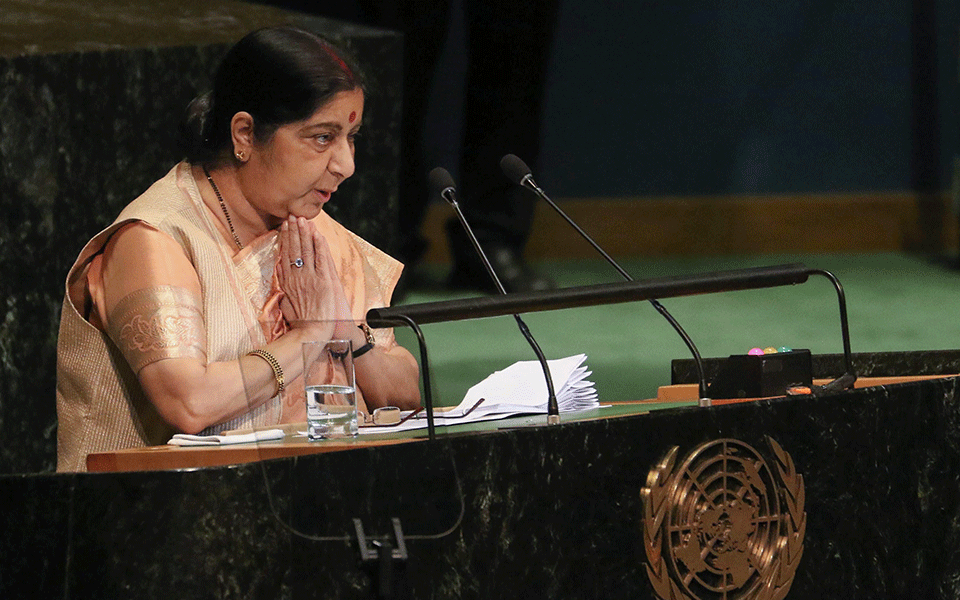
United Nations: UN General Assembly President Maria Fernanda Espinosa has expressed condolences at the demise of India's former External Affairs Minister Sushma Swaraj, describing her as an "extraordinary" woman and leader who devoted her life to public service.
Swaraj passed away at the All India Institute of Medical Sciences (AIIMS) in New Delhi on Tuesday night after suffering a cardiac arrest. The senior BJP leader was 67.
Saddened by the news of the passing of @SushmaSwaraj, an extraordinary woman & leader who devoted her life to public service. I had the honour of meeting her in my visits to #India, & will always remember her fondly, Espinosa tweeted.
She added in her tweet that she sends her deepest condolences to all of her loved ones @IndiaUNNewYork," tagging India's Permanent Mission to the UN in her message.
Before assuming her role as the President of the 73rd session of the UN General Assembly in September 2018, becoming only the fourth woman to lead the General Assembly in its 73-year history, Espinosa had visited India and met Prime Minister Narendra Modi and Swaraj.
In her meeting with Swaraj, the top UN official had discussed revitalisation of the UN, including reform of the Security Council, strengthening global counter terrorism legal framework and other global issues.
Condolence messages poured from across India and the world at the demise of Swaraj, one of the most charismatic and dignified political leaders.
Over the years, Swaraj had visited the UN on multiple occasions, addressing world leaders in Hindi at the annual high-level General Assembly sessions.
She had headlined the commemoration of the first International Yoga Day at the UN in June 2015, launching the annual celebration of Yoga at the world body's headquarters along side then UN Secretary General Ban Ki-moon.
India's Permanent Representative to the UN Ambassador Syed Akbaruddin tweeted a video montage of Swaraj's powerful speeches at the UN, beginning from her address to the General Debate at the 70th General Assembly session in 2015 till her statement in 2018.
"Leaving behind indelible memories. We @IndiaUNNewYork will always cherish memories of her @UN. Farewell Madam @SushmaSwaraj," Akbaruddin said in an emotional message on Twitter.
The Global Organisation of People of Indian Origin (GOPIO) also conveyed its heartfelt condolences on the passing of Swaraj. As minister looking after the Overseas Indian Affairs, GOPIO has had a close working relation and cooperation on many of the NRI and PIO issues as well as on new initiatives from her ministry.
The organisation said it has been working with Swaraj since she was the leader of BJP in the Rajya Sabha. In her passing away, we will miss a Statesman as well as a sincere and able political leader, GOPIO Chairman Thomas Abraham and President Sunny Kulathakal said in a statement.
Let the Truth be known. If you read VB and like VB, please be a VB Supporter and Help us deliver the Truth to one and all.
Hospital wall collapse: CM orders suspension of executive engineer; kin of victims get solatium
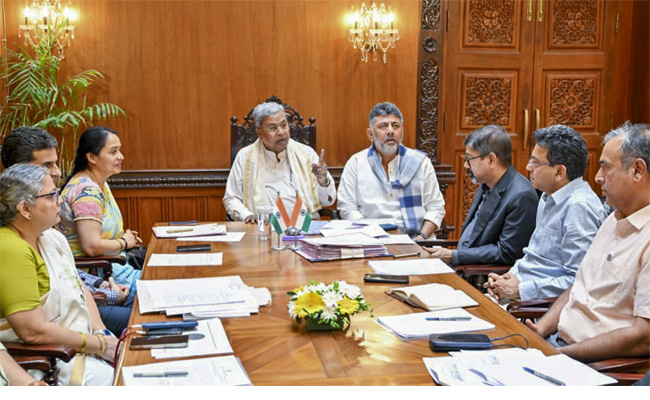
Bengaluru (PTI): Karnataka Chief Minister Siddaramaiah on Thursday ordered the immediate suspension of an executive engineer for the Bowring and Lady Curzon Hospital wall collapse that claimed the lives of seven people, during a high-level review meeting at Vidhana Soudha.
A compensation of Rs 5 lakh, as announced by the CM Siddaramaiah, was distributed to the families of seven victims who lost their lives in the tragedy on Wednesday evening, which occurred due to heavy downpour with gusty winds and hailstorm.
The meeting of municipal commissioners of the five corporations, chaired by the chief minister and attended by Deputy Chief Minister D K Shivakumar, focused on fixing accountability and examining lapses that led to the tragedy.
"Why was soil dumped in a way that damaged the wall? Why did you not monitor this?" Siddaramaiah asked, pulling up hospital authorities during the meeting.
A statement from the chief minister's office said that the CM ordered the immediate suspension of the executive engineer of the Karnataka Health Systems Development Project (KHSDP).
ALSO READ: Three arrested for running fake Aadhaar racket in UP's Badaun
He also questioned the hospital authorities, asking why they failed to monitor the dumping of soil that weakened the structure.
The chief minister directed that a notice be issued to the head of the Hospital.
During the meeting, Siddaramaiah said the rains had caused extensive damage in the city, with over 250 trees uprooted.
The Chief Minister instructed officials to take necessary measures before the onset of the monsoon to avoid untoward incidents.
Commissioners of all five municipal zones in Bengaluru have been asked to take precautionary steps, including trimming dry and dangerous tree branches, the CMO said.
Siddaramaiah also directed them to get the silt cleared from stormwater drains to prevent flooding, and that immediate action be taken to remove debris and fallen branches from roads.
Further, he instructed that barricades be placed at underpasses where water stagnates and restricts public movement.
The Greater Bengaluru Authority (GBA) Chief Commissioner M Maheshwar Rao said in a statement that Shivajinagar MLA Rizwan Arshad distributed compensation cheques of Rs 5 lakh each to the families of the deceased on Thursday.
Seven people, including a six-year-old girl, were killed and seven others injured when the compound wall collapsed amid heavy rain, strong winds and a hailstorm on Wednesday evening.
Police said the victims, comprising three from Bengaluru, two from Kerala on a study tour and one each from Uttar Pradesh and Assam, had taken shelter near the wall when it suddenly gave way, trapping them under the debris.
The chief minister questioned officials over the dumping of soil near the wall despite knowing it could weaken the structure, and directed that a notice be issued to the head of Bowring Hospital.
Siddaramaiah, who had visited the spot soon after the incident along with senior officials, reviewed the situation and ordered a detailed probe into the collapse.