Switzerland vote on proposal to ban 'burqa', face coverings in public
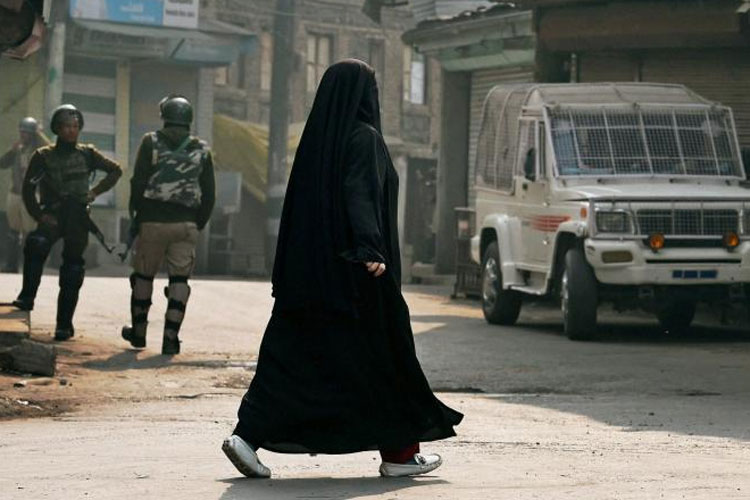
Geneva, Mar 7: At a time when seemingly everyone in Europe is wearing masks to battle COVID-19, the Swiss go to the polls Sunday to vote on a long-laid proposal to ban face-coverings, both the niqabs and burqas worn by a few Muslim women in the country and the ski masks and bandannas used by protesters.
The issue strikes at the intersection of religious freedom, security, the economy and women's rights.
Critics say the proposal Yes to a ban on covering the face is an ironic throwback to a time not long ago when violent extremism was a greater concern than global pandemic, and say it would unfairly stigmatise Muslims who wear full face-covering burqas or niqabs, which have open slits for the eyes, in Switzerland.
Proponents, including populist, right-wing movements behind the idea, say it's needed to combat what they consider a sign of the oppression of women and to uphold a basic principle that faces should be shown in a free society like that of the rich Alpine democracy.
The issue is one of three measures on national ballots in the vote culminating Sunday most voters in Switzerland cast ballots by mail as part of the latest installment of regular Swiss referendums that give voters a direct say in policymaking.
Other proposals would create an e-ID to improve security of online transactions an idea that has run afoul of privacy advocates and a free-trade deal with Indonesia, which is opposed by environmentalists who have concerns about palm oil plantations on the archipelago in the Indian and Pacific Oceans.
The face-covering measure has come to be known colloquially as the burqa ban." It would put Switzerland in line with countries like Belgium and France that have already enacted similar measures. Two Swiss regions also already have such bans.
One campaign poster presented by the Swiss People's Party a populist, right-wing party that is the leading faction in parliament and has strongly backed the measure features a caricatured image of the scowling eyes of a woman in a burqa above the words: Stop Islamic Radicalism.
A coalition of left-leaning parties have put up signs that read: Absurd. Useless. Islamophobic. Support appears to have been eroding, but the vote is expected to be tight. An initial poll for public broadcaster SSR by the gfs.bern agency in January found more than half of voters backed the proposal, but a second poll published on February 24 showed the figures had dipped to under half. Some remain undecided.
The Swiss government opposes the measure, arguing that it could crimp economic development: Most Muslim women who wear such veils in Switzerland are visitors from well-heeled Persian Gulf states, who are often drawn to bucolic Swiss lakeside cities. The justice minister insists existing laws work just fine.
The measure would make it punishable by fines to cover the face in public in places like restaurants, sports stadiums, public transport or simply walking in the street though exceptions are made for religious, security and health reasons, as well as for the Swiss traditional Carnival celebrations.
A counter-proposal would require people to show their faces if requested to do so by authorities.
It's another indication how Switzerland is grappling with security issues and cultures and people from abroad. In the past, Swiss voters have approved a ban on the construction of minarets in the Alpine country whose flag carries the cross.
Andreas Tunger-Zanetti, a researcher who heads the Center for Religious Studies at the University of Lucerne, estimates at most a few dozen Muslim women wear full-face coverings in the country of 8.5 million people, and says the issue is really about Switzerland's take on religion and ability to cope with diversity.
Let the Truth be known. If you read VB and like VB, please be a VB Supporter and Help us deliver the Truth to one and all.
Indian startup's 'Drishti' satellite launched aboard SpaceX rocket
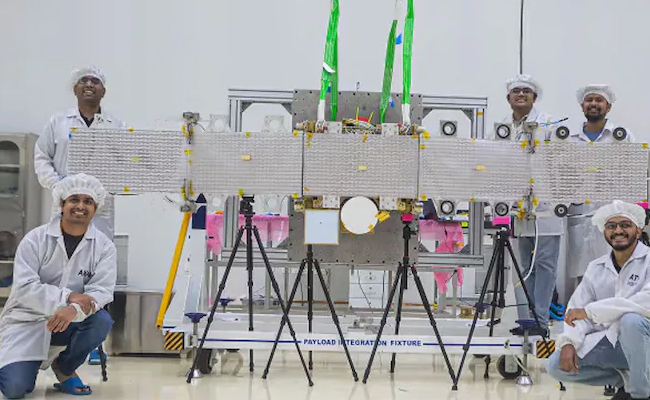
New Delhi (PTI): Bengaluru-based space start-up GalaxEye's Mission Drishti satellite was launched on Sunday aboard SpaceX's Falcon 9 rocket from California.
Mission Drishti is the world's first OptoSAR satellite, integrating electro-optical (EO) and synthetic aperture radar (SAR) sensors into a single operational platform, according to the company.
While EO sensors capture high-resolution images during sunlight and clear skies, SAR sensors provide all-weather and all-time images, using radar pulses.
In a statement, Suyash Singh, founder and CEO of GalaxEye, said, "With the satellite (Mission Drishti) now successfully in orbit, our immediate focus is on completing its commissioning. As we move through this phase, we are already witnessing strong global interest in the differentiated datasets enabled by our OptoSAR payload."
The satellite will help address long-standing limitations of conventional systems and enable more reliable and consistent data acquisition across diverse environmental conditions, the company said.
As a dual-use Earth observation satellite, the mission will support use cases across defence, agriculture, disaster management, maritime monitoring, and infrastructure planning.
The satellite is also expected to complement India's broader initiatives, including the 29 active Earth Observation satellites outlined in ISRO's recent annual report.
The launch came after five years of indigenous research and development, and extensive environmental testing and performance validation of the Mission Drishti.
In a statement, Lt Gen AK Bhatt (Retd), director general of Indian Space Association (ISpA), said, "GalaxEye has achieved what only a few global players have, which is seamlessly combining optical and SAR capabilities on a single platform to enable persistent, all-weather intelligence."
What stands out is not just the technology, but its broader impact on how downstream applications will increasingly define value in the space economy, particularly in Earth observation, where timely, decision-grade insights are critical," he added.
ISpA is the premier industry association of space and satellite companies in the country.
Union Minister Jitendra Singh also took note of the Mission Drishti launch, saying the development marked a significant milestone in India's space journey.
In a post on X, the minister said, "The successful launch of the world's first OptoSAR satellite, and the largest privately-built satellite in the country, reflects the immense potential of our young innovators driving nation-building."
GalaxEye aims to scale up Mission Drishti to a constellation of 10 satellites by 2030, developing a robust and sovereign Earth observation infrastructure for India.