Sydney Airport tests passport-free biometric check-in
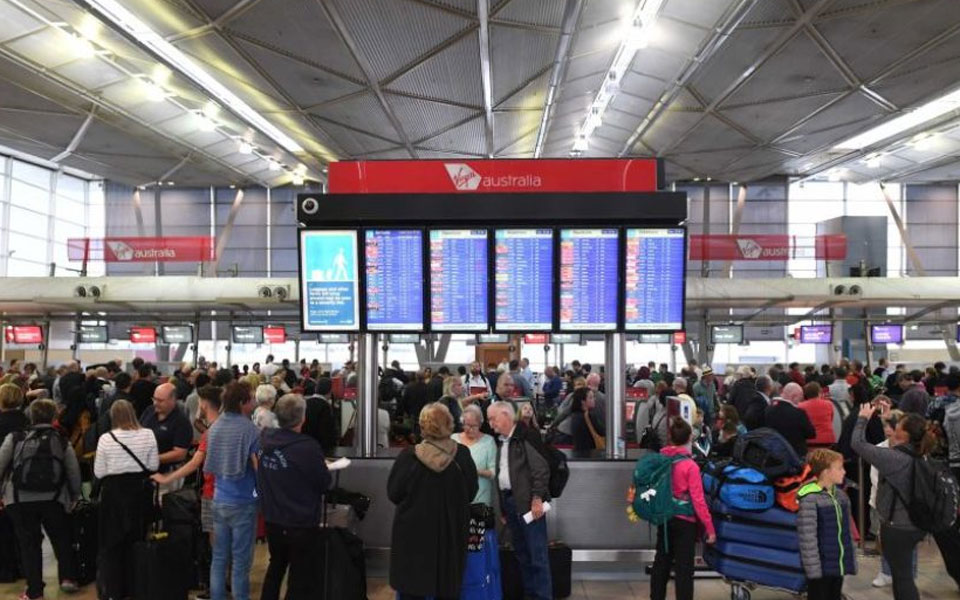
Qantas passengers who travel through Sydney Airport will be among the first groups of travelers to use facial recognition in automated check-ins, bag drop, lounge access and plane boarding. The system will ultimately allow officials to process travelers quicker. Early trials which provide a glimpse into a seamless, passport-free future are currently underway, but their implementation is provoking mixed responses.
Sydney Airport CEO Geoff Culbert is optimistic: "There will be no more juggling passports and bags at check-in and digging through pockets or smartphones to show your boarding pass -- your face will be your passport and your boarding pass at every step of the process". The biometrics system has also been endorsed by the Australian federal government, which promised to pump $22.5 million AUD ($16.6 million) to ensure facial recognition technology would be adopted across all Australian airports. Canberra is at the forefront of the nationwide 'SmartGate' rollout which is expected to reach completion by March 2019.
Most people wouldn't bat an eyelash if you uttered 'biometrics' and 'smartphone unlocking' in the same breath, but security experts warn the airport trials will be tracked by government departments who could apply the same technology in public spaces. "(Biometrics) can produce real harm", Dr. Bruce Baer Arnold said in a statement to The Australian Financial Review. Data transparency has become an increasingly big deal post-GDPR, and it's in this domain where potential issues lie. While most citizens are embracing the system, experts believe the country will eventually reach "a tipping point" where overwhelming amounts of personal data could be stored and used without alerting citizens.
In the US, similar facial recognition techniques which would replace conventional identification are being considered. The Department of Homeland Security (DHS) is already planning to launch its Vehicle Face System -- an initiative that identifies people who enter and exit the US border -- this August.
courtesy : engadget.com
Let the Truth be known. If you read VB and like VB, please be a VB Supporter and Help us deliver the Truth to one and all.
Two injuries, one DNF, a DQ as India end messy World Relays campaign
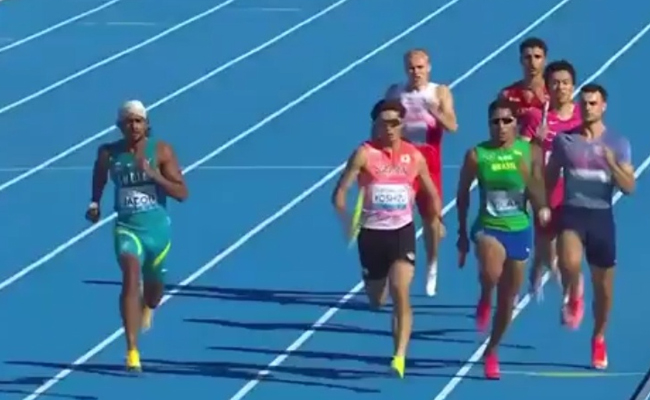
Gaborone (Botswana) (PTI): Amoj Jacob and Ragul Kumar got injured during the men's 4x400m and 4x100 races respectively as India ended their World Athletics Relays campaign in disappointment on the second day of competitions here on Sunday.
The Indian camp had high hopes of making the 2027 World Championships in the men's 4x400m relay but the team did not finish (DNF) the race as Jacob suffered cramps and pulled out of the race after taking the baton from the first leg runner Dharamveer Choudhary. Rajesh Ramesh and Vishal TK were to run in the third and fourth legs.
Those teams which could not qualify for the 2027 Beijing World Championships by reaching the final round of each of the six relay events on Saturday were given another chance in the second qualification round on Sunday.
The top two teams in each of the two heats (in all six relay events) booked the Beijing ticket on Sunday.
India will now have to try and qualify for the World Championships through the Top Lists of the World Athletics, which is a long and tedious process.
In the men's 4x100m race, third leg runner Ragul Kumar fell down the track after failing to hand over the baton inside the exchange zone to fourth leg runner Gurindervir Singh, which clearly showed the lack of coordination among the runners.
Harsh Santosh Raut and Animesh Kujur ran the first two legs.
The Indian quartet was disqualified and Kumar was seen being taken away from the Field of Play with the help of the volunteers.
It was a comedy of errors in the case of the women's 4x100m race, which saw the baton being dropped during an exchange between first leg runner Tamanna and second runner Nithya Gandhe, though the Indians finished the race in 53.09 seconds.
Gandhe started running quite a distance, but after realising that the baton was not in her hand, she turned and ran back to pick it up.
The only silver-lining for the Indian contingent was the national record time in the mixed 4x100m relay race, though the quartet of Ragul Kumar, Nithya Gandhe, Animesh Kujur and Sneha SS finished sixth in heat number two with a time of 41.35 seconds, bettering the previous national mark of 42.30 seconds set in March in Chandigarh.
The mixed 4x400m relay quartet of Theerthesh P Shetty, Kumari Saloni, Nihal William and Rashdeep Kaur ended at fifth in heat number one with a time of 3 minutes and 19.40 seconds.
On Saturday, all the five Indian relay teams had failed to make it to the respective final rounds and thus missed out on the 2027 World Championships berths.