Syrian insurgents capture central city of Hama in another blow to Syrian president
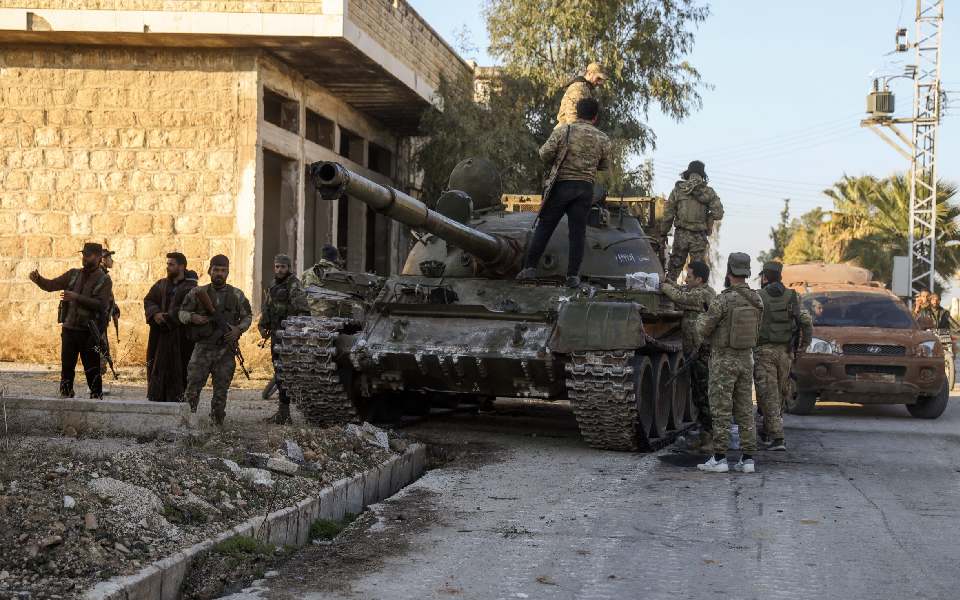
Beirut, Dec 5: Syrian insurgents entered the central city of Hama Thursday after days of intense clashes with government forces as they push forward with their week-long offensive that brought large parts of Syria under their control.
The Syrian army said it has withdrawn from Hama after insurgents broke through its defences marking another setback for President Bashar Assad, days after losing the country's largest city.
The Syrian army said it redeployed from Hama and took positions outside the city to protect the lives of civilians.
The insurgents' next target is likely to be the central city of Homs, the country's third largest. Homs, which is about 40 kilometres south of Hama, is the gate to the capital Damascus, President Bashar Assad's seat of power as well as the coastal region that is a base of support for him.
Abu Mohammed al-Golani, the de facto leader of the Syrian insurgency announced in a video message that the insurgency reached the city of Hama in a “conquering that is not vengeful, but one of mercy and compassion.”
The capture of Hama, Syria's fourth largest city, is another blow to Assad days after insurgents captured much of the northern city of Aleppo, the country's largest city.
Al-Golani, leader of the most powerful insurgent group in Syria the Hayat Tahrir al-Sham, publicly toured Aleppo city Wednesday. He spoke about Hama on Thursday from an undisclosed location in what appears to be a video filmed with a mobile phone.
On Thursday morning, Syrian insurgents said they entered Hama after three days of intense clashes with government forces on its outskirts, part of an ongoing offensive.
The Syrian army said in a statement later that a number of troops were killed after resisting the insurgents for days. It accused the attackers of relying on suicide attacks to break through the defences of the city.
The Britain-based Syrian Observatory for Human Rights — an opposition war monitor — said after fierce battles inside Hama, opposition gunmen now control the police command headquarters in the city as well as the sprawling air base and the central prison from where hundreds of detainees were set free.
“If Hama falls, it means that the beginning of the regime's fall has started,” the Observatory's chief, Rami Abdurrahman, told The Associated Press before the city's capture.
Hama is one of the few cities that remained under full government control during Syria's conflict, which broke out in March 2011 following a popular uprising. Its capture is a major setback for President Bashar Assad.
The offensive is being led by the jihadi group HTS as well as an umbrella group of Turkish-backed Syrian militias called the Syrian National Army. Their sudden capture of the northern city of Aleppo, an ancient business hub, was a stunning prize for Assad's opponents and reignited the conflict which had been largely stalemated for the past few years.
Aleppo's takeover marked the first opposition attack on the city since 2016, when a brutal Russian air campaign retook it for Assad after rebel forces had initially seized it. Intervention by Russia, Iran and Iranian-allied Hezbollah, and other groups has allowed Assad to remain in power.
The latest flare-up in Syria's long civil war comes as Assad's main regional and international backers, Russia and Iran, are preoccupied with their own wars.
Tens of thousands of people have been displaced by the renewed fighting, which began with the surprise opposition offensive November 27.
The insurgents claimed on their Military Operations Department channel on the Telegram app Thursday that they have entered Hama and are marching toward its centre.
“Our holy warriors are fighting fierce battles in Hama neighbourhoods with forces of the criminal regime,” the channel quoted a local commander identified as Maj. Hassan Abdul-Ghani as saying.
Hama is a major intersection point in Syria that links that country's centre with the north as well as the east and the west. It is about 200 kilometres north of the capital, Damascus, Assad's seat of power. Hama province also borders the coastal province of Latakia, a main base of popular support for Assad.
The city's name is known for the 1982 massacre of Hama, one of the most notorious in the modern Middle East, when security forces under Assad's late father, Hafez Assad, killed thousands to crush a Muslim Brotherhood uprising.
Let the Truth be known. If you read VB and like VB, please be a VB Supporter and Help us deliver the Truth to one and all.
EC role, Hindu vote consolidation among factors for BJP win in Bengal polls: J-K CM Omar
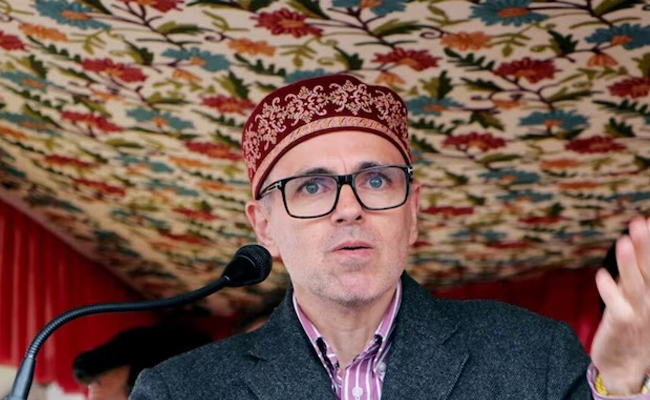
Srinagar (PTI): Jammu and Kashmir Chief Minister Omar Abdullah on Tuesday attributed the BJP's West Bengal win to a "significant role" played by the Election Commission (EC), alongside a consolidation of Hindu votes and a fractured minority mandate.
Abdullah also said the INDIA bloc needs to define its role in the political landscape of the country and make it clear whether the opposition alliance was limited to the parliamentary elections or extended to the state elections as well.
Talking to PTI Videos, Abdullah hinted that the EC has compromised its neutrality by conducting the Special Intensive Revision (SIR) in West Bengal and linked it to the BJP's gains in the state, claiming large-scale deletion of legitimate voters.
On the performance of the BJP in the just concluded assembly elections, Abdullah said the saffron party has almost nothing to show in southern states.
"So then you look at West Bengal and Assam. Yes, the BJP improved its tally in Assam. There are various reasons for that. You know as well as I do, what those are. West Bengal, I think we need to look at the results very carefully," he said.
"The easiest explanation for the West Bengal result is the serious curtailing of voter list," Abdullah said.
"Voters found their names deleted. People who served in uniform and fought for this country on the borders, who were considered Indian citizens all their lives, were suddenly held to a higher standard and not allowed to vote. Something is not right," he said.
While alleging that the EC played a "significant part" in the results, the chief minister admitted the outcome was multifaceted and noted a consolidation of over 60 per cent of the Hindu vote towards the BJP and a "significant fracture" in the minority vote, particularly in seats where Muslims constitute over 50 per cent of the population.
"There is no doubt that the role of the Election Commission played a significant part in the results but we will also have to look at the other factors," he said.
He said the results of West Bengal cannot be compared to those in other states. "The situation was unique to West Bengal. The SIR that was done, the way in which the voter lists were changed, the sort of minute scrutiny that the Election Commission subjected West Bengal to, the role of the central investigative agencies.
"All of these are situations that at least in recent electoral history of India are unique to West Bengal. So to suggest that we can learn lessons from West Bengal and implement them in other parts of the country, I think would not be correct," he said.
Abdullah had recently said that if the West Bengal results throw a surprise, the role of EC will come under scrutiny.
However, during Tuesday's interview, the chief minister said he still maintains that electronic voting machines (EVMs) do not lead to vote theft.
"What we saw in West Bengal...I know there are a lot of people who believe that the EVMs themselves are flawed. I am not a proponent of that conspiracy theory.
"But I do believe that the Election Commission has done itself no favours in the way in which it has gone about both the process of delimitation and the process of finalisation of electoral rolls," he said and cited the example of delimitation exercise in Jammu and Kashmir or Assam.
"These are clear examples of how the process was done to benefit one party or in the case of Jammu and Kashmir, one party and its allies. And the results speak for themselves. You created seven new seats in Jammu and Kashmir and out of those six seats were won by the BJP. You redrew assembly constituencies to benefit one particular party or its allies. And the same is true for West Bengal as well," he said.
Referring to the INIDA bloc, he said the election results were no new message for the alliance.
"We need to decide what the INDIA bloc is for. Is it only for Parliament or for state elections as well?" he asked.
"What happened in West Bengal is unfortunate. The Congress and TMC fought against each other. Now the Congress agrees with Mamata Banerjee that 100 seats were stolen, but the fact is they fought each other," he said.
Despite the friction, Abdullah reaffirmed the "pre-eminent position" of the Congress within the opposition alliance, dismissing the idea of any other party assuming the mantle.
"The Congress is the only party other than the BJP with a pan-India presence. All of us acknowledge this," he stated.
"To suggest someone else can assume a leadership role would be incorrect. Kharge Sahib is the president of the Congress, and by virtue of that, he assumes leadership of the INDIA bloc meetings. That is the way it should be," the chief minister said.
Abdullah said any 'Common Minimum Programme' would depend on whether the opposition alliance decides to fight state assembly elections collectively, noting that he would share his specific views with the bloc internally rather than through the media.