Taiwan's strongest earthquake in nearly 25 years damages buildings and causes a small tsunami
Taipei (AP/PTI): Taiwan's strongest earthquake in a quarter century rocked the island during the morning rush Wednesday, damaging buildings and creating a tsunami that washed ashore on southern Japanese islands. There were no immediate reports of deaths or injuries, and the tsunami threat largely passed about two hours later.
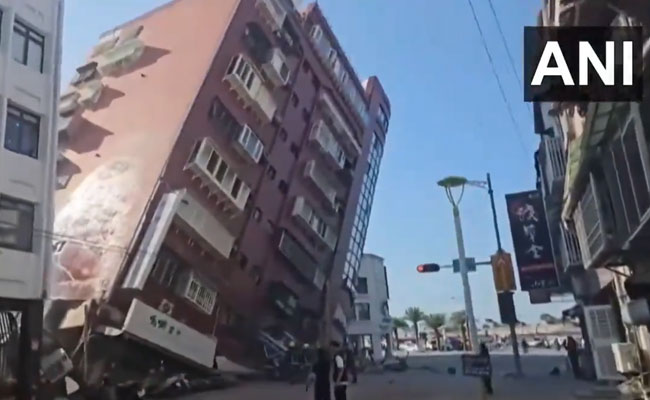
A five-storey building in the lightly populated southeastern coastal city of Hualien near the epicentre appeared heavily damaged, collapsing its first floor and leaving the rest leaning at a 45-degree angle. In the capital, tiles fell from older buildings and within some newer office complexes, while debris fell from some building sites. Schools evacuated their students to sports fields, equipping them with yellow safety helmets. Some also covered themselves with textbooks to guard against falling objects as aftershocks continued.
Train service was suspended across the island of 23 million people, as was subway service in Taipei, where a newly constructed above-ground line partially separated. The national legislature, a converted school built before World War II, also had damage to walls and ceilings.
Traffic along the east coast was at a virtual standstill, with landslides and falling debris hitting tunnels and highways in the mountainous region. Those caused damage to vehicles, though it wasn't clear if anyone was hurt.
Despite the quake striking at the height of the morning rush hour just before 8 am, the initial panic faded quickly on the island that is regularly rocked by temblors and prepares for them with drills at schools and notices issued via public media and mobile phone.
Still, the earthquake was strong enough to scare people who are used to such shaking.
“Earthquakes are a common occurrence, and I've grown accustomed to them. But today was the first time I was scared to tears by an earthquake,” Taipei resident Hsien-hsuen Keng said. ”I was awakened by the earthquake. I had never felt such intense shaking before.”
She said her fifth-floor apartment shook so hard that “apart from earthquake drills in elementary school, this was the first time I had experienced such a situation.”
There was still no word on casualties from the epicentre near the city of Hualien, where a deadly quake in 2018 collapsed a historic hotel and other buildings. Taiwan's worst quake in recent years struck on September 21, 1999, with a magnitude of 7.7, causing 2,400 deaths, injuring around 100,000 and destroying thousands of buildings.
The Japan Meteorological Agency said a tsunami wave of 30 centimetres(about 1 feet) was detected on the coast of Yonaguni island about 15 minutes after the quake struck. Smaller waves were measured in Ishigaki and Miyako islands. Japan sent military aircraft to gather information about the impact around the Okinawa region.
Taiwan's earthquake monitoring agency gave the magnitude as 7.2 while the US Geological Survey put it at 7.4. It struck about 18 kilometres south-southwest of Hualien and was about 35 kilometres (21 miles) deep. Multiple aftershocks followed, and the USGS said one of the subsequent quakes was 6.5 magnitude and 11.8 kilometres (7 miles) deep. Shallower quakes tend to cause more surface damage.
The earthquake was felt in Shanghai and several provinces along China's southeastern coast, according to Chinese media. China and Taiwan are about 160 kilometres (100 miles) apart. China issued no tsunami warnings for the Chinese mainland.
Residents of China's Fujian province reported violent shaking, according to Jimu News, an online outlet. One man told Jimu that the shaking awakened him and lasted about a minute.
In the Philippines, residents along the northern coast were told to evacuate to higher ground, but no major tsunami was reported about three hours after the quake.
Villagers in the provinces of Batanes, Cagayan, Ilocos Norte and Isabela were asked not to return to their homes until the tsunami alert was lifted, Philippine Institute of Volcanology and Seismology Teresito Bacolcol said.
Japan's Chief Cabinet Secretary Yoshimasa Hayashi said there has been no report of injury or damage in Japan. He urged the residents in the Okinawa region to stay on high ground until all tsunami advisories are lifted. He cautioned the people against disinformation and urged to stay calm and assist others.
The Pacific Tsunami Warning Centre said there was no tsunami threat to Hawaii or the US Pacific territory of Guam. About three hours after the earthquake, it said the threat had largely passed for all areas with waves being reported only in Taiwan and southern Japan.
Taiwan lies along the Pacific ”Ring of Fire", the line of seismic faults encircling the Pacific Ocean where most of the world's earthquake's occur.
#WATCH | A very shallow earthquake with a preliminary magnitude of 7.5 struck in the ocean near Taiwan. Japan has issued an evacuation advisory for the coastal areas of the southern prefecture of Okinawa after the earthquake triggered a tsunami warning. Tsunami waves of up to 3… pic.twitter.com/2Q1gd0lBaD
— ANI (@ANI) April 3, 2024
Let the Truth be known. If you read VB and like VB, please be a VB Supporter and Help us deliver the Truth to one and all.
TN Assembly elections: Eight-month pregnant homemaker wins Thiru Vi Ka Nagar seat for TVK

Chennai (PTI): Before giving birth, she had already delivered a mandate—a symbol of hope for Thiru Vi Ka Nagar.
Echoing Delhi’s 2013 “common citizen” political churn associated with the rise of the Aam Aadmi Party (AAP), an eight-month-pregnant homemaker, M R Pallavi, has been elected as an MLA from Chennai’s Thiru Vi Ka Nagar constituency, emerging as one of the notable first-time faces of the Vijay-led TVK in the recently held Tamil Nadu Assembly elections.
In the narrow lanes of Thiru Vi Ka Nagar, a steady stream of media personnel has been making their way to Pallavi’s residence—a scene reminiscent of the result day in Delhi when journalists thronged the modest home of Rakhi Birla, who had won from Mangolpuri on an AAP ticket.
Pallavi, 36, a homemaker educated up to class XII, defeated the DMK candidate K S Ravichandran by a margin of 22,333 votes in the reserved Thiru Vi Ka Nagar Assembly constituency.
Tamilaga Vettri Kazhagam emerged as the single largest party by winning 108 seats, while DMK and AIADMK got 59 and 47, respectively.
Pallavi’s victory has drawn attention due to her personal circumstances. She campaigned extensively while eight months pregnant, going door-to-door to reach voters.
According to local accounts, she even fainted once during the campaign but continued her outreach.
She has not spoken to the media following her victory, as doctors have advised her to rest. Her husband, Rajesh, briefly recounted her campaign efforts.
A self-professed admirer of actor-turned-politician Vijay, Pallavi joined TVK soon after its formation and is now among its first-time legislators.
Doctors have advised her to be hospitalised around May 20, as she is expecting her second child. Ahead of that, voters in Thiru Vi Ka Nagar have entrusted her with representing them in the state Assembly.
Political observers say the rise of candidates like Pallavi signals a possible shift in Tamil Nadu’s political landscape, with voters backing a new party and candidates from non-traditional backgrounds.