Takeaways from Trump-Putin meeting: No agreement, no questions but lots of pomp
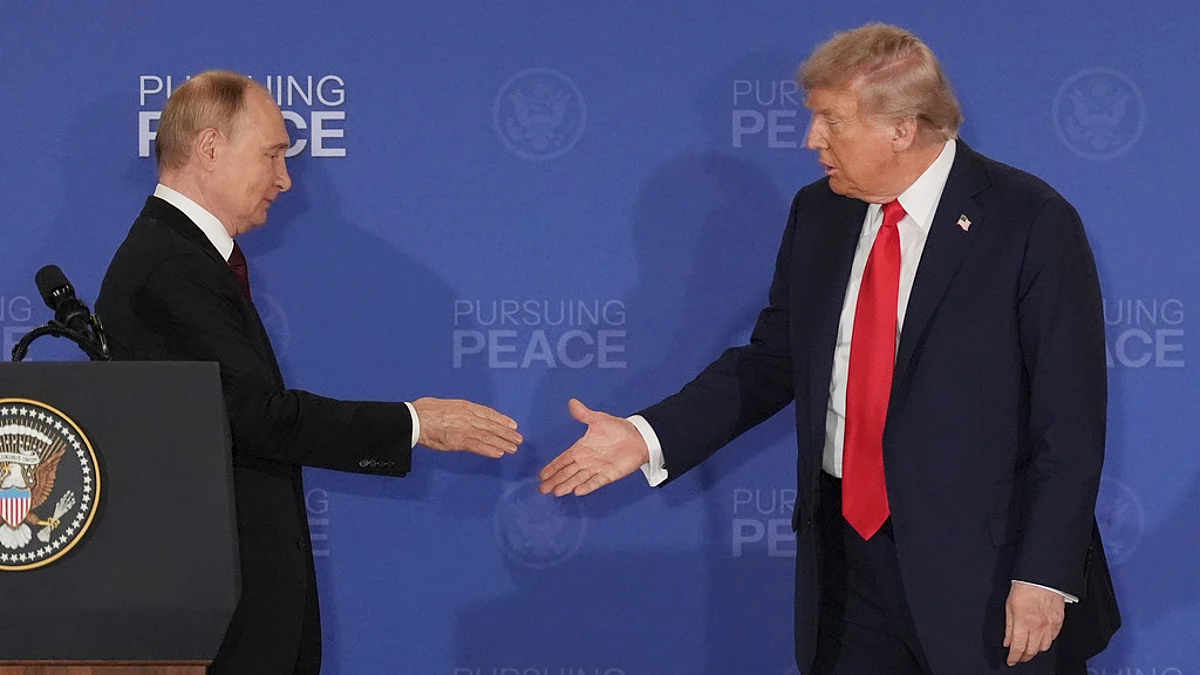
Washington (AP): The much-anticipated summit between US President Donald Trump and Russian leader Vladimir Putin began with a warm welcome and a flyover by screaming jets at a US military base in Alaska but ended with a thud Friday after they conceded that they had failed to reach any agreements on how to end the Russia-Ukraine war.
After about 2 1/2 hours of talks at Joint Base Elmendorf-Richardson in Anchorage, the two men appeared before reporters for what had been billed as a joint news conference — but they took no questions.
“We had an extremely productive meeting and many points were agreed to, there are just a very few that are left,” Trump said. “We didn't get there, but we have a very good chance of getting there.”
Putin, welcomed into the US after being shunned by Western allies since early 2022 for ordering the invasion of Ukraine, thanked Trump for hosting the meeting and suggested with a chuckle that the next time the two sit down it could be in Moscow.
Here are key takeaways from the summit:
A warm welcome underscoring the friendly Trump-Putin relationship
Putin got a red carpet welcome and even rode in Trump's presidential limousine from the tarmac to the summit venue. There, the pair were joined by two of their top aides: Secretary of State and national security adviser Marco Rubio and special envoy Steve Witkoff for Trump and Foreign Minister Sergey Lavrov and national security adviser Yuri Ushakov for Putin.
Putin, who spoke first after the meeting concluded, lauded the historical relationship between the United States, Russia and the former Soviet Union, recalling joint missions conducted by the two countries during World War II.
He said the US and Russia share values, a standard talking point for Russian officials when trying to woo Trump and his aides. Putin also noted that Trump has frequently said the Ukraine war wouldn't have happened had he won the 2020 election.
"I think that would have been the case," the Russian leader said, a comment sure to please Trump.
However, there is no indication and no way to prove that Moscow would have acted differently toward Ukraine had Democrat Joe Biden not been elected.
Trump touts progress but concedes there was no deal
Trump had gone into the meeting hoping to get Putin to agree to a ceasefire with Ukraine — or at least a commitment from Russia to enter into negotiations to reach one.
Instead, Trump conceded that “we haven't quite got there” and said he would be conferring with Ukrainian President Volodymyr Zelenskyy and NATO leaders about next steps.
Trump said he and Putin had made some significant progress toward the goal of ending the conflict but gave no details on what that entailed and had to acknowledge that they had been unable to bridge substantial gaps.
“I believe we had a very productive meeting,” Trump said. “We haven't quite got there, but we've made some headway. So, there's no deal until there's a deal.”
In a subsequent conversation with Sean Hannity of Fox News Channel, Trump again offered no details on his discussions with Putin.
With diplomatic progress creeping along, time is on Putin's side
Amid drawn-out diplomatic moves to end the war, time is appears to be on Putin's side. That gives a leg up to Russian forces, who have used their larger numbers to slowly grind down defences in eastern Ukraine 3 1/2 years into the conflict.
Putin got a pleasant reception from the leader of the free world on US soil and walked away hours later without either providing details on what they discussed, whether a ceasefire was any closer to reality or what the next steps would be.
Putin praised Trump for the “friendly” tone of the talks — Trump said nothing publicly about the killing of Ukrainian civilians in Moscow's attacks — and for “understanding that Russia has its own national interests.”
Putin said Moscow and Washington should “turn the page,” with relations having sunk to the lowest point since the Cold War.
Putin appearing in the US for the first time in 10 years was celebrated as a sign that Moscow was no longer a pariah on the global stage. In a social media post, Russian Foreign Ministry spokeswoman Maria Zakharova told followers that the Western press would be on the verge of “losing their minds.”
“For three years, they talked about Russia's isolation, and today they saw the red carpet being rolled out to greet the Russian president in the United States,” she said.
There were no details and no questions
Both men said the talks were “productive” but the lack of any announcement of solid achievements was revealing.
The news conference ended up being less than 15 minutes of rather standard diplomatic comments — and gave no indication that any concrete results were achieved — and offered little departure from their previous comments on the war in Ukraine.
Trump has made it a feature of his second term to parry questions from reporters in front of world leaders, but in the clearest sign of his disappointment, the president abruptly cut short his plans to take questions.
Trump had gone into the summit saying here was a 25 per cent chance that the summit would fail and that it was meant to be a “feel-out meeting,” but he had also floated the idea of bringing Zelenskyy to Alaska for a subsequent, three-way meeting if things went well. It's unclear what comes next.
Let the Truth be known. If you read VB and like VB, please be a VB Supporter and Help us deliver the Truth to one and all.
Indian startup's 'Drishti' satellite launched aboard SpaceX rocket
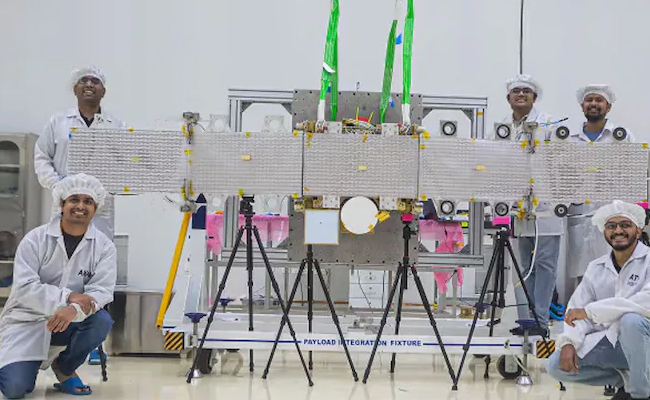
New Delhi (PTI): Bengaluru-based space start-up GalaxEye's Mission Drishti satellite was launched on Sunday aboard SpaceX's Falcon 9 rocket from California.
Mission Drishti is the world's first OptoSAR satellite, integrating electro-optical (EO) and synthetic aperture radar (SAR) sensors into a single operational platform, according to the company.
While EO sensors capture high-resolution images during sunlight and clear skies, SAR sensors provide all-weather and all-time images, using radar pulses.
In a statement, Suyash Singh, founder and CEO of GalaxEye, said, "With the satellite (Mission Drishti) now successfully in orbit, our immediate focus is on completing its commissioning. As we move through this phase, we are already witnessing strong global interest in the differentiated datasets enabled by our OptoSAR payload."
The satellite will help address long-standing limitations of conventional systems and enable more reliable and consistent data acquisition across diverse environmental conditions, the company said.
As a dual-use Earth observation satellite, the mission will support use cases across defence, agriculture, disaster management, maritime monitoring, and infrastructure planning.
The satellite is also expected to complement India's broader initiatives, including the 29 active Earth Observation satellites outlined in ISRO's recent annual report.
The launch came after five years of indigenous research and development, and extensive environmental testing and performance validation of the Mission Drishti.
In a statement, Lt Gen AK Bhatt (Retd), director general of Indian Space Association (ISpA), said, "GalaxEye has achieved what only a few global players have, which is seamlessly combining optical and SAR capabilities on a single platform to enable persistent, all-weather intelligence."
What stands out is not just the technology, but its broader impact on how downstream applications will increasingly define value in the space economy, particularly in Earth observation, where timely, decision-grade insights are critical," he added.
ISpA is the premier industry association of space and satellite companies in the country.
Union Minister Jitendra Singh also took note of the Mission Drishti launch, saying the development marked a significant milestone in India's space journey.
In a post on X, the minister said, "The successful launch of the world's first OptoSAR satellite, and the largest privately-built satellite in the country, reflects the immense potential of our young innovators driving nation-building."
GalaxEye aims to scale up Mission Drishti to a constellation of 10 satellites by 2030, developing a robust and sovereign Earth observation infrastructure for India.